


Economy
Foreign Exchange Reserves
Foreign Exchange Reserves (Forex Reserves) are external assets held by a country’s central bank to meet international payment obligations, manage external vulnerabilities and support stability in the foreign exchange market.
Management of Foreign Exchange Reserves in India
- Custodian: The Reserve Bank of India (RBI) is the custodian of India’s foreign exchange reserves and is responsible for their management and investment.
- Legal Framework: The legal provisions governing the management of India’s foreign exchange reserves are laid down in the Reserve Bank of India Act, 1934.
Components of India’s Forex Reserves
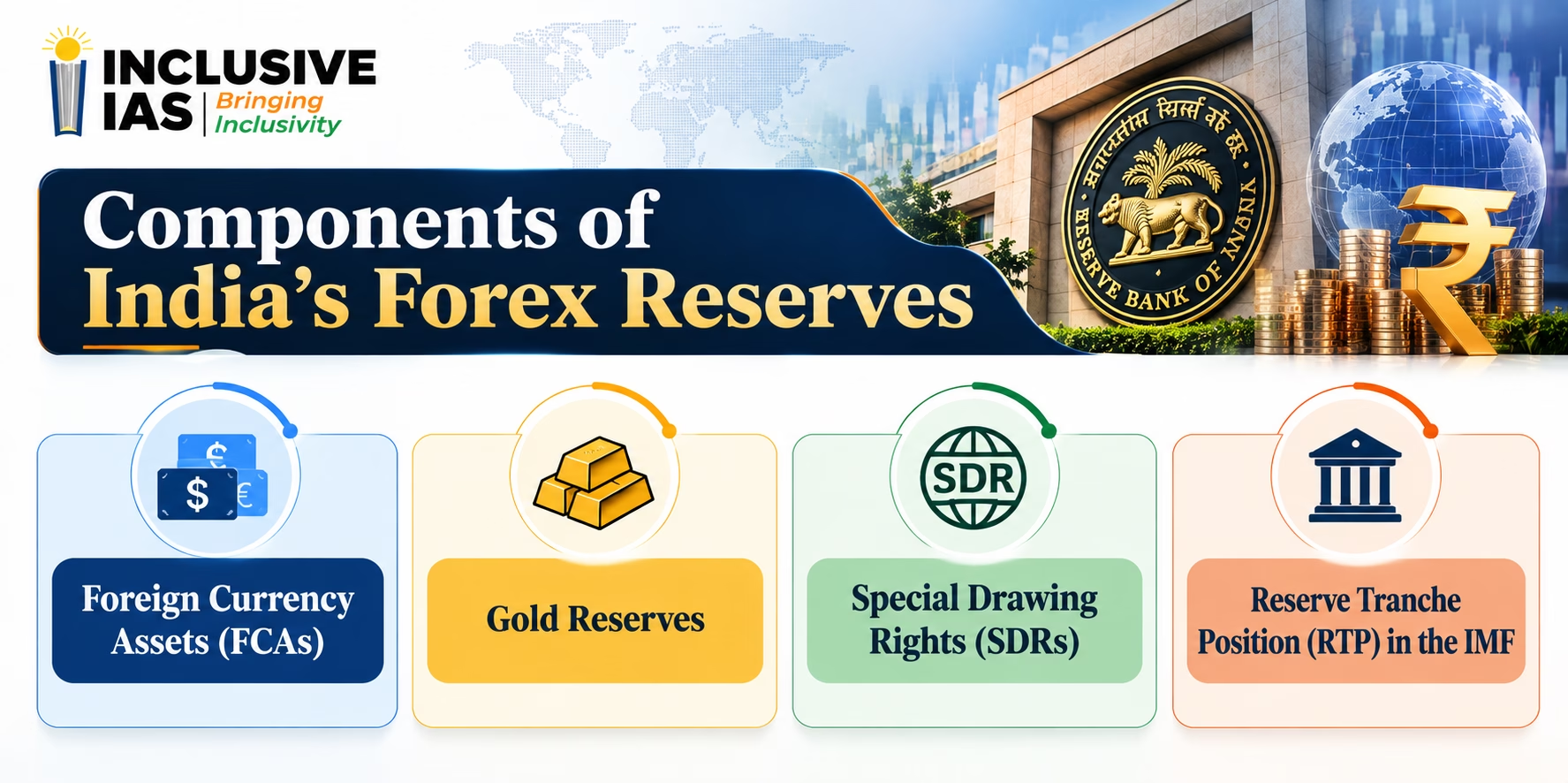
India’s foreign exchange reserves consist of four major components:
- Foreign Currency Assets (FCAs): FCAs are held in major foreign currencies such as the US dollar, euro, pound sterling and Japanese yen. They are usually held in the form of foreign government securities, deposits with foreign central banks, deposits with international commercial banks and other safe foreign currency instruments. FCAs form the largest part of reserves.
- Factors Affecting Foreign Currency Assets (FCA)
- Purchase and Sale of Foreign Exchange by RBI
- Income from Deployment of Forex Reserves: Interest and other income earned from investing foreign exchange reserves add to FCA.
- External Aid Receipts of the Central Government
- Revaluation of Foreign Currency Assets: Changes in exchange rates alter the US dollar value of assets held in currencies such as the euro, pound sterling and Japanese yen, causing valuation changes in FCA.
- Example: RBI may hold US Treasury securities, euro-denominated securities, deposits with the Bank for International Settlements (BIS), and balances with foreign central banks and commercial banks as part of its Foreign Currency Assets.
- Factors Affecting Foreign Currency Assets (FCA)
- Gold Reserves: Physical gold bullion held by the RBI as a strategic hedge against currency devaluation, inflation, and global geopolitical turbulence. The RBI holds its gold domestically in its vaults and overseas with institutions such as the Bank of England and the Bank for International Settlements (BIS).
- Special Drawing Rights (SDRs): The SDR is an international reserve asset created by the International Monetary Fund (IMF). The SDR is not a currency, but its value is based on a basket of five currencies—the US dollar, the euro, the Chinese renminbi, the Japanese yen, and the British pound sterling.
- Reserve Tranche Position (RTP) in the IMF: A reserve tranche refers to a specific portion of a country’s financial commitment to the International Monetary Fund that it can use at its discretion, without facing restrictions or additional charges. According to the IMF, the reserve tranche is about one-quarter of a member nation’s quota. This reserve tranche can be used for different purposes, including balance of payments.
*The biggest contributor to India’s Forex reserves is foreign currency assets, followed by gold.
Import Cover
- Import Cover indicates how many months of total national imports can be paid for with the country’s available foreign exchange reserves.
Where Does RBI Invest Forex Reserves?
Under the RBI Act, 1934, the RBI is permitted to invest reserves in:
- Deposits with the Bank for International Settlements (BIS) and other central banks
- Deposits with foreign commercial banks
- Debt instruments representing sovereign or sovereign-guaranteed liability of not more than 10 years of residual maturity
- Other eligible instruments and institutions approved by the Central Board of the RBI in accordance with the Act
- Certain types of derivatives
Uses of Foreign Exchange Reserves
- Financing Imports: Forex reserves provide foreign currency to meet essential import requirements, particularly during periods of foreign exchange shortage.
- Managing Exchange Rate Volatility: The RBI can sell foreign currency from its reserves to reduce excessive volatility and sharp depreciation of the rupee.
- Meeting External Debt Obligations: Reserves provide foreign currency for repayment of external debt and interest obligations when required.
- Managing Balance of Payments Difficulties: Forex reserves provide a buffer when a country faces a shortage of foreign exchange due to a Balance of Payments deficit.
- Protection Against External Shocks: Reserves provide financial protection during global financial crises, sudden capital outflows or disruptions in international capital flows.
- Maintaining International Confidence: Adequate reserves strengthen confidence among foreign investors, creditors and trading partners about India’s ability to meet its external obligations.