Supreme Court of India – Guardian of the Constitution
The Supreme Court of India stands as the apex judicial authority in the country and is the final interpreter of the Constitution. Unlike the United States, which has a dual system of judiciary, India follows an integrated judiciary where both Central and State laws are enforced through a single unified structure. This hierarchical system places the Supreme Court at the top, followed by High Courts and then subordinate courts like district and sessions courts.
India’s unified judicial system ensures a common platform for interpreting and enforcing laws, fostering constitutional unity in a diverse federal polity. The Supreme Court was inaugurated on January 28, 1950, replacing the Federal Court of India (established under the Government of India Act, 1935) and the Judicial Committee of the British Privy Council as the final court of appeal.
Constitutional Provisions
The Supreme Court is governed by Articles 124 to 147 of the Constitution, which detail its:
- Establishment and composition
- Appointment and tenure of judges
- Jurisdiction and powers
- Independence and procedures
Composition
Current Composition
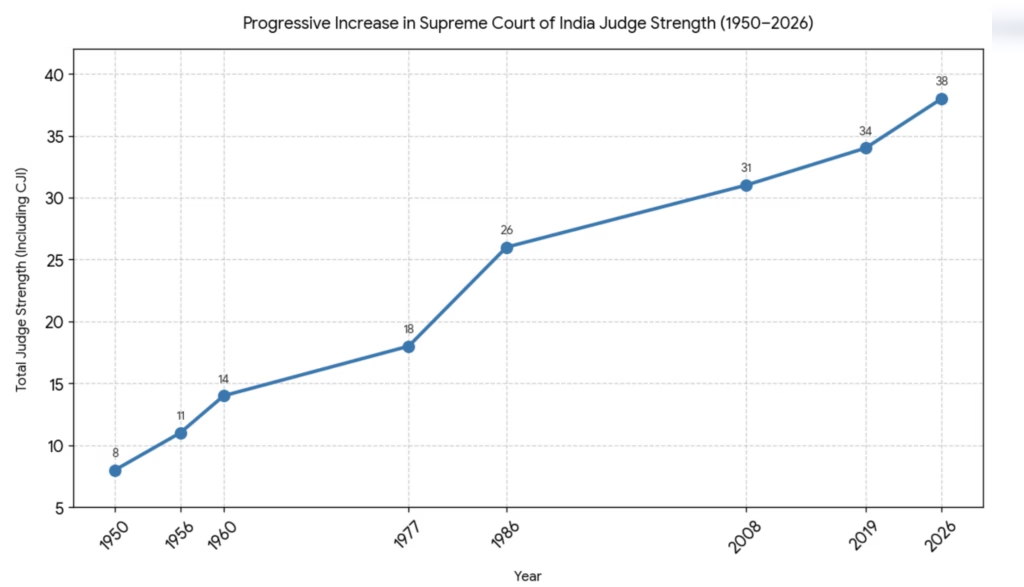
- As of now, the Supreme Court of India comprises 38 judges — 1 Chief Justice of India (CJI) and 37 other judges.
- The President of India has given assent to the Supreme Court (Number of Judges) Amendment Act, 2026, which increases the sanctioned strength of the Supreme Court from 34 to 38 judges, including the Chief Justice of India (CJI).
Constitutional Provision
- Article 124(1) of the Constitution provides for the establishment and composition of the Supreme Court.
- Parliament is empowered to increase the number of judges by law.
Originally, the sanctioned strength was 8 judges (including the Chief Justice), but this number has been increased over time through various amendments:
Appointment of Supreme Court Judges
- General Procedure
- Judges of the Supreme Court are appointed by the President of India.
- For appointing the Chief Justice of India, the President consults such judges of the Supreme Court and High Courts as he/she deems necessary.
- For appointing other judges, the President must consult the Chief Justice of India, and such other judges of the Supreme Court and High Courts as deemed necessary.
Meaning of ‘Consultation’ – Evolution through Landmark Cases
Case Name | Year | Key Ruling |
|---|
First Judges Case | 1981 | “Consultation” does not mean concurrence. The President is not bound by CJI’s advice. |
Second Judges Case | 1993 | “Consultation” means concurrence. The President is bound by the advice of the CJI, who must consult two senior-most judges. |
Third Judges Case | 1998 | In the Third Judges Case (1998), the Supreme Court held that the consultation process for judicial appointments by the Chief Justice of India must involve a “consultation of plurality of judges.” The opinion of the Chief Justice of India alone does not amount to consultation. Instead, the Chief Justice must consult a collegium of the four senior-most judges of the Supreme Court, and if two judges give an adverse opinion, the recommendation should not be forwarded to the government.The court held that the recommendation made by the chief justice of India without complying with the norms and requirements of the consultation process are not binding on the government. |
Fourth Judges Case | 2015 | NJAC Act & 99th Constitutional Amendment declared unconstitutional. Collegium system restored to preserve judicial independence. |
National Judicial Appointments Commission (NJAC) – Struck Down
- The 99th Constitutional Amendment Act, 2014 and NJAC Act, 2014 sought to replace the collegium system with the NJAC.
- In 2015, the Supreme Court struck down both as unconstitutional, citing that they compromised the independence of the judiciary.
Appointment of Chief Justice of India
Established Convention (1950–1973)
- The senior-most judge of the Supreme Court was conventionally appointed as the CJI.
Departures from Convention
- In 1973, Justice A.N. Ray was appointed as CJI superseding three senior judges.
- Again in 1977, Justice M.U. Beg was appointed as CJI superseding Justice H.R. Khanna.
Supreme Court’s Response
- In the Second Judges Case (1993), the Court ruled that the senior-most judge must be appointed as CJI, reinforcing judicial independence.
Qualifications of Supreme Court Judges
- To be eligible for appointment as a Judge of the Supreme Court, a person must satisfy the following criteria as per Article 124(3) of the Constitution:
- Must be a citizen of India; and
- Must have any one of the following qualifications:
- Judicial Experience: Has served as a judge of a High Court (or of two or more High Courts in succession) for at least 5 years; or
- Legal Practice: Has been an advocate of a High Court (or of two or more High Courts in succession) for at least 10 years; or
- Distinguished Jurist: In the opinion of the President, is a distinguished jurist.
- Note:
- The Constitution does not prescribe a minimum age for appointment to the Supreme Court.
- This allows for flexibility in recognizing both experience and legal scholarship.
Oath or Affirmation by Judges
Before assuming office, every judge of the Supreme Court must take an oath or affirmation, administered by the President of India (or a person appointed by the President for this purpose), as per Third Schedule of the Constitution.
In the oath, a judge pledges to:
- to bear true faith and allegiance to the Constitution of India;
- to uphold the sovereignty and integrity of India;
- to duly and faithfully and to the best of his/her ability, knowledge and judgement perform the duties of the Office without fear or favour, affection or ill-will; and
- to uphold the Constitution and the laws.
Salaries and Allowances of Supreme Court Judges
- The salaries, allowances, leave, pensions, and other privileges of the Chief Justice and other judges of the Supreme Court are determined by the Parliament through legislation.They cannot be varied to their disadvantage after their appointment except during a financial emergency
- Additional Allowances and Facilities
- Sumptuary Allowance (for expenses of hospitality and other ceremonial duties)
- Free official residence
- Medical facilities
- Official car with chauffeur
- Telephone, domestic help, and other secretarial staff
- Pension for Retired Judges
- Retired Chief Justice and Judges are entitled to receive 50% of their last drawn salary as monthly pension
Tenure of Supreme Court Judges
The Constitution does not specify a fixed term for Supreme Court judges, but lays down the following provisions:
- Age Limit: A judge holds office until the age of 65 years.
- Any dispute regarding a judge’s age is decided by an authority designated by Parliament.
- Voluntary Resignation: A judge can resign from his/her office by writing to the President.
- Removal by the President: A judge can be removed from office by the President on the recommendation of Parliament, following the impeachment procedure.
Removal of Judges (Impeachment Process)
- A judge of the Supreme Court can be removed from office only by the President.
- The President issues the removal order after an address by Parliament is presented in the same session recommending removal.
- Requirements for Removal Motion
- The address in each House must be supported by a special majority:
- Majority of the total membership of the House, and
- Two-thirds of the members present and voting.
- Grounds of Removal (Article 124(4))
- Proved misbehaviour.
- Incapacity.
Procedure for Removal (As per the Judges Inquiry Act, 1968)
- The Judges Enquiry Act (1968) regulates the procedure relating to the removal of a judge of the Supreme Court by the process of impeachment
- Initiation:
- A removal motion must be signed by at least 100 MPs in Lok Sabha or 50 MPs in Rajya Sabha.
- Admission:
- The Speaker or Chairman may either admit or refuse to admit the motion.
- Inquiry Committee Formation:
- If admitted, a three-member inquiry committee is set up:
- Chief Justice or a Judge of the Supreme Court
- Chief Justice of a High Court
- A distinguished jurist
- Investigation:
- The committee investigates and submits a report on whether the judge is guilty.
- Parliamentary Approval:
- If the committee finds the judge to be guilty of misbehaviour or suffering from an incapacity, the House can take up the consideration of the motion.
- It must be passed in both Houses by a special majority:
- Majority of total membership, and
- Two-thirds of members present and voting
- Presidential Order:
- Once passed in both Houses, an address is sent to the President, who then issues the removal order.
Impeachment History in India
- No Supreme Court judge has been impeached so far.
- Justice V. Ramaswami (1991–1993) was the first judge against whom an impeachment motion was initiated.
- Although the inquiry committee found him guilty of misbehaviour, the Lok Sabha did not pass the motion.
- The motion failed as the Congress Party abstained from voting.
Acting Chief Justice
The President of India can appoint a Judge of the Supreme Court as the Acting Chief Justice of India under any of the following situations:
- When the office of the Chief Justice of India (CJI) is vacant.
- When the CJI is temporarily absent.
- When the CJI is unable to perform duties due to any reason (e.g. illness).
This provision ensures continuity in the functioning of the Supreme Court without disruption.
Ad hoc Judges
- Article 127 of the Constitution provides for the appointment of Ad hoc Judges in the Supreme Court.
- Purpose
- To ensure the functioning of the Supreme Court is not hindered due to a lack of quorum of permanent judges.
- Key Provisions
- The Chief Justice of India (CJI) can appoint a High Court judge as an ad hoc judge of the Supreme Court.
- This can be done only when:
- There is an insufficient number of permanent judges available to hold or continue a session of the supreme court.
- Conditions for Appointment
- The CJI must can do so only after consultation with the chief justice of the High Court concerned and with the previous consent of the President
- The appointed judge must be qualified to be a judge of the Supreme Court (as per Article 124).
- Powers and Status
- While attending the sittings of the Supreme Court, the ad hoc judge enjoys all the jurisdiction, powers, and privileges of a Supreme Court judge.
- It is the duty of the judge so appointed to attend the sittings of the Supreme Court, in priority to other duties of his/her office.
Retired Judges
Under Article 128, the Chief Justice of India (CJI) may request:
- A retired judge of the Supreme Court or a retired judge of a High Court (qualified for Supreme Court appointment), to act temporarily as a judge of the Supreme Court.
- Conditions:
- Requires prior consent of:
- The President, and
- The retired judge concerned.
- Powers & Privileges:
- While serving, the retired judge enjoys all powers, jurisdiction, and privileges of a regular Supreme Court judge.But, he/she will not otherwise be deemed to be a judge of the Supreme Court.
- They are entitled to allowances as determined by the President.
- Purpose:
- This provision is designed to supplement judicial capacity temporarily during times of increased workload or shortage of judges.
Seat of the Supreme Court
Article 130 of the Constitution declares Delhi as the permanent seat of the Supreme Court.
However, it permits the Chief Justice of India (CJI) to appoint another place or places as the seat of the Supreme Court, but only with the approval of the President.
This provision is optional, not mandatory — meaning:
Procedure of the Court
- The Constitution of India empowers the Supreme Court to regulate its own procedures. This autonomy is critical for ensuring judicial independence and efficiency.
- Rule-Making Authority
- The Supreme Court can, with the approval of the President, make rules for regulating generally the practice and procedure of the Court.
- This authority is derived from Article 145 of the Constitution.
- Bench Composition
- Constitutional Bench:
- Cases involving substantial questions of law related to the interpretation of the Constitution or presidential references under Article 143 are decided by a bench of at least five judges.
- Division Benches and Single Judges:
- Other matters are typically heard by division benches (two or three judges) or even single judges, as per the rules framed.
- Delivery of Judgements
- All judgements are delivered in open court, promoting transparency and public accountability.
- Decisions are made by majority vote.
- Dissenting opinions are permitted and recorded. This is a notable feature of India’s judicial system, allowing minority views to be part of the official record.
Independence of the Supreme Court
The Supreme Court of India plays a pivotal role in upholding the Constitution, safeguarding citizens’ fundamental rights, and maintaining the federal structure. To perform these roles effectively, judicial independence is vital. The Constitution ensures that the judiciary functions without fear, favour, or external pressure from the executive or legislature.
Why Independence is Essential
- Acts as the guarantor of the Constitution and fundamental rights
- Is the final interpreter of the law
- Functions as a check on executive and legislative excesses
- Ensures the rule of law and promotes constitutional morality
Constitutional Safeguards Ensuring Judicial Independence
- Mode of Appointment
- Judges are appointed by the President in consultation with senior judges of the Supreme Court and High Courts, limiting executive discretion and preventing political appointments.
- Security of Tenure
- Supreme Court judges can only be removed by the President through a rigorous process involving Parliamentary impeachment. They do not serve at the pleasure of the executive.
- Fixed Service Conditions
- Salaries, allowances, leave, and pensions are fixed by Parliament and cannot be altered to their disadvantage after appointment (except during a financial emergency).
- Charges on Consolidated Fund of India
- The salaries, allowances, and pensions of the judges and staff of the Supreme Court, along with all its administrative expenses, are charged on the Consolidated Fund of India (CFI).
- This means they are non-votable in Parliament — Parliament cannot reduce or reject them, though they may be discussed.
- This provision ensures the financial independence of the judiciary, protecting it from executive or legislative interference.
- Protection Against Legislative Discussion
- Parliament or State Legislatures cannot discuss a judge’s conduct in the discharge of duties, except during an impeachment process.
- Ban on Post-Retirement Practice
- Retired Supreme Court judges cannot practice in any court or authority in India. This prevents any conflict of interest or compromise during their tenure.
- Power to Punish for Contempt
- The Supreme Court has the power to punish for its own contempt, allowing it to maintain its dignity, authority, and independence.
- Control Over Internal Staff
- The Chief Justice of India can appoint staff and prescribe their conditions of service, ensuring administrative autonomy.
- Jurisdiction Cannot Be Curtailed
- Parliament cannot reduce the jurisdiction or powers of the Supreme Court, though it may extend them. This protects the Court’s constitutional role.
Jurisdiction and Powers of the Supreme Court
The Constitution has conferred extensive jurisdiction and vast powers on the Supreme Court of India. It is:
- A Federal Court (like the American Supreme Court),
- The final court of appeal (like the British House of Lords),
- The guardian and final interpreter of the Constitution,
- The guarantor of Fundamental Rights, and
- Possesses advisory and supervisory powers.
The jurisdiction and powers of the Supreme Court can be classified as follows:
- Original Jurisdiction
- Writ Jurisdiction
- Appellate Jurisdiction
- Advisory Jurisdiction
- Court of Record
- Power of Judicial Review
- Power of Constitutional Interpretation
- Other Powers
Original Jurisdiction of the Supreme Court
As the apex federal court of India, the Supreme Court exercises original jurisdiction in disputes involving the units of the Indian federation. This means it has the authority to hear these matters first-hand, and no other court can entertain such cases.
Constitutional Basis
- Article 131 of the Indian Constitution confers exclusive original jurisdiction to the Supreme Court in federal disputes. “Exclusive” means only the Supreme Court can decide, and “original” means it directly hears the matter without any appeal from a lower court.
- As a federal court, the Supreme Court decides the disputes between different units of the Indian Federation.
- More elaborately, any dispute:
- Between the Centre and one or more states; or
- Between the Centre and any state or states on one side and one or more other states on the other side; or
- Between two or more states.
- In the above federal disputes, the Supreme Court has exclusive original jurisdiction. Exclusive means, no other court can decide such disputes and original means, the power to hear such disputes in the first instance, not by way of appeal.
Conditions for Jurisdiction
Two key conditions must be met:
- The dispute must involve a question of law or fact on which the existence or extent of a legal right depends.
- Private citizens cannot initiate such suits under Article 131. Only units of the federation (Centre and States) can.
Exceptions: Where Article 131 Does NOT Apply
The original jurisdiction does not extend to:
- Treaty-related disputes arising from pre-constitutional agreements that expressly bar such jurisdiction:
- A dispute arising out of any treaty, agreement, covenant, engagement, sanad or other similar instrument which, having been entered into or executed before the commencement of the constitution, continues in operation after such commencement, or which provides that the said jurisdiction shall not extend to such a dispute.
- Inter-State river water disputes (governed by Article 262 and Inter-State Water Disputes Act)
- Matters referred to the Finance Commission
- Adjustment of pensions and expenses between Centre and States
Conclusion
- The original jurisdiction of the Supreme Court under Article 131 ensures federal balance by resolving critical disputes between the Union and the States. However, it is narrowly tailored to exclude political questions and matters dealt with under other mechanisms like tribunals or commissions.
Writ Jurisdiction of the Supreme Court
The Constitution of India designates the Supreme Court as the guarantor and defender of the fundamental rights of the citizens. Under Article 32, any citizen whose Fundamental Rights have been violated can directly approach the Supreme Court for redressal.
Constitutional Basis
- Article 32 empowers the Supreme Court to issue directions, orders, or writs, including:
- Habeas Corpus
- Mandamus
- Prohibition
- Certiorari
- Quo Warranto
- These writs are constitutional remedies to enforce the Fundamental Rights guaranteed under Part III of the Constitution.
Original But Not Exclusive
- The writ jurisdiction of the Supreme Court is original because a citizen can approach it directly without having to go through lower courts.
- However, it is not exclusive—High Courts under Article 226 also have the power to issue writs.
Key Difference:
- Supreme Court (Art. 32): Can issue writs only for enforcement of Fundamental Rights.
- High Courts (Art. 226): Can issue writs for Fundamental Rights as well as other legal rights—making it broader.
Concurrent Jurisdiction with High Courts
- Citizens have the option to approach either the Supreme Court or the High Court when their Fundamental Rights are violated.
- This makes the writ jurisdiction of the Supreme Court concurrent with that of High Courts, unlike its exclusive original jurisdiction in federal disputes (under Article 131).
Appellate Jurisdiction of the Supreme Court
The Supreme Court of India, being the highest court of appeal, has succeeded the Federal Court of India and replaced the Privy Council as the final appellate authority. It primarily functions as a court of appeal, hearing appeals against judgments of High Courts in a wide range of matters.
Classification of Appellate Jurisdiction
The appellate jurisdiction of the Supreme Court can be classified under four broad heads:
- Appeals in Constitutional Matters
- Appeals in Civil Matters
- Appeals in Criminal Matters
- Appeals by Special Leave (Article 136)
1. Appeals in Constitutional Matters
An appeal can be made to the Supreme Court from a High Court judgment if the High Court certifies that:
- The case involves a substantial question of law, that requires interpretation of the Constitution.
The appeal is admitted on the ground that the constitutional question has been wrongly decided by the High Court.
2. Appeals in Civil Matters
Appeal lies from a High Court judgment in civil matters if the high court certifies:
- The High Court certifies that the case involves a substantial question of law of general importance; and
- that the question needs to be decided by the Supreme Court.
Note: The earlier requirement of a minimum monetary value (₹20,000) for such appeals was removed by the 30th Constitutional Amendment Act, 1972.
3. Appeals in Criminal Matters
The Supreme Court can hear appeals in criminal cases under the following circumstances:
Appeal as a Matter of Right
- If the High Court:
- Has reversed an acquittal and sentenced the person to death, or
- Has withdrawn a case from a lower court and sentenced the accused to death.
- In both cases, no certificate is needed from the High Court.
Appeal with High Court’s Certificate
- If the High Court certifies that the case is a fit one for appeal, even in other criminal cases, the Supreme Court can admit it.
Expanded Jurisdiction (Post 1970)
- In 1970, the Parliament had enlarged the Criminal Appellate Jurisdiction of the Supreme Court
- Appeal also lies if the High Court:
- Reverses an acquittal and awards life imprisonment or imprisonment for 10 years or more.
- Takes up a case from a lower court and convicted the accused person and sentenced him/her to imprisonment for life or for ten years
4. Appeal by Special Leave (Article 136)
- This is a plenary and discretionary power of the Supreme Court. It allows the Court to grant special leave to appeal from any judgment of any court or tribunal (except military courts and court-martials).
- Salient Features:
- Not a right:It is a discretionary power and hence, cannot be claimed as a matter of right.
- Can be granted in final or interlocutory judgments.
- Can relate to any matter: civil, criminal, tax, labour, revenue, etc.
- Applicable against any court/tribunal, not just High Courts (except a military court).
- The Supreme Court has itself stated that Article 136 should be exercised sparingly and only in exceptional situations.
Advisory Jurisdiction of the Supreme Court
- Under Article 143 of the Constitution, the President of India is empowered to seek the opinion of the Supreme Court on important legal and constitutional matters. This mechanism allows the executive to obtain the guidance of the apex court even before a dispute arises or is adjudicated in a regular court of law.
Scope of Article 143
- The President can refer two categories of matters to the Supreme Court:
- Matters of Public Importance
- Any question of law or fact that is of public importance,that has arisen or is likely to arise in the future.
- The Supreme Court may choose to give its opinion or decline the request.
- Disputes Related to Pre-Constitution Instruments
- On any dispute arising out of any pre-constitution treaty, agreement, covenant, engagement, sanad or other similar instrument, which is excluded from the original jurisdiction of the Supreme Court.
- In such cases, the Supreme Court must give its opinion.
- Nature of the Advisory Opinion
- The opinion rendered by the Supreme Court under Article 143 is not binding on the President.
- It is advisory in nature, not a judicial decision.
- The government may accept or ignore the Court’s advice.
- However, such opinions carry immense moral and legal weight, and are often followed in practice.
- Significance of Advisory Jurisdiction
- Enables the executive to obtain an authoritative legal interpretation on complex issues.
- Helps in preventive legal guidance before conflicts escalate into actual litigation.
- Strengthens the role of the Supreme Court as the guardian of the Constitution, even beyond adversarial litigation.
- Notable Examples
- Berubari Union Case (1960) – Regarding the transfer of territory to Pakistan.
- Ayodhya Reference (1993) – On whether a Hindu temple existed before the Babri Masjid structure (which the Court declined to answer).
Supreme Court as a Court of Record (Article 129)
As per the Constitution, the Supreme Court is a Court of Record. This status grants it two key powers:
Judicial Records as Precedents
- All judgments, proceedings, and acts of the Supreme Court are recorded for perpetual memory.
- These records are of evidentiary value and cannot be questioned in any court.
- They serve as legal precedents and references for subordinate courts across India.
Power to Punish for Contempt
- The Supreme Court has the inherent power to punish for contempt of court, not just of itself but also of all High Courts, subordinate courts, and tribunals in India.
- This power ensures that the authority, dignity, and functioning of the judiciary are protected.
Power of Judicial Review
- Judicial Review refers to the power of the Supreme Court to examine the constitutionality of:
- Legislative enactments (laws passed by Parliament or state legislatures), and
- Executive orders (actions or decisions taken by the executive wing of the Union or state governments).
- Scope of Judicial Review
- If any law or executive order is found to be ultra vires (i.e., beyond the powers conferred by the Constitution), the Supreme Court can declare it unconstitutional, illegal, and invalid.
- Once declared null and void, such a law or executive action cannot be enforced by the government.
- Significance
- It acts as a guardian of the Constitution.
- Ensures that laws conform to Fundamental Rights and the basic structure of the Constitution.
- Acts as a check on arbitrary exercise of power by the legislature and executive.
- Related Case Laws
- Kesavananda Bharati v. State of Kerala (1973) – Established the Basic Structure Doctrine, which limits Parliament’s power to amend the Constitution.
- Minerva Mills v. Union of India (1980) – Reaffirmed the supremacy of the Constitution and the power of judicial review.
- Article 13 explicitly provides for judicial review of laws in violation of Fundamental Rights.
Review Jurisdiction of the Supreme Court
- The Supreme Court has the power to review any judgement pronounced or order made by it. This ensures a mechanism for self-correction and upholds the principles of fairness and justice.
- Constitutional Backing
- This power is derived from Article 137 of the Constitution of India.
- Time Limit and Bench
- A review petition must be filed within 30 days from the date of the judgement/order.
- It should be submitted to the same judge or bench that delivered the original judgement/order.
- Grounds for Review Petition
- A review petition is entertained on limited grounds:
- Discovery of new and important evidence which was not available earlier.
- Error apparent on the face of the record (e.g., obvious mistakes in judgement).
- Any other sufficient reason as per the interest of justice.
- Outcome of Review Petition
- The court may:
- Dismiss the petition, or
- Issue notice to the opposite party for response.
Curative Petition
- Even if a review petition is dismissed, the court may entertain a curative petition in exceptional circumstances.
- Grounds for Curative Petition
- Violation of principles of natural justice
- Gross miscarriage of justice
- Bias of the judge who heard the case
- Preventing abuse of the process of the court
- A curative petition is seen as a final legal remedy available after all other legal avenues have been exhausted.
Other Powers of the Supreme Court
Apart from its primary jurisdictions, the Supreme Court enjoys several miscellaneous powers that reinforce its role as the apex judicial authority in India.
- Presidential and Vice-Presidential Election Disputes
- The Supreme Court is the sole authority to adjudicate disputes regarding the election of the President and the Vice-President of India.
- It exercises original, exclusive, and final jurisdiction in such matters.
- Disciplinary Role Over UPSC and State PSCs
- On a reference made by the President, the Supreme Court can inquire into the misbehaviour of the Chairman or members of the UPSC, SPSC, or JSPSC.
- If found guilty, it can recommend their removal.
- The President is bound by the advice of the Supreme Court in such cases.
- Transfer and Withdrawal of Cases
- The Supreme Court can:
- Withdraw cases pending before High Courts and decide them itself.
- Transfer cases or appeals from one High Court to another to ensure fair justice.
- Binding Authority
- The law declared by the Supreme Court is binding on all courts within the territory of India under Article 141.
- Its decrees and orders are enforceable across the entire country.
- All civil and judicial authorities are required to act in aid of the Supreme Court under Article 144.
- Judicial Superintendence
- The Supreme Court exercises judicial control and superintendence over all courts and tribunals functioning in India.
- Enlargement of Jurisdiction
- The Parliament can enlarge the jurisdiction and powers of the Supreme Court with respect to matters in the Union List.
- With a special agreement between the Centre and states, its jurisdiction can also be extended to other matters.
Contempt of Courts Act, 1971
- The law relating to contempt was codified by the Contempt of Courts Act, 1971, following recommendations of the H.N. Sanyal Committee (1963).
Types of Contempt
- Under the Act, the contempt of court may be civil or criminal.
- Civil Contempt:
- Wilful disobedience to any judgment, order, direction, or undertaking of the court.
- Criminal Contempt:
- The publication of any matter or doing an act which:
- Scandalises or lowers the authority of the court.
- Prejudices or interferes with judicial proceedings.
- Interferes or obstructs the administration of justice in any other manner.
- Exceptions – What Does Not Constitute Contempt
- Innocent publication or distribution of materials.
- Fair and accurate reporting of court proceedings.
- Fair criticism of judicial acts and judgments in good faith.
- Punishment
- Under the Act, a contempt of court is punishable with
- Simple imprisonment up to 6 months.
- Fine up to ₹2,000.
- Or both.
- Limitations
- No contempt proceedings can be initiated after one year from the alleged date of contempt.
- The Act does not apply to Nyaya Panchayats or other village courts.
The Supreme Court of India is not just a court of law but also the conscience-keeper of the Constitution. It upholds justice, liberty, equality, and rule of law, making it the cornerstone of Indian democracy. Its powers, independence, and responsibilities make it one of the most powerful constitutional courts in the world.
FAQs
Q1. Who appoints the judges of the Supreme Court?
A: The President of India, in consultation with the judiciary (as per the Collegium system).
Q2. What is the retirement age of a Supreme Court judge?
A: 65 years.
Q3. Can Supreme Court decisions be reviewed?
A: Yes, through a review petition under Article 137, and in rare cases, a curative petition.
Q4. Is the advisory opinion of the Supreme Court binding on the President?
A: No, it is not binding.
Q5. Can High Courts issue writs like the Supreme Court?
A: Yes, and their writ jurisdiction is even wider as they can issue writs for other purposes too.
At InclusiveIAS, our editorial team is led by experts who have successfully cleared multiple stages of the UPSC Civil Services Examination, including Mains and Interview. With deep insights into the demands of the exam, we focus on crafting content that is accurate, exam-relevant, and easy to grasp.
Whether it’s Polity, Current Affairs, GS papers, or Optional subjects, our notes are designed to:
Break down complex topics into simple, structured points
Align strictly with the UPSC syllabus and PYQ trends
Save your time by offering crisp yet comprehensive coverage
Help you score more with smart presentation, keywords, and examples
🟢 Every article, note, and test is not just written—but carefully edited to ensure it helps you study faster, revise better, and write answers like a topper.