Marine genetic resources, including the fair and equitable sharing of benefits
- The Agreement requires its Parties to share both monetary and non-monetary benefits arising from activities with respect to marine genetic resources and digital sequence information on marine genetic resources of areas beyond national jurisdiction in a fair and equitable manner.
- It also requires Parties to ensure that information is notified to a Clearing-House Mechanism established under the Agreement both before and after collection or sampling of marine genetic resources in areas beyond national jurisdiction, including, among others, information on opportunities to become involved in relevant projects.
- Parties are further required to ensure that information is notified to the Clearing-House Mechanism at the stage of utilization, including commercialization, of those resources and digital sequence information on such resources.
- The Agreement addresses access to traditional knowledge of Indigenous Peoples and local communities associated with marine genetic resources in areas beyond national jurisdiction.
- An access and benefit-sharing committee is also established.
Details - Marine genetic resources and benefit-sharing Non-monetary benefits arising from activities with respect to marine genetic resources are to be shared in the form of access to samples and digital sequence information, open access to scientific data, and capacity-building and transfer of marine technology, among others.
- Monetary benefits will be shared through payments to a special fund to, among others, fund capacity-building projects under the Agreement, and to assist developing States Parties in implementing the Agreement. Those payments will initially be made through annual contributions by developed States Parties until the Conference of the Parties to the Agreement decides on the modalities for the sharing of monetary benefits.
|
Measures such as area-based management tools, including marine protected areas
- The Agreement provides for procedures for the establishment and implementation of area-based management tools, including marine protected areas, in areas beyond national jurisdiction, including on an emergency basis in certain cases.
- It includes processes for the making and review of proposals, public consultations, including to garner scientific input, decision-making by the Conference of the Parties to the Agreement, and monitoring and periodic review by the Scientific and Technical Body established under the Agreement
Environmental impact assessments
An environmental impact assessment is a process which aims to identify and evaluate the potential impacts of an activity with a view to informing decision-making. Such assessments are used to prevent, mitigate and manage the impacts of planned activities on the environment. |
- The Agreement elaborates on the provisions of the United Nations Convention on the Law of the Sea on impact assessments by establishing detailed processes, thresholds and other requirements for conducting and reporting assessments in areas beyond national jurisdiction.
- Parties are required to conduct a screening of a planned activity under their jurisdiction or control that takes place in areas beyond national jurisdiction when that activity may have more than a minor or transitory effect on the marine environment, or when the effects of the activity are unknown or poorly understood.
- If there are reasonable grounds for believing that the activity may cause substantial pollution of or significant and harmful changes to the marine environment, an environmental impact assessment must be conducted in accordance with the process set out in the Agreement, which includes obligations related to public notification and consultation.
- Decisions on whether an activity may proceed or not following an environmental impact assessment will be made by the State with jurisdiction or control over the activity rather than by an international body.
- However, other States may register their concerns with the Party that authorized the activity and with the Scientific and Technical Body established under the Agreement.
- Monitoring, reporting and review of authorized activities are foreseen by the Agreement.
- Parties are also to consider conducting strategic environmental assessments, which are broader assessments for plans and programmes to be conducted in areas beyond national jurisdiction.
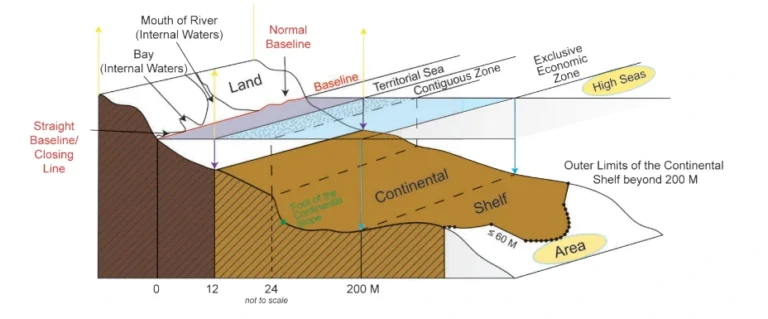
Mining in the international seabed area-Present Status - Mining in the international seabed area (the Area) is governed by a specific regime set out in the United Nations Convention on the Law of the Sea under which the International Seabed Authority is mandated to organize and control activities in the Area, particularly with a view to administering its resources.
- It acts on behalf of humankind and work is ongoing under its auspices to develop regulations for exploitation of minerals in the Area, including measures to protect the marine environment from harmful effects which may arise from activities in the Area.
|
Capacity-building and the transfer of marine technology
- The Agreement does not define “capacity-building” or “transfer of marine technology”.
- The Agreement makes important strides towards strengthening the capacity of States by requiring cooperation to assist Parties, particularly developing States Parties, through capacity-building and the development and transfer of marine technology.
- Capacity-building and the transfer of marine technology are to be based on and responsive to the needs and priorities of developing States Parties and be, among others, country-driven.
- The Agreement sets out specific modalities for how the transfer of marine technology shall be undertaken.
- The Agreement requires Parties to provide resources for capacity-building and the development and transfer of marine technology within their capabilities, and also sets out a funding mechanism to ensure financial support for such activities. It also provides modalities for the monitoring and review of capacity-building and the transfer of marine technology to, among others, assess needs, review gaps in meeting those needs, measure performance, and make recommendations for enhancing activities.
- The Treaty provides for the establishment of a capacity-building and transfer of marine technology committee.
Cross Cutting Issues
Institutional arrangements
- It provides for the establishment of:
- A Conference of the Parties, which serves as the governing body of the Agreement
- A Scientific and Technical Body
- A secretariat
- A Clearing-House Mechanism as the main platform for exchange of information under the Agreement.
Funding
- Establishing a funding mechanism composed of
- a voluntary trust fund to facilitate the participation of representatives of developing States Parties in the meetings of the bodies established under the Agreement;
- a special fund
- the Global Environment Facility trust fund;
- Treaty stipulates that the special fund and the Global Environment Facility trust fund will, among others, be utilized to fund capacity-building projects, assist developing States Parties in implementing the Agreement, support conservation and sustainable use programmes by Indigenous Peoples and local communities, and support public consultations
- The treaty requires the Conference of the Parties to determine an initial resources mobilization goal through 2030 for the special fund.
Implementation and compliance
- Requires Parties to take the necessary measures to ensure the implementation of the Agreement
- Establishes an Implementation and Compliance Committee to facilitate and consider implementation and promote compliance, which will function in a manner that is transparent, nonadversarial and non-punitive
Dispute settlement
- It provides for a system for the peaceful settlement of disputes regarding the interpretation or application of the Agreement
- It provides for the possibility for the Conference of the Parties to request the International Tribunal for the Law of the Sea to give advisory opinions in certain circumstances.
When will the Agreement begin operating?
- The Agreement is open for signature for two years, from 20 September 2023 until 20 September 2025
- After the period for signature has closed, a State or regional economic integration organization may become party to the Agreement through accession in accordance with its internal procedures.
- The Agreement will take effect (known under treaty law as “entering into force”) 120 days after the date of the deposit of the 60th instrument of ratification, acceptance, approval or accession. At that point the Agreement will become binding on all those who have become parties, meaning all of the rights and obligations thereunder take effect
Why the Treaty Matters
- First Comprehensive Framework
- First global framework in decades for high seas biodiversity.
- Promotes international cooperation → integrated, holistic ocean governance.
- Advances inclusive ocean management
- Several of its provisions will support inclusive ocean management, including those related to the traditional knowledge and participation of Indigenous Peoples and local communities, on gender responsiveness of capacity-building and on gender balance and equitable geographic representation in the composition of the bodies established under the Agreement
- Scientific & Capacity Benefits
- It will promote marine scientific research and facilitate the generation and dissemination of data and information to help improve our knowledge of marine biodiversity of areas hitherto largely underexplored and to support science-based conservation and management measures.
- It will contribute to addressing the uneven capacity to carry out and benefit from activities with respect to marine genetic resources of areas beyond national jurisdiction and digital sequence information on such resources, ensuring that such activities are in the interests of all States and for the benefit of all humanity.
- It will address uneven capacity and assist States in strengthening cooperation and coordination and in undertaking activities in areas beyond national jurisdiction through capacity-building and the transfer of marine technology
- Environmental Benefits
- It will enable area-based management tools, including marine protected areas, to be established in areas beyond national jurisdiction, which will contribute to protecting and restoring ecosystems and strengthening resilience to stressors, including climate change, ocean acidification and marine pollution
- It will assist in preventing and minimizing impacts on the marine environment, including through its provisions on environmental impact assessments and area-based management tools, including marine protected areas
- Global Equity & Benefit-Sharing
- Ensures fair sharing of marine genetic resources from the high seas.
- Promotes equitable access to scientific data and benefits for all humanity.
- Provides a funding mechanism to support participation of developing nations.
- Link to Global Goals
- Directly contributes to SDG 14 (Life Below Water) and broader climate & biodiversity goals.
- Seen as a major step in tackling the “triple planetary crisis”: climate change, biodiversity loss, and pollution.
Importance of Oceans - It is an essential reserve of biodiversity, constituting over 90 per cent of the habitable space on Earth. Such biodiversity provides critical ecosystem services, supporting livelihoods of billions and food security, among others.
- It provides important goods and services, such as means of transport, energy production, tourism potential, and a host of minerals and organisms of relevance to various sectors in the context of a sustainable ocean-based economy.
- It produces oxygen that we breathe and is a significant carbon sink, drawing in a quarter of global greenhouse gas emissions and over 90 per cent of the excess heat in the climate system, aiding in limiting rises in air temperature and the effects of climate change.
Cumulative Pressures on Oceans - It is heavily impacted by pollution. Garbage, including plastic and other marine debris, oil spills and harmful algal blooms resulting from nutrient run-off are just some examples.
- Marine species are being lost at significant rates due to various cumulative pressures, including overexploitation, habitat destruction, the effects of climate change, and pollution.
- It is impacted by warming waters and acidification, affecting marine species and disrupting weather systems, and contributing to sea-level rise.
|
UPSC Spot Check
Prelims
The BBNJ Treaty is legally binding and falls under which international framework?
(a) Paris Agreement
(b) UN Convention on Biological Diversity
(c) UN Convention on the Law of the Sea (UNCLOS)
(d) Minamata Convention
At InclusiveIAS, our editorial team is led by experts who have successfully cleared multiple stages of the UPSC Civil Services Examination, including Mains and Interview. With deep insights into the demands of the exam, we focus on crafting content that is accurate, exam-relevant, and easy to grasp.
Whether it’s Polity, Current Affairs, GS papers, or Optional subjects, our notes are designed to:
Break down complex topics into simple, structured points
Align strictly with the UPSC syllabus and PYQ trends
Save your time by offering crisp yet comprehensive coverage
Help you score more with smart presentation, keywords, and examples
🟢 Every article, note, and test is not just written—but carefully edited to ensure it helps you study faster, revise better, and write answers like a topper.