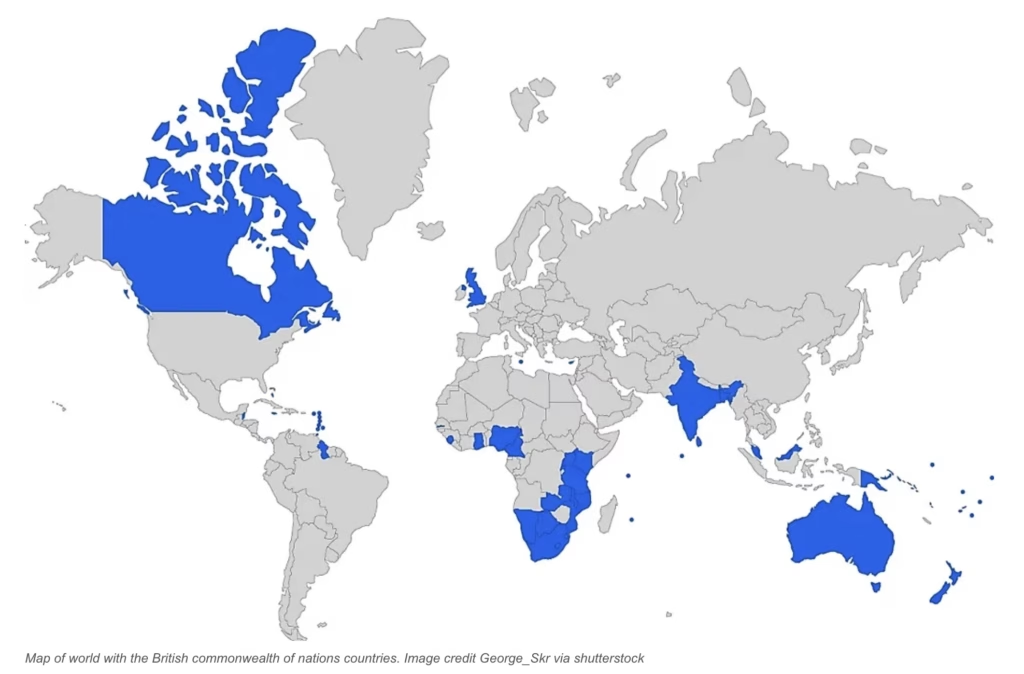
Commonwealth Heads of Government Meeting
- Leaders of Commonwealth countries meet every two years for the Commonwealth Heads of Government Meeting (CHOGM), hosted by different member countries on a rotating basis.
- The Commonwealth Heads of Government Meeting (CHOGM) is a biennial event that brings together Commonwealth heads of governments to discuss and debate topical issues and challenges.
- Essentially a policy and decision-making forum, these meetings have historically shaped policies on pressing issues affecting member nations. It also provides space for engagement with civil society and business.
- At the conclusion of each summit, a Communiqué is released outlining the commitment of all 56 Commonwealth member states.
- Who attends CHOGM?
- Heads of Government from the 56 member states of the Commonwealth.
- Civil society, Commonwealth Associated Organisations and Accredited Associations, including the Commonwealth Human Rights Initiative (CHRI).
- Non-Commonwealth civil society, governments and businesses.
Board of Governors
- All member governments are represented on the Commonwealth Secretariat Board of Governors by their High Commissioners.
- The role of the Board of Governors, which usually meets once a year, is to approve the Secretariat’s strategic plans, work programmes and budgets.
The Commonwealth Secretariat
- It is the intergovernmental organisation that supports member countries to achieve the Commonwealth’s aims of development, democracy and peace.
- It co-ordinates Commonwealth activities.
- Located at Marlborough House, London, UK.
- It was established in 1965
The Secretariat works all over the Commonwealth, to: - protect the environment and encourage sustainable use of natural resources on land and sea
- boost trade and the economy
- support democracy, government and the rule of law
- develop society and young people, including gender equality, education, health and sport
- support small states, helping them tackle the particular challenges they face.
Commonwealth Fund for Technical Co-operation (CFTC) - It is the main way that the Commonwealth Secretariat provides technical help to Commonwealth countries.
- The Commonwealth Fund for Technical Co-operation (CFTC) approach emphasises country ownership by delivering technical assistance on a demand-driven basis.
- Technical assistance is delivered predominantly on a south-south basis, and also aims to mainstream gender considerations throughout all project work.
- Support is provided in many forms, including:
- dispatch of long and short term experts;
- supporting twinning arrangements and exchanges between our members;
- undertaking of research and feasibility studies and targeted capacity building activities;
- and providing a ‘referrals facility’ to respond to requests for assistance in areas of work outside the Secretariat’s strategic focus, but which could be supported by:
- Commonwealth family of organisations;
- other Commonwealth member states; or
- relevant international organisations and other entities.
|
Commonwealth Secretary-General
- The Commonwealth Secretary-General is responsible for representing the Commonwealth publicly, and is the Chief Executive Officer of the Commonwealth Secretariat.
- The Commonwealth Secretary-General is responsible for:
- promoting and protecting the Commonwealth’s values
- representing the Commonwealth publicly
- the management of the Commonwealth Secretariat.
- The Secretary-General is nominated by Commonwealth leaders and can serve a maximum of two terms of four years each.
Commonwealth Chair-in-Office
- The Chair-in-Office represents the Commonwealth at high-level international meetings and reinforces the Good Offices role of the Commonwealth Secretary-General.
- The term ‘Good Offices’ refers to the Commonwealth’s conflict prevention and resolution work.
- The Chair-in-Office is the leader of the Commonwealth country that hosts a Commonwealth Heads of Government Meeting (CHOGM).
- The two-year role comes into effect at the start of the CHOGM.
The Commonwealth Foundation
- It is an intergovernmental organisation established by Heads of Government in support of the belief that the Commonwealth is as much an association of peoples as it is of governments.
- Its headquarters are in Marlborough House in London
The Commonwealth of Learning (COL)
- It is the world’s only intergovernmental organisation solely concerned with the promotion and development of distance education and open learning.
- COL is hosted by the Government of Canada and headquartered in Burnaby, British Columbia Canada.
- Created by Commonwealth Heads of Government, COL encourages the development and sharing of open learning/distance education knowledge, resources and technologies.
- COL is helping developing nations improve access to quality education and training.
FAQs
Q1. What is the Commonwealth of Nations?
The Commonwealth is a voluntary association of 56 independent and equal countries committed to shared values of democracy, development, and cooperation. It evolved from the British Commonwealth and is based on the Commonwealth Charter.
Q2. Who is the current Head of the Commonwealth?
King Charles III is the current Head of the Commonwealth. The role is symbolic, not hereditary, and future Heads are chosen by consensus of member countries.
Q3. Is India a founding member of the Commonwealth?
Yes, India is a founding member and continues to play an active role in Commonwealth activities.
At InclusiveIAS, our editorial team is led by experts who have successfully cleared multiple stages of the UPSC Civil Services Examination, including Mains and Interview. With deep insights into the demands of the exam, we focus on crafting content that is accurate, exam-relevant, and easy to grasp.
Whether it’s Polity, Current Affairs, GS papers, or Optional subjects, our notes are designed to:
Break down complex topics into simple, structured points
Align strictly with the UPSC syllabus and PYQ trends
Save your time by offering crisp yet comprehensive coverage
Help you score more with smart presentation, keywords, and examples
🟢 Every article, note, and test is not just written—but carefully edited to ensure it helps you study faster, revise better, and write answers like a topper.