Organisation for Economic Co-operation and Development (OECD)

  • Home
  • Organisation for Economic Co-operation and Development (OECD)
Shape Image One

Organisation for Economic Co-operation and Development (OECD)

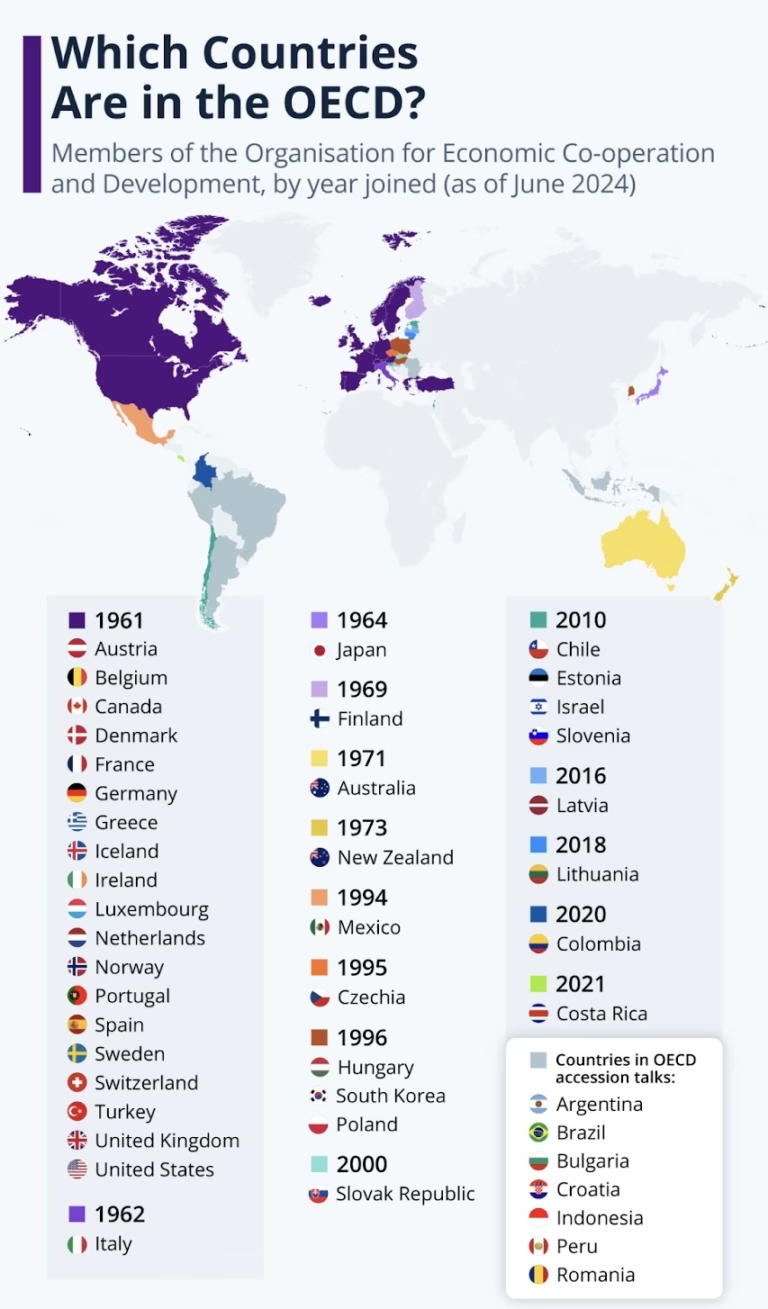
  • The Organisation for Economic Co-operation and Development (OECD) is an international organisation of 38 countries committed to democracy and the market economy. 
  • It is a unique forum where the governments of 38 democracies  with market-based economies collaborate to develop policy standards to promote sustainable economic growth.
  • The OECD provides a setting where governments can compare experiences, seek answers to common challenges, identify good practices, and develop high standards for economic policy.
  • Today, OECD member countries account for three-fifths of world GDP, three-quarters of world trade, over 90 percent of global official development assistance, half of the world’s energy consumption, and 18 percent of the world’s population.

Origin

  • The forerunner of the OECD was the Organisation for European Economic Co-operation (OEEC), which was formed to administer American and Canadian aid under the Marshall Plan for the reconstruction of Europe after World War II. 
  • The Convention transforming the OEEC into the OECD was signed in Paris on 14 December 1960 and entered into force on 30 September 1961.

Member Countries

  • The OECD’s 38 Member countries span the world, from North America and South America to Europe and Asia-Pacific. 
  • Members are represented by ambassadors at the OECD Council, which defines and oversees the work of the Organisation as set out in the OECD Convention.

Key partners

  • The OECD works closely with some of the world’s largest economies: Brazil, China, India, Indonesia, and South Africa, who are OECD Key Partners. 
  • They participate in the OECD’s daily work, bringing useful perspectives and increasing the relevance of policy debates.
  • Key Partners participate in policy discussions in OECD bodies, take part in regular OECD surveys and are included in statistical databases.

Funding

  • OECD is funded by its member countries. National contributions are based on a formula which takes account of the size of each member’s economy. 
  • Countries may also make voluntary contributions to financially support outputs in the OECD programme of work.

Work

  • The OECD is a forum and knowledge hub that helps shape better policies for better lives through its standards, trusted statistics and analysis, platforms for dialogue and support to policy reform. 
  • The Organisation informs and shapes public policy and policy debates by providing evidence-based analysis and standards. It convenes countries and a range of stakeholders to forge progress across policy areas and sets standards to level the playing field.

OECD Mission

The OECD’s mission is to bring together the governments of countries committed to democracy and the market economy from around the world to:

  • support sustainable economic growth;
  • boost employment;
  • raise living standards;
  • maintain financial stability;
  • assist other countries’ economic development;
  • contribute to growth in world trade.

Governance

The Council

  • The Council is the OECD’s decision-making body. Composed of one representative from each Member Country as well as from the European Union. 
  • It is chaired by the Secretary-General, and provides the strategic direction for the Organisation and its work. 
  • An annual Ministerial Council Meeting, chaired by one or more Members, brings governments together to discuss the world’s major policy challenges and set the OECD’s priorities for the year ahead.

The Substantive Committees 

  • The substantive bodies propose solutions, develop standards, assess data and policy successes, and review policy actions. They are focused on major policy challenges from climate change and the economy to trade and tax, 
  • They include specialists from countries, academia, business and civil society groups that play a vital role in setting common global standards in public policy. 

The Secretariat

  • The Secretariat, led by the Secretary-General, carries out the work of the OECD from its headquarters in Paris.
  • Economists, lawyers, scientists, political analysts, digital experts, statisticians and other specialists work with government experts to provide insights and expertise to help guide evidence-based policymaking in close co-ordination with Members.

FAQs 

Q1. What is OECD?

The OECD (Organisation for Economic Co-operation and Development) is an international organisation of 38 countries promoting democracy, market economy, and sustainable economic growth.

Q2. When was OECD established?

The OECD was established on 30 September 1961, replacing the Organisation for European Economic Co-operation (OEEC) which managed the Marshall Plan post-WWII.

Q3. How many members are in the OECD?

There are 38 member countries in the OECD, spread across North America, Europe, Asia-Pacific, and South America.

✍️ Curated by InclusiveIAS Editorial Team

At InclusiveIAS, our editorial team is led by experts who have successfully cleared multiple stages of the UPSC Civil Services Examination, including Mains and Interview. With deep insights into the demands of the exam, we focus on crafting content that is accurate, exam-relevant, and easy to grasp.

Whether it’s Polity, Current Affairs, GS papers, or Optional subjects, our notes are designed to:

  • Break down complex topics into simple, structured points

  • Align strictly with the UPSC syllabus and PYQ trends

  • Save your time by offering crisp yet comprehensive coverage

  • Help you score more with smart presentation, keywords, and examples

🟢 Every article, note, and test is not just written—but carefully edited to ensure it helps you study faster, revise better, and write answers like a topper.

Add Your Heading Text Here