Solar Energy in India – Potential, Challenges & Government Initiatives

  • Home
  • Solar Energy in India – Potential, Challenges & Government Initiatives
Shape Image One

Solar Energy in India

Solar energy is the most abundant and accessible form of renewable energy, harnessed from the sun’s radiation using technologies such as photovoltaic (PV) cells, concentrated solar power (CSP), and solar thermal systems. It is clean, inexhaustible, and plays a pivotal role in reducing dependence on fossil fuels and cutting carbon emissions. For India, located in the tropical belt with nearly 300 sunny days a year, solar energy offers immense potential to meet growing electricity demand while advancing energy security.

Factly

  • The National Institute of Solar Energy estimates that India has a solar energy potential of  748 GWp (Giga Watt peak)
  • India has officially surpassed Japan to become the world’s third-largest solar power producer. 
    • According to the International Renewable Energy Agency (IRENA), India generated an impressive 1,08,494 GWh of solar energy, leaving Japan behind at 96,459 GWh
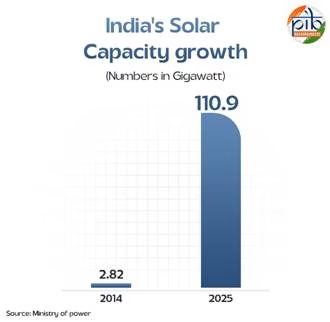
  • India’s cumulative solar power capacity stood at 119.02 GW as of July 2025. 
    • This includes 90.99 GW from ground‑mounted solar plants, 19.88 GW from grid‑connected rooftop systems, 3.06 GW from hybrid projects, and 5.09 GW from off‑grid solar installations, reflecting the country’s diverse approach to expanding renewable energy
  • In July 2025, India’s solar power capacity had increased by 4,000%, and the country’s total renewable energy capacity reached 227 GW. 
  • Palli village in Jammu & Kashmir became a notable example, emerging as India’s first carbon-neutral panchayat by running entirely on solar power.

Boost in Domestic Solar Manufacturing

  • India’s solar manufacturing sector includes key components like solar modules, solar PV cells, and ingots and wafers. 
    • Producing these within the country supports the domestic economy and reduces dependence on imports. 
  • In just one-year, solar module manufacturing capacity nearly doubled—from 38 GW in March 2024 to 74 GW in March 2025. 
  • Similarly, solar PV cell manufacturing rose from 9 GW to 25 GW. 
  • A big milestone was the start of India’s first ingot-wafer manufacturing facility (2 GW), further strengthening the entire solar supply chain

Potential of Solar Energy in India’s Energy Landscape

  • Abundant Solar Resources
    • India is one of the most solar-rich countries in the world, receiving an average of 300 sunny days per year, making it ideal for solar energy generation.
      • India lies in the tropical region, with the Tropic of Cancer passing through many states. This gives the country a high potential for solar power generation. 
      • The total solar sector potential of the Indian continent is 748 GW. States/ UTs like Rajasthan, Jammu and Kashmir, Maharashtra, Madhya Pradesh, and Andhra Pradesh have some of the highest solar potential in the country, making them key drivers of India’s clean energy growth
      • The National Institute of Solar Energy estimates that India has the potential to generate over 750 GW(approx) of electricity from solar power, which is more than adequate to meet its growing energy needs.
  • Government Commitments and Targets
    • India targets to install 500 GW of renewable energy by 2030 and solar energy is set to play a critical role in it
    • Initiatives like the Solar Park Scheme, the Atal Mission for Rejuvenation and Urban Transformation (AMRUT), and the International Solar Alliance (ISA) further bolster solar energy’s role in India’s future.
  • Cost Competitiveness
    • The cost of solar energy has dropped significantly in recent years due to technological advancements and reduced manufacturing costs, making it one of the most cost-effective sources of energy in India.
    • Solar power has become cheaper than conventional grid electricity in many regions, which is crucial for widespread adoption.
  • Job Creation and Economic Growth
    • The solar industry can generate significant employment opportunities, from the manufacturing of solar panels and infrastructure development to installation and maintenance.
    • With the potential for growth, solar energy can contribute to economic development and help create a new green economy in India.
      • Large solar parks now provide low-cost electricity
  • Environmental Benefits
    • Clean & Green: Produces electricity with zero greenhouse gas emissions during operation, helping combat climate change.
      • It can contribute to India’s commitments to the Paris Agreement
    • Reduces Air Pollution: Replaces fossil fuels, mitigating harmful air pollutants like SO₂, NOx, and particulate matter that cause smog and health problems.
    • Conserves Water: Unlike thermal power plants that require massive amounts of water for cooling, solar PV systems require minimal water (mostly for panel cleaning).
  • Energy Security
    • Reduces dependence on imported fossil fuels (coal, oil, gas), saving foreign exchange and enhancing national energy independence.
  • Social and Developmental Benefits
    • Energy Access: Enables decentralized power generation, crucial for electrifying remote and rural areas where grid extension is difficult.
    • Empowers Agriculture: PM-KUSUM scheme allows farmers to run pumps with solar power and sell surplus electricity, providing an additional income source.
    • Low Operational Cost: Once installed, the fuel (sunlight) is free, leading to very low operating costs and stable electricity prices over time.

Challenges in Expanding Solar Energy Infrastructure

  • Land Acquisition and Site Selection
    • Large-scale solar projects require significant amounts of land, which is often a challenge due to competition with agriculture, urban development, and environmental concerns.
    • Land acquisition for solar parks and projects can be time-consuming and fraught with legal, social, and environmental challenges.
  • Intermittency and Grid Integration
    • Solar power is intermittent, generating electricity only during the day and depending on weather conditions, making it a challenge to integrate it with the existing grid.
    • The lack of a robust energy storage system to store excess power during peak sunlight hours and release it during non-sunlight periods limits solar energy’s contribution to a stable, 24/7 energy supply.
  • Financing and Investment
    • Despite the declining cost of solar panels, the initial capital investment for large-scale solar infrastructure remains high.
    • Securing long-term financing for solar projects, especially in rural and remote areas, is challenging due to perceived financial risks and the high upfront costs involved.
  • Inadequate Infrastructure for Solar Power Distribution
    • The existing grid infrastructure in India, particularly in rural areas, is outdated and ill-equipped to handle the influx of decentralized solar power.
    • There is a need for significant upgrades in transmission and distribution networks to support solar energy integration.
  • Technical and Skill Gaps
    • A shortage of skilled labor and technical expertise in solar power installation, maintenance, and grid integration is a bottleneck for scaling up solar energy infrastructure.
    • Proper training and certification programs for solar technicians are needed to meet the growing demand in the sector.
  • Policy and Regulatory Barriers
    • Inconsistent policies and regulations, including state-level variations in tariffs, subsidies, and grid connectivity rules, create uncertainty for investors and project developers.
    • Delays in permitting processes and a lack of streamlined procedures hinder the timely implementation of solar projects.

Way Forward

  • Efficient Land Use and Site Selection
    • Prioritize the development of solar energy on non-agricultural, barren, and wasteland areas to minimize conflicts with food production.
    • Utilize rooftops of buildings, industrial parks, and government buildings for distributed solar power generation, reducing the dependency on large tracts of land.
  • Energy Storage and Grid Modernization
    • Invest in energy storage technologies, such as advanced batteries and pumped hydro storage, to store excess solar power and provide grid stability.
    • Modernize and upgrade the grid infrastructure to handle decentralized solar energy, ensuring smooth integration into existing transmission and distribution networks.
  • Public-Private Partnerships and Financial Incentives
    • Facilitate financing mechanisms such as green bonds, low-interest loans, and tax incentives to attract private investment in solar energy projects.
    • Encourage public-private partnerships (PPP) to accelerate project development and reduce the financial burden on the government.
  • Training and Skill Development
    • Launch skill development programs focused on solar energy installation, maintenance, and grid integration, targeting both urban and rural communities.
    • Collaborate with academic institutions and industry leaders to create a pipeline of skilled professionals in the renewable energy sector.
  • Policy Consistency and Regulatory Reforms
    • Ensure clear, consistent, and long-term policies to foster investor confidence and encourage large-scale investment in solar energy.
    • Standardize and streamline permitting processes across states and reduce bureaucratic delays to speed up project implementation.
  • Research and Development
    • Invest in R&D for improving solar technologies, including increasing the efficiency of solar panels, developing solar thermal technologies, and integrating solar power with other renewable sources.
    • Foster innovation in hybrid systems, such as solar-wind, to provide a more stable and reliable energy supply

Government Key Initiatives

The government has launched several flagship initiatives to promote the adoption and development of solar energy across the country.

  • PM Surya Ghar: Muft Bijli Yojana
    • PM Surya Ghar Muft Bijlee Yojana is a central scheme with an outlay of Rs. 75,021 crores to help one crore Indian households to get up to 300 units of free electricity every month by installing rooftop solar panels. The government provides a subsidy of ₹30,000 for 1 kW, ₹60,000 for 2 kW, and ₹78,000 for 3 kW rooftop solar systems or higher
  •  PM-KUSUM (Pradhan Mantri Kisan Urja Suraksha Evam Utthaan Mahabhiyaan)
    • The PM-KUSUM Scheme supports farmers in using solar energy instead of diesel. Farmers can get a 30% to 50% subsidy to install new solar pumps or convert old pumps to solar. 
    • They can also build solar power plants up to 2 MW on their own land and earn money by selling electricity to local DISCOMs. 
    • The scheme is carried out by state implementing agencies.
    • Moreover, it is aimed at ensuring energy security for farmers in India, along with honouring India’s commitment to increase the share of installed capacity of electric power from non-fossil fuels sources to 50% by 2030 as part of Intended Nationally Determined Contributions (INDCs)
  • Solar Parks Scheme
    • The government is running a scheme called “Development of Solar Parks and Ultra Mega Solar Power Projects” to set up large solar power plants connected to the electricity grid, with a target of 40 GW by March 2026. 
      • So far, 53 Solar Parks with a total capacity of about 39,323 MW have been approved in 13 states. 
      • Out of these, 18 parks (10,856 MW) are fully developed, where 10,756 MW of solar power projects are already working. Another 3140 MW of solar projects are running in 8 parks (10,043 MW). 
      • In total, 13896 MW of solar power projects have started operating in 26 Solar Parks, while the remaining parks are still being developed. 
  •  PM JANMAN: Empowering PVTG Communities through Solar Electrification
    • The Pradhan Mantri Janjati Adivasi Nyaya Maha Abhiyan (PM JANMAN) was launched to address the development needs of Particularly Vulnerable Tribal Groups (PVTGs) through 11 critical interventions across 9 Ministries. 
    • A key initiative under this mission and Dharti Aaba Janjatiya Gram Utkarsh Abhiyan (DA JGUA) is the New Solar Power Scheme, with an outlay of ₹515 crore, aimed at electrifying one lakh un-electrified households in Tribal and PVTG habitations across 18 states, promoting inclusive growth and sustainable energy access in remote tribal areas.
  • Increase in Solar PV Manufacturing Capacity           
    • Since 2014, India’s capacity to make solar PV cells has grown about 21 times, going up from  1.2 GW in 2014 to about 25 GW by March 2025. 
    • Similarly, the capacity to make solar PV modules has grown more than 34 times, rising from 2.3 GW in 2014 to about 78 GW by March 2025
  • India’s Global Solar Leadership: ISA & OSOWOG
    • International Solar Alliance (ISA): Launched by India and France at COP21 in 2015, the ISA is a global alliance of 100+ countries working to combat climate change through solar energy. 
      • It aims to mobilise $1 trillion in investments by 2030, reduce technology and financing costs, and promote affordable solar solutions. 
      • With a special focus on Least Developed Countries (LDCs) and Small Island Developing States (SIDS), the ISA seeks to drive low-carbon growth through cost-effective and transformational energy solutions.
    • ONE SUN- ONE WORLD- ONE GRID (OSOWOG): The ‘One Sun, One World, One Grid’ (OSOWOG) initiative, launched by India at the ISA Assembly in 2018, envisions a global solar grid under the idea that ‘the sun never sets.’ 
      • Led by ISA, it aims to connect solar resources across regions from South Asia to Africa and Europe, with studies and frameworks already underway
  • Other Important initiatives
    • Floating Solar Projects:
      • The Omkareshwar Floating Solar Park in Madhya Pradesh is one of Asia’s largest floating solar parks, with a planned capacity of 600 MW.
        • These solar projects are set up on water bodies to save land and work more efficiently
    • Agrivoltaics:
      • Agrivoltaics use solar panels and allow farming underneath, increasing land use and farmer income. 
        • Projects like the Sun master Plant in Delhi and a 105 KW system by ICAR in Jodhpur show India’s progress in clean energy.

Other Steps

The government has taken several steps for the promotion of solar energy in the country. These include:

  • Permitting Foreign Direct Investment (FDI) up to 100 percent under the automatic route,
  • Waiver of Inter State Transmission System (ISTS) charges for inter-state sale of solar and wind power for projects to be commissioned by 30th June 2025
  • Declaration of trajectory for Renewable Purchase Obligation (RPO) up to the year 2029-30
  • Notification of standards for deployment of solar photovoltaic system/devices,
  • Setting up of Project Development Cell for attracting and facilitating investments,
  • Standard Bidding Guidelines for tariff based competitive bidding process for procurement of Power from Grid Connected Solar PV and Wind Projects.
  • The government has issued orders that power shall be dispatched against Letter of Credit (LC) or advance payment to ensure timely payment by distribution licensees to RE generators.
  • Notification of Promoting Renewable Energy through Green Energy Open Access Rules 2022.
    • Under the rules, eligible consumers are entitled to demand supply of Green Power from Discoms. Discoms would be obligated to procure and supply green power to eligible consumers.
  • Launch of Green Term Ahead Market (GTAM) to facilitate sale of Renewable Energy power including Solar power through exchanges.

India’s solar energy journey has witnessed exponential growth—both in installed capacity and domestic manufacturing. With flagship schemes like PM Surya Ghar Yojana, PM-KUSUM, Solar Parks Scheme, and initiatives under the International Solar Alliance, the country is rapidly moving toward a solar-powered future. However, to fully harness this potential, India must overcome challenges related to intermittency, financing, land acquisition, and grid integration. A comprehensive approach involving infrastructure investment, R&D, skill development, and consistent policy support will be key to transforming solar energy into a pillar of India’s Atmanirbhar Bharat and Net Zero 2070 vision.

GS-3 Mains Question 

1. Solar energy is emerging as a key pillar of India’s renewable energy strategy. Discuss the achievements and challenges in scaling solar power in India.

(10 marks, 150 words)

2. Examine the role of solar energy in achieving India’s energy security and climate goals. What measures have been taken to enhance domestic solar manufacturing?

(15 marks, 250 words)

3. How can India balance the need for large-scale solar installations with concerns about land use, grid integration, and financing? Suggest a roadmap for inclusive solar energy development.

(15 marks, 250 words)

✍️ Curated by InclusiveIAS Editorial Team

At InclusiveIAS, our editorial team is led by experts who have successfully cleared multiple stages of the UPSC Civil Services Examination, including Mains and Interview. With deep insights into the demands of the exam, we focus on crafting content that is accurate, exam-relevant, and easy to grasp.

Whether it’s Polity, Current Affairs, GS papers, or Optional subjects, our notes are designed to:

  • Break down complex topics into simple, structured points

  • Align strictly with the UPSC syllabus and PYQ trends

  • Save your time by offering crisp yet comprehensive coverage

  • Help you score more with smart presentation, keywords, and examples

🟢 Every article, note, and test is not just written—but carefully edited to ensure it helps you study faster, revise better, and write answers like a topper.