Hydroponics is the technique of growing plants using a water-based nutrient solution rather than soil, and can include an aggregate substrate, or growing media, such as vermiculite, coconut coir, or perlite.
Hydroponics is not only used on earth, but has also proven itself in plant production experiments in Earth orbit.
Types of Hydroponic Systems
Deep Water Culture (DWC)
How it works: Plant roots are suspended in a nutrient-rich, oxygenated water solution.
Wick System
How it works:Wick systems are the simplest type of hydroponics. Here, plants are placed in a growing medium on a tray positioned above a nutrient solution reservoir. Wicks extend from the reservoir to the tray, drawing water and nutrients upward through capillary action to moisten the growing medium and feed the plant roots.
Nutrient Film Technique (NFT)
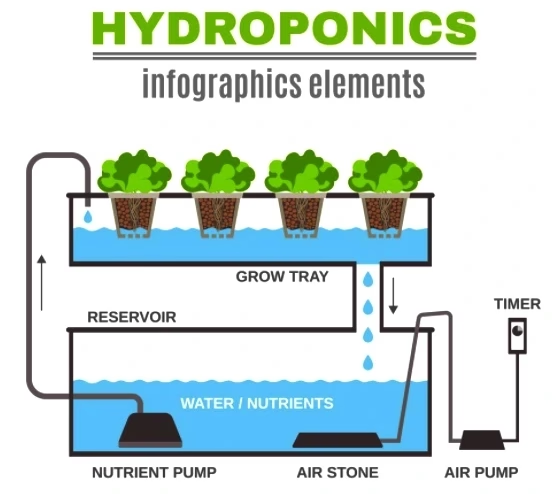
How it works:In Nutrient Film Technique (NFT) systems, plants are positioned above a shallow, continuous flow of nutrient solution that passes over the tips of their roots. The growing channels are slightly sloped, allowing the solution to flow down the tray and drain back into the reservoir. An air stone in the reservoir keeps the water aerated for healthy root growth.
Ebb and Flow (Flood & Drain)
How it works: In ebb and flow hydroponic systems, a grow bed is periodically flooded with nutrient solution from a reservoir placed below. A submersible pump connected to a timer controls the process—when the timer switches on, the pump fills the grow bed with water and nutrients, and once it switches off, gravity drains the solution back into the reservoi
Drip System
How it works: Nutrient solution is slowly dripped onto plant roots via a network of tubes.
Aeroponics
How it works: Roots are suspended in air and sprayed with a fine mist of nutrient solution.
Advantages
More complete control of nutrient content, pH and growing environment.
No weeding or cultivation required.
Much higher crop yields: Hydroponics increases crop yield by giving plants direct access to water, nutrients, and oxygen without the need for soil, allowing for more efficient resource use and faster growth cycles compared to traditional farming.
Saves Labor: Saves labor by automatic watering and fertilizing.
It can be set up indoors in places that would not normally be available for the growing of plants and have even been studied as a potential method of crop production aboard spacecraft.
Example: dry desert areas or cold climate regions
Climate is not a factor, and hydroponic systems use dramatically less water compared with conventionally grown plants.
The plants also have less root and nutrient competition than those grown in soil, and they have significantly fewer pests, so individuals can be planted more closely together.
Challenges
High Initial Investment
Initial and operational costs are higher than soil culture.
Energy Intensive
Artificial lighting, pumps, and air circulation systems consume electricity.
Technical Knowledge Required
Needs trained personnel for nutrient management, pH control, and maintenance.
Limited Crop Variety
It is not suitable for all crops.
Mostly suitable for leafy greens, herbs, and soft vegetables.
Risk of Disease Spread
In water-based systems, if a disease enters, it can spread rapidly to all plants.
Hydroponics is revolutionizing modern farming by conserving resources, enabling urban food production, and producing clean, pesticide-free vegetables. While it cannot fully replace traditional agriculture, it can complement it, especially in urban, arid, or soil-degraded areas. With growing urbanization, awareness, and support from startups and policy-makers, hydroponics holds immense potential to reshape India’s agricultural future.
FAQs
1. What is hydroponics?
Hydroponics is a method of growing plants without soil, using a water-based nutrient solution and inert growing mediums.
2. Is hydroponics suitable for India?
Yes. It’s ideal for water-scarce areas, urban spaces, and regions with degraded soil.
3. What are the best crops for hydroponics?
Leafy greens (lettuce, spinach), herbs (basil, mint), tomatoes, strawberries, and bell peppers are commonly grown.
At InclusiveIAS, our editorial team is led by experts who have successfully cleared multiple stages of the UPSC Civil Services Examination, including Mains and Interview. With deep insights into the demands of the exam, we focus on crafting content that is accurate, exam-relevant, and easy to grasp.
Whether it’s Polity, Current Affairs, GS papers, or Optional subjects, our notes are designed to:
Break down complex topics into simple, structured points
Align strictly with the UPSC syllabus and PYQ trends
Save your time by offering crisp yet comprehensive coverage
Help you score more with smart presentation, keywords, and examples
🟢 Every article, note, and test is not just written—but carefully edited to ensure it helps you study faster, revise better, and write answers like a topper.