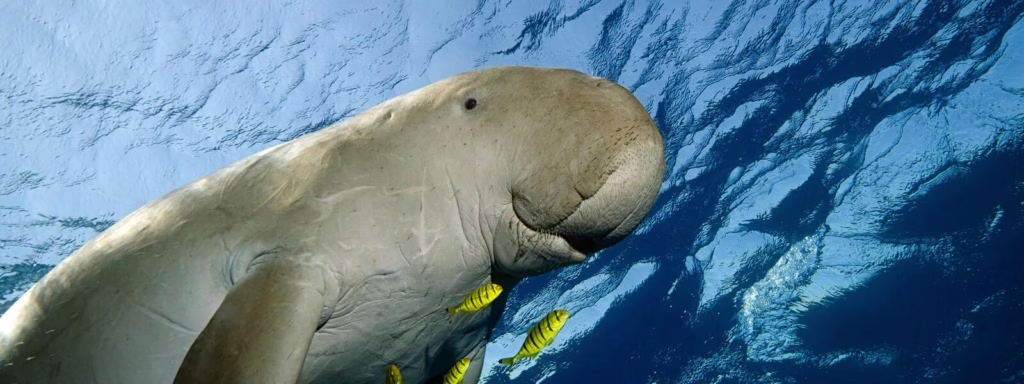
Dugong/Sea Cows

Shape Image One

Dugong/Sea Cows

Context

  • Tamil Nadu has witnessed a revival in the population of dugongs, a regionally endangered marine species, once on the brink of extinction in Indian waters. 
  • A drone survey, conducted between March and May this year(2025) by the Wildlife Institute of India (WII), has estimated that the Palk Bay (PB) and the Gulf of Mannar (GoM) region is now home to more than 200 dugongs.
    • The State’s conservation model — combining poaching prevention, rescue and release operations, community participation, and habitat restoration — supported by the Wildlife Institute of India (WII), has proven successful in the Palk Bay and Gulf of Mannar region. This achievement has also earned international recognition as a replicable model for marine conservation.

Introduction

  • Dugongs (Dugong dugon) are the only herbivorous mammals found in India’s marine ecosystems.
  • Commonly known as sea cows, dugongs are often referred to as the “farmers or gardeners of the sea” for their important role in preserving the coastal ecosystems and aiding fish production.
  • Dugongs are cousins of manatees and share a similar plump appearance, but have a dolphin fluke-like tail. And unlike manatees, which use freshwater areas, the dugong is strictly a marine mammal
  • Dugongs graze peacefully on sea grasses in shallow coastal waters of the Indian and western Pacific Oceans.
  • It is one of four living species of the order Sirenia, which also includes three species of manatees.

Features

  • Size: Grow up to 3 metres in length and weigh over 400 kg.
  • They have a tail with flukes, like a whale, which provides locomotion through vertical movement and flippers. They do not have a dorsal fin like a shark. 
  • They have a wide flat nose, small eyes, and small ears. They possess paddle-like forelimbs without nails.
  • They are gentle, slow-moving marine mammals.
  • A dugong reaches its adult size between the ages of 9 and 18 years, longer than in most other mammals.

Distribution & Occurrence

  • These enormous vegetarians can be found in warm coastal waters from East Africa to Australia, including the Red Sea, Indian Ocean, and Pacific.
  • The range of the dugong extends over the coastal waters of some 37 countries ranging from east Africa, through south and south-east Asia to Australia.
  •  Dugongs occur along some parts of the Indian coast line and more commonly in the west pacific.

Distribution in India

  • Found in warm coastal waters, especially in seagrass meadows in sheltered habitats such as bays and lagoons.
  • In Indian waters, the largest population exists between India and Sri Lanks in the Gulf of Mannar and in Palk Bay.
  • Indian distribution:
    • Gulf of Mannar
    • Palk Bay
    • Gulf of Kutch
    • Andaman & Nicobar Islands

Behaviour of Dugongs

  • Feeding Behaviour:
    • Herbivorous species.
    • Grazers of underwater seagrass beds.
    • Daily diet: Consume 30–40 kg of seagrass.
    • Use bristled, sensitive snouts to root out grasses and rough lips to chomp.
    • Act as “gardeners of the sea,” maintaining seagrass ecosystem health.
  • Underwater Activity:
    • Can stay underwater for about six minutes before surfacing.
    • Sometimes “stand” on their tail with their head above water to breathe.
  • Social Behaviour:
    • They are social animals that are usually seen alone or in pairs, but they can gather in larger groups of hundreds
    • Slow, languid swimmers, often called “sea cows.”

Reproduction of Dugongs

  • Breeding & Calving:
    • Long reproductive cycle – one calf after a year-long pregnancy.
    • Birth rate is low; contributes to vulnerability of species.
    • Despite the longevity of the Dugong, which may live for fifty years or  up to seventy years, females give birth only a few times during their life and invest considerable parental care in their young.
  • Maternal Care:
    • Calf is helped by the mother to surface and breathe immediately after birth.
    • Young stays close to mother for about 18 months, often riding on her back.
  • Population Vulnerability:
    • Low reproductive rate + long maternal dependency makes population recovery slow.
    • Historically hunted for meat, oil, skin, bones, and teeth → high anthropogenic pressure.
  • Cultural Note:
    • Believed to be the basis of ancient seafaring myths of mermaids and sirens.

Migration

  • The dugong is a migratory animal, but very slow moving. Instances have been recorded while many dugongs travelled less than 15 km (9 mi), some went as far as 560 km (348 mi). 
  • Scientists believe that dugongs move long distances for several reasons. They may be looking for food, as cyclones or floods can affect the seagrass. Males may be following females, or looking for their own territory. 
  • Dugong do not prefer cold water.If the water gets cold, less than 17 degrees Centigrade, they  travel to warmer areas.

Conservation Status

  • IUCN Red List Status: Vulnerable 
  • Wildlife (Protection) Act, 1972: Listed under Schedule I, providing the highest level of legal protection in India.
  • CITES: Appendix I
  • In a major measure to protect the species, the government, in September 2022, notified 448.34 square kilometres in the northern Palk Bay as a Dugong Conservation Reserve, under the Wild Life (Protection) Act. The region is home to over 12,250 hectares of seagrass meadows, a vital feeding ground for dugongs.
    • The IUCN has formally adopted a motion recognising India’s first Dugong Conservation Reserve in the Palk Bay spread over Thanjavur and Pudukkottai districts.

Threats

  • Hunting for meat and oil (historical and illegal poaching).
  • Commercial fishing practices → accidental entanglement and drowning.
  • Habitat degradation due to seagrass loss from trawling, pollution, and coastal development.
  • Slow reproduction rate worsens population decline.

FAQs 

Q1. Why are dugongs called the “gardeners of the sea”?

Dugongs feed on seagrass and help maintain its health and regeneration. This grazing prevents overgrowth and promotes biodiversity, which supports fish populations and marine ecosystem balance.

Q2. Where are dugongs found in India?

Dugongs are found in the Gulf of Mannar, Palk Bay, Gulf of Kutch, and the Andaman & Nicobar Islands.

Q3. What is the IUCN status of the dugong?

The dugong is listed as Vulnerable on the IUCN Red List, and in India, it is protected under Schedule I of the Wildlife (Protection) Act, 1972.

✍️ Curated by InclusiveIAS Editorial Team

At InclusiveIAS, our editorial team is led by experts who have successfully cleared multiple stages of the UPSC Civil Services Examination, including Mains and Interview. With deep insights into the demands of the exam, we focus on crafting content that is accurate, exam-relevant, and easy to grasp.

Whether it’s Polity, Current Affairs, GS papers, or Optional subjects, our notes are designed to:

  • Break down complex topics into simple, structured points

  • Align strictly with the UPSC syllabus and PYQ trends

  • Save your time by offering crisp yet comprehensive coverage

  • Help you score more with smart presentation, keywords, and examples

🟢 Every article, note, and test is not just written—but carefully edited to ensure it helps you study faster, revise better, and write answers like a topper.