Government Initiatives Strengthening Employment in India

  • Home
  • Government Initiatives Strengthening Employment in India
Shape Image One

Government Initiatives Strengthening India’s Employment

By building a robust skilling ecosystem and nurturing a globally competitive workforce, India can significantly enhance youth employability in international job markets. Sustained government initiatives have contributed to higher workforce participation, declining unemployment, improved incomes, and expanded opportunities across both traditional and emerging sectors.
Government Initiatives

  • Skill India
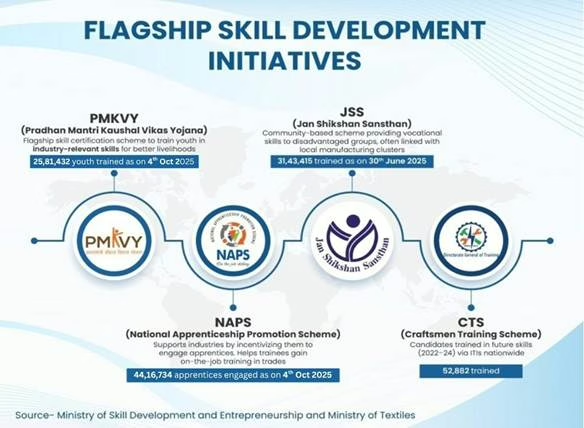
    • Under the Skill India Mission, the Ministry of Skill Development and Entrepreneurship (MSDE) provides skill, re-skill, and up-skill training through a nationwide network of centres. 
    • Key schemes include the following
  • Rozgar Mela
    • The government has been organizing Rozgar Melas to boost employment initiatives in the country through the National Skill Development Corporation (NSDC), under the Ministry of Skill Development & Entrepreneurship (MSDE). 
    • These events aim to connect unemployed youth with suitable job opportunities in the private sector. It is a half-day event where employers and job seekers gather to apply for and interview for job positions. 
  • PM Vishwakarma
    • This scheme aims to provide holistic support to artisans and craftspeople in scaling up their conventional products and services. 
    • As on 30 September 2025, there were ~30 lakhs registered artisans and craftsmen, with skill verification completed for 26 Lakhs+ beneficiaries.
  • ITI upgradation Scheme
    • Approved in May 2025, the scheme envisages upgradation of 1000 Govt. ITIs in a hub and spoke model as state-led, industry-managed skilling institutions. 
    • 200 ITIs will function as hub institutions and 800 as spokes. 
    • Besides, 20 lakh youth are aimed to be skilled over a five year period.
  • The Employment Linked Incentive (ELI) Scheme
    • It seeks to support job creation, enhance employability, and expand social security coverage, with focus on the manufacturing sector. 
    • It aims to create 3.5 crore+jobs in two years with an outlay of ₹1 lakh crore.
  • Pradhan Mantri Viksit Bharat Rojgar Yojana
    • Launched in August 2025, aims to boost job creation by supporting both employers and employees through incentives. 
    • The scheme runs from August 2025 to July 2027, with a total budget of ₹99,446 crore covering FY 2025-26 to FY 2031-32. 
    • It has two parts- Part A offers incentives for hiring 1.92 crore new eligible employees. Part B incentivizes employers to create around 2.59 crore additional jobs.
  • Additionally, for creating industry-ready workforce, initiatives like internships in companies (PM Internship Scheme) and public-private partnership for skill development and vocational training are poised to go a long way.
  • Besides, the Make In India initiative seeks to revitalize manufacturing, generate large-scale employment especially for semi-skilled and unskilled workers.

Initiatives Specifically for Women

  • Namo Drone Didi
    • A central sector scheme, it aims to empower women-led Self-Help Groups (SHGs) by equipping them with drone technology to provide agricultural services. 
    • The scheme aims to provide 15, 000 drones to selected Women SHGs (2024-25 to 2025-2026) for providing rental services to farmers for agriculture purposes (application of liquid fertilizers and pesticides for the present). This initiative is likely to generate an additional income of at least Rs. 1 lakh per year for each SHG, contributing to economic empowerment, sustainable livelihood generation.
  • Mission Shakti
    • By promoting awareness, creating a secure environment, and offering workshops and training, Mission Shakti seeks to transform women’s lives and foster an inclusive and empowered society. The Ministry of Women and Child Development is also implementing the ‘Palna’ component under Mission Shakti, aimed at providing daycare services and child protection.
  • Lakhpati Didi Scheme
    • A Lakhpati Didi is a SHG member with an annual household income of ₹1,00,000 or more. This income is calculated for at least four agricultural seasons and/or business cycles, with an average monthly income exceeding ₹10,000, so that it is sustainable. India aims to create 3 crore Lakhpati Didis, and 2 crore women have already achieved this milestone.
  • Besides, various other schemes like Bank Sakhi, Bima Sakhi, Krishi Sakhi, and Pashu Sakhi have enabled women to find sustainable employment. 
  • To garner women entrepreneurship, the government has launched several initiatives in terms of easier access to credit, marketing support, skill development, support to women start-ups, etc. 
  • Schemes and initiatives such as the PM Employment Guarantee Programme, SANKALP, PM Micro Food Processing Scheme, Adivasi Mahila Sashaktikaran Yojana, Swayam Shakti Sahakar Yojna, DAY-NRLM, and others are fostering women-led enterprises by providing financial assistance, skill training, and mentorship. These measures are empowering women entrepreneurs to launch and expand their businesses.
  • To further enhance women’s participation in the workforce, the government is implementing several programmes like Women in Science and Engineering (WISE-KIRAN) and SERB-POWER, which promote women in research and development.

Conclusion

Going forward, sustained implementation and convergence of employment-related initiatives can transform India’s demographic advantage into a globally competitive workforce, ensuring productive employment and shared prosperity.

Sample UPSC Mains Question 

Q.“Discuss how recent government initiatives aimed at skill development and employment generation are strengthening India’s workforce participation, with special emphasis on women-centric programmes.”(250 words)

✍️ Curated by InclusiveIAS Editorial Team

At InclusiveIAS, our editorial team is led by experts who have successfully cleared multiple stages of the UPSC Civil Services Examination, including Mains and Interview. With deep insights into the demands of the exam, we focus on crafting content that is accurate, exam-relevant, and easy to grasp.

Whether it’s Polity, Current Affairs, GS papers, or Optional subjects, our notes are designed to:

  • Break down complex topics into simple, structured points

  • Align strictly with the UPSC syllabus and PYQ trends

  • Save your time by offering crisp yet comprehensive coverage

  • Help you score more with smart presentation, keywords, and examples

🟢 Every article, note, and test is not just written—but carefully edited to ensure it helps you study faster, revise better, and write answers like a topper.