BRICS

Shape Image One

BRICS

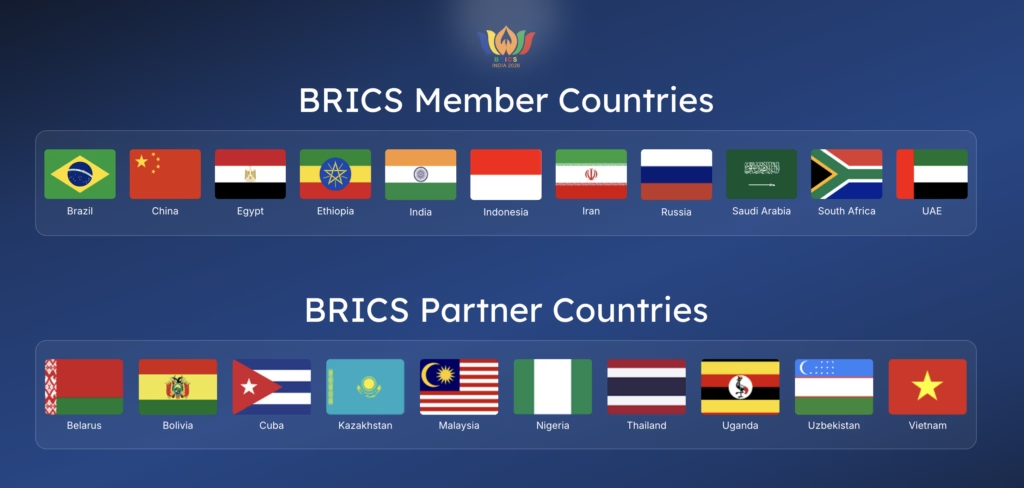
  • BRICS is a grouping of eleven countries—Brazil, Russia, India, China, South Africa, Saudi Arabia, Egypt, the United Arab Emirates, Ethiopia, Indonesia, and Iran.
  • It serves as a political and diplomatic coordination forum for countries from the Global South and for coordination in the most diverse areas.

The 18th BRICS Summit is scheduled to be hosted by India in 2026 as part of its BRICS chairmanship.

Objectives of BRICS

  • Strengthening Cooperation: To enhance economic, political, and social cooperation among member countries across diverse sectors.
  • Global South Representation:To increase the voice and influence of Global South countries in international decision-making and global governance.
  • Reforming Global Institutions:To promote greater legitimacy, equitable participation, and efficiency in major international institutions such as the United Nations (UN), International Monetary Fund (IMF), World Bank, and World Trade Organization (WTO).
  • Sustainable Development and Social Inclusion:It aims to bolster sustainable social and economic development and promote social inclusion.

History and Origins

  • The acronym BRIC was conceived in 2001 by an economist from the Goldman Sachs investment bank in recognition of the dynamic economic growth of Brasil, Russia, India, and China.
  • As a cooperation and concertation forum, the BRIC was created by the political initiative of the governments of its founding countries. Its initial goal was to engage in dialog about the major themes in the international agenda and politically strengthen their common stances in order to democratize, legitimize, and balance the global order.
  • The first BRICS meeting occurred at the Ministers of Foreign Affairs level in 2006, at the margins of the United Nations General Assembly in New York. The first meeting of the Summit of Heads of State was held in 2009 in the city of Ekaterinburg, Russia.
  • As of the 2008 financial crisis, the then four countries began to act in a concerted manner in the context of the G20, the International Monetary Fund (IMF), and the World Bank, presenting proposals to reform the international economic and financial governance to reflect the increased relative weight of emerging countries in the global economy.
  • With the incorporation of South Africa in 2011, an “S” was added to the original acronym for the group’s first expansion. In 2023, during the Johannesburg Summit, the second expansion was defined, with the adhesion of six new members.
  • Over the past years, the BRICS has remained an informal coordination mechanism, with the presidency rotating among its members. Its activities traditionally revolve around three pillars: 1) politics and security; 2) economy and finance; and 3) P2P (‘people-to-people’), or civil society.

Member Countries

  • The BRICS is currently composed of eleven countries: its five original members – Brasil, China, India, Russia, and South Africa  -, and six new members admitted in 2024-25 – Egypt, Ethiopia, Indonesia, Iran, Saudi Arabia, and the United Arab Emirates. 
  • The group was originally composed of Brasil, Russia, India, and China in 2006.
  •  South Africa joined in 2011.

Partner Countries

According to the mandate agreed upon through the Johannesburg Declaration, the leaders approved the creation of the BRICS partner country category during the Kazan Summit in 2024. The BRICS partner countries are: Belarus, Bolivia, Cuba, Kazakhstan,  Malaysia, Nigeria, Thailand, Uganda, and Uzbekistan.

How is the presidency of the BRICS defined?

  • The BRICS presidency rotates according to the letters of its acronym.  
  • Up until the now, the country holding the BRICS Presidency follows the acronym order, its term beginning on January 1st and ending on December 31st each year. With the recent inclusion of new members, a new rotation formula will be discussed.
  • The temporary presidencies define the priorities of the agenda and organize the group’s annual summit

What are the participation categories at the BRICS?

  • Members and Partners :There are two participation categories at the BRICS: members and partners.
  • The eleven members – Brasil, China, Egypt, Ethiopia, India, Indonesia, Iran, Russia, Saudi Arabia, South Africa, and the United Arab Emirates – participate in all meetings, where the decision-making process is based on consensus.
  • The discussion about the partner country modality resulted from the mandate established during the Johannesburg Declaration and its creation was announced at the Kazan Summit, in October 2024. 
  • Partners are generally invited to participate in the BRICS Chancellors and Leaders Summit; however, they can also be present in other meetings if there is consensus among the members.

Other engagement modalities: BRICS “Outreach” X BRICS “Plus”

  • Other modalities of participation in BRICS meetings include the “BRICS Outreach”, launched by South Africa in 2013, and the “BRICS Plus”, launched by China in 2017.
  • “BRICS Outreach” is a meeting between BRICS member countries and those from the geographic region of the country currently holding the rotating presidency who have been invited to such meetings.
  • “BRICS Plus” is a meeting between BRICS member countries and invited countries that are not from the geographic region of the country currently holding the BRICS rotating presidency.

Is the BRICS an international organization?

  • The BRICS does not constitute an international organization, nor a formal group. Rather, it is a forum, a group, or a coordination and cooperation mechanism among countries of the Global South.

How does the admission process of new full members of the BRICS occur?

  • In order to accede to the BRICS as a member, a country must go through the following stages: 1) declaration as a country interested in becoming a BRICS member; 2) potential BRICS member state; and 3) BRICS member state.
  • A country is considered interested when its highest leadership or minister of Foreign Affairs formally communicates its desire to become a member of the BRICS to the mechanism’s rotating presidency.
  • Next, the BRICS rotating presidency shares the group’s guiding principles, standards, and criteria related to the adhesion process with the interested country, and forwards the country’s formal interest statement to the BRICS members.
  • The member country Sherpas will then analyze the requests and issue recommendations for the consideration of the BRICS Ministers of Foreign Affairs, who will decide whether to elevate the candidates to the consideration of the presidents.
  • The final decision regarding the adhesion is reached through consensus among the BRICS leaders.

Does the BRICS have a constitutive treaty?

  • The BRICS does not have a constitutive treaty, its own budget, or a permanent secretariat.
  • The presidency rotates annually, with the incumbent responsible for organizing and sponsoring the group’s activities.
  • Over time, leaders’ declarations and ministerial statements have formed a legacy of shared decisions and positions that underpin the group’s work.

What does Global South mean?

  • The Global South refers to a group of developing countries primarily located in the Southern Hemisphere, including Latin America, Africa, Southern Asia, and Southeast Asia. 
  • These countries share characteristics such as diversified economies, social challenges, and often act in coordination at international forums to advocate for reforms in the global economic and political order. Their goals include fostering economic cooperation, strengthening their negotiating power in international forums, reducing dependency on developed countries, promoting sustainable development, and re-balancing global power. 
  • These countries are represented by groups such as BRICS, the G77 + China, and the African Union.

BRICS Initiatives

New Development Bank (NDB)

  • The New Development Bank is a multilateral development bank established by BRICS to mobilise resources for infrastructure and sustainable development projects in member countries and other emerging economies. It supports clean energy, transport, environmental protection, water and sanitation, social infrastructure, and digital infrastructure.
  • The bank supports public or private projects through loans, guarantees, equity participation and other financial instruments and cooperates with international organizations and other financial entities, and provides technical assistance for projects to be supported by the bank.
  • Origin:The idea of setting up NDB was first conceived in 2012 during the BRICS Summit in New Delhi, India.
    • The agreement for establishing the NDB was signed during the BRICS Summit held in Fortaleza on July 15, 2014, and the Bank started operations on July 21, 2015.
  • Headquarter:The bank is headquartered in Shanghai, China, with regional offices in South Africa and Brazil.
  • Membership:Membership in NDB is open to any member of the United Nations.
  • Capital: The NDB has an initial authorized capital of USD 100 billion and an initial subscribed capital of USD 50 billion, which was equally distributed among the five founding members (Brazil, Russia, India, China, and South Africa). 
  • Voting Power:Unlike in the case of the World Bank or ADB, each member in the NDB has an equal voting power.
  • Governance Structure:
    • The Bank is governed by a Board of Governors made up of the finance ministers of the five BRICS countries, and a Board of Directors.
    • Both the presidency and vice-presidency of the NDB are rotated among BRICS founding members.

    BRICS Contingent Reserve Arrangement (CRA)

    • The Contingent Reserve Arrangement is a financial safety net among BRICS members designed to provide support during balance-of-payments difficulties and currency volatility. 
    • The objective of this reserve is to provide protection against global liquidity pressures. This includes currency issues where members’ national currencies are being adversely affected by global financial pressures.
    • It was established in 2015 by the BRICS countries: Brazil, Russia, India, China and South Africa. The legal basis is formed by the Treaty for the Establishment of a BRICS Contingent Reserve Arrangement, signed in Fortaleza, Brazil, on 15 July 2014. 
    • It entered into force upon ratification by all BRICS states, announced at the 7th BRICS summit in July 2015.

     BRICS Pay and Financial Infrastructure

    • BRICS has been working on projects such as BRICS Pay, a decentralized payment messaging system aimed at facilitating cross-border transactions in local currencies to reduce dependency on dominant international payment systems and promote financial cooperation.

    Cooperation Pillars for Holistic Development

    • BRICS cooperation is structured around three broad pillars:
      • Political and security cooperation
      • Economic and financial cooperation
      • Cultural and people-to-people exchanges
    • These pillars guide broader initiatives on trade, technology, sustainability, and governance reforms.

    Research, Innovation, and Education Networks

    • BRICS promotes joint research, science and innovation collaboration and academic linkages. For example, the BRICS STI (Science, Technology and Innovation) Framework Programme supports multinational research and technology cooperation. 
    • The BRICS Universities League enhances higher-education collaboration across member and partner countries.

    De-Dollarisation and Global Financial Governance Reform

    • The grouping has pushed for reform of global financial institutions by advocating for increased representation of emerging and developing economies in institutions like the IMF and World Bank and by promoting alternatives to traditional financial systems.

     Climate Finance, AI and Sustainable Development Declarations

    • Recent BRICS Summits have seen key initiatives and declarations such as:
      • BRICS Leaders’ Framework Declaration on Climate Finance
      • Statement on Global Governance of Artificial Intelligence (AI)
    • These aim to address global challenges collaboratively.

    FAQs

    Q1. Is BRICS a formal international organisation?

    No, BRICS is an informal intergovernmental coordination forum without a permanent secretariat.

    Q2. How many countries are members of BRICS now?

    As of 2026, BRICS has 11 member countries.

    Q3. Does BRICS take decisions by voting?

    No, all decisions are taken by consensus among member states.

    ✍️ Curated by InclusiveIAS Editorial Team

    At InclusiveIAS, our editorial team is led by experts who have successfully cleared multiple stages of the UPSC Civil Services Examination, including Mains and Interview. With deep insights into the demands of the exam, we focus on crafting content that is accurate, exam-relevant, and easy to grasp.

    Whether it’s Polity, Current Affairs, GS papers, or Optional subjects, our notes are designed to:

    • Break down complex topics into simple, structured points

    • Align strictly with the UPSC syllabus and PYQ trends

    • Save your time by offering crisp yet comprehensive coverage

    • Help you score more with smart presentation, keywords, and examples

    🟢 Every article, note, and test is not just written—but carefully edited to ensure it helps you study faster, revise better, and write answers like a topper.