


Table of Contents
ToggleLandslides are the downward movement of rock, soil, and debris down a slope under the direct influence of gravity
It is a major disaster in hilly and mountainous regions. Landslides often occur due to heavy rainfall, earthquakes, slope instability, deforestation, road construction, mining and unplanned development in fragile regions.
In India, landslides are common in the Himalayan region, North-East India, Western Ghats, Eastern Ghats and some parts of the Nilgiris. They cause loss of life, damage to roads, houses, bridges, hydropower projects, forests and agricultural land.
The Indian subcontinent, with diverse physiographic, seismic, tectonic and climatological conditions is subjected to varying degree of landslide hazards; the Himalayas including Northeastern mountains ranges being the worst affected, followed by a section of Western Ghats and the Vindhyas.
Removal of vegetation and toe erosion have also triggered slides.
Torrential rainfall on the deforested slopes is the main factor in Peninsular India namely in Western Ghat and Nilgiris. Human intervention by way of slope modification has added to this effect
Structural Measures
Non-Structural Measures
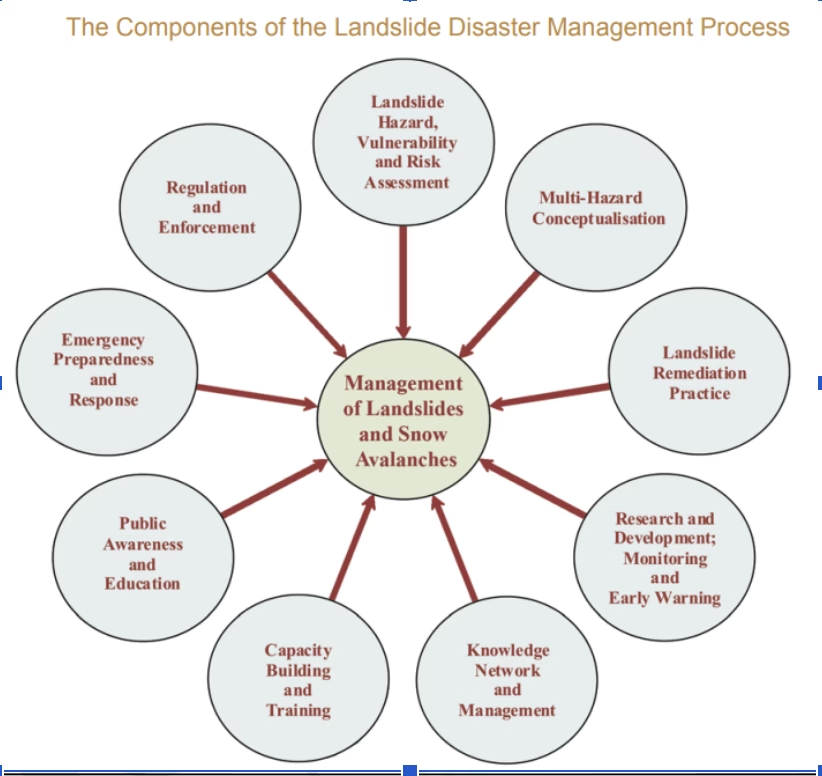
Landslides are a serious disaster risk in India’s hilly and mountainous regions. Their impact is increasing due to climate change, unplanned development, deforestation and fragile geology. Effective landslide management requires a shift from post-disaster relief to risk reduction through hazard mapping, slope stabilisation, safe construction, ecological protection, early warning and community preparedness.
Q1. Discuss the structural and non-structural measures for landslide risk reduction.
(250 words, 15 marks)
Q2. Unplanned development in hill areas has increased landslide vulnerability in India. Analyse.
(250 words, 15 marks)
Q3. Explain the significance of landslide hazard zonation mapping in disaster risk reduction.
(150 words, 10 marks)
At InclusiveIAS, our editorial team is led by experts who have successfully cleared multiple stages of the UPSC Civil Services Examination, including Mains and Interview. With deep insights into the demands of the exam, we focus on crafting content that is accurate, exam-relevant, and easy to grasp.
Whether it’s Polity, Current Affairs, GS papers, or Optional subjects, our notes are designed to:
Break down complex topics into simple, structured points
Align strictly with the UPSC syllabus and PYQ trends
Save your time by offering crisp yet comprehensive coverage
Help you score more with smart presentation, keywords, and examples
🟢 Every article, note, and test is not just written—but carefully edited to ensure it helps you study faster, revise better, and write answers like a topper.

Empowering UPSC aspirants with structured preparation, exam-focused notes, free tests, and expert guidance — trusted by thousands of serious aspirants.
