


Ramsar Sites in India
Ramsar Convention
The Ramsar Convention, officially known as the Convention on Wetlands, is an intergovernmental treaty for the conservation and wise use of wetlands and their resources.
- Adopted: 2 February 1971, at Ramsar, Iran.
- Entered into Force: 1975.
- India Joined: 1 February 1982.
- Contracting Parties: 172 (October 2026).
- Ramsar Sites Worldwide: More than 2,536 (October 2026).
Wetlands
As per the Ramsar Convention, "Wetlands are the areas of marsh, fen, peatland or water, whether natural or artificial, permanent or temporary, with water that is static or flowing, fresh, brackish or salt, including areas of marine water the depth of which at low tide does not exceed six metres”. Linking land and water, wetlands store fresh water, recharge groundwater, buffer floods and sustain fisheries and farming. They also shelter migratory birds and rich biodiversity, placing them among the most productive ecosystems on Earth.
Globally, these habitats are protected under the Convention on Wetlands or the Ramsar Convention, an intergovernmental treaty.
Importance of Wetlands
- Biodiversity Conservation: Provide habitats for aquatic organisms, migratory birds and other wildlife.
- Flood Regulation: Absorb and store excess water, reducing the impact of floods.
- Groundwater Recharge: Help replenish groundwater resources.
- Livelihood Support: Sustain fisheries, agriculture and other wetland-dependent livelihoods.
- Coastal Protection: Coastal wetlands, particularly mangroves, protect shorelines from storms, cyclones and tidal surges.
Ramsar Sites
A Ramsar Site is a wetland designated as a Wetland of International Importance under the Ramsar Convention. These sites are recognised for their ecological, botanical, zoological, limnological or hydrological significance.
The Ramsar Convention rests on three pillars:
- Wise Use of Wetlands
- Designation and Effective Management of Ramsar Sites
- International Cooperation on Wetland Conservation.
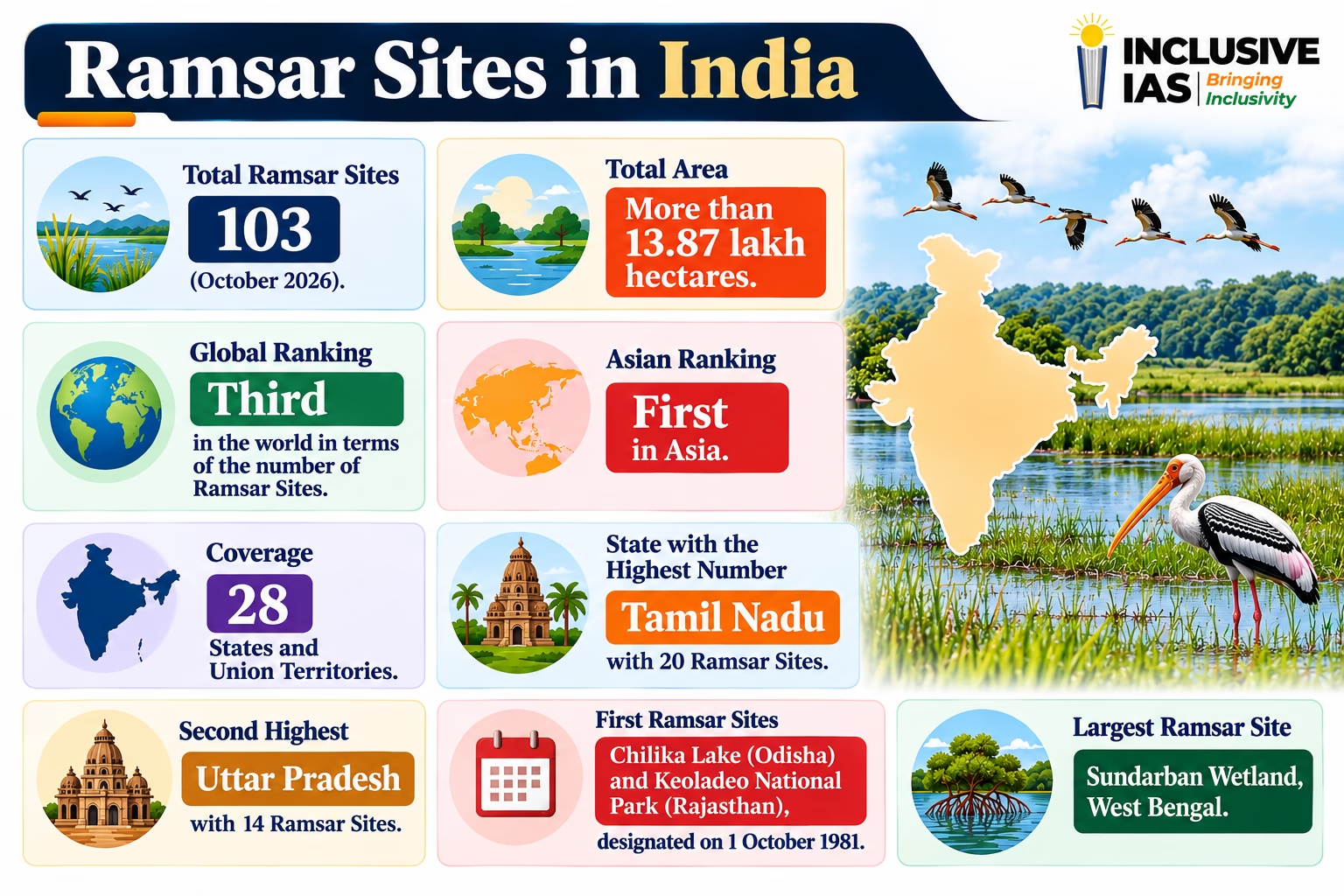
Chilika Lake in Odisha and Keoladeo National Park in Rajasthan became India’s first Ramsar Sites on 1 October 1981.
Designation of Ramsar Sites in India
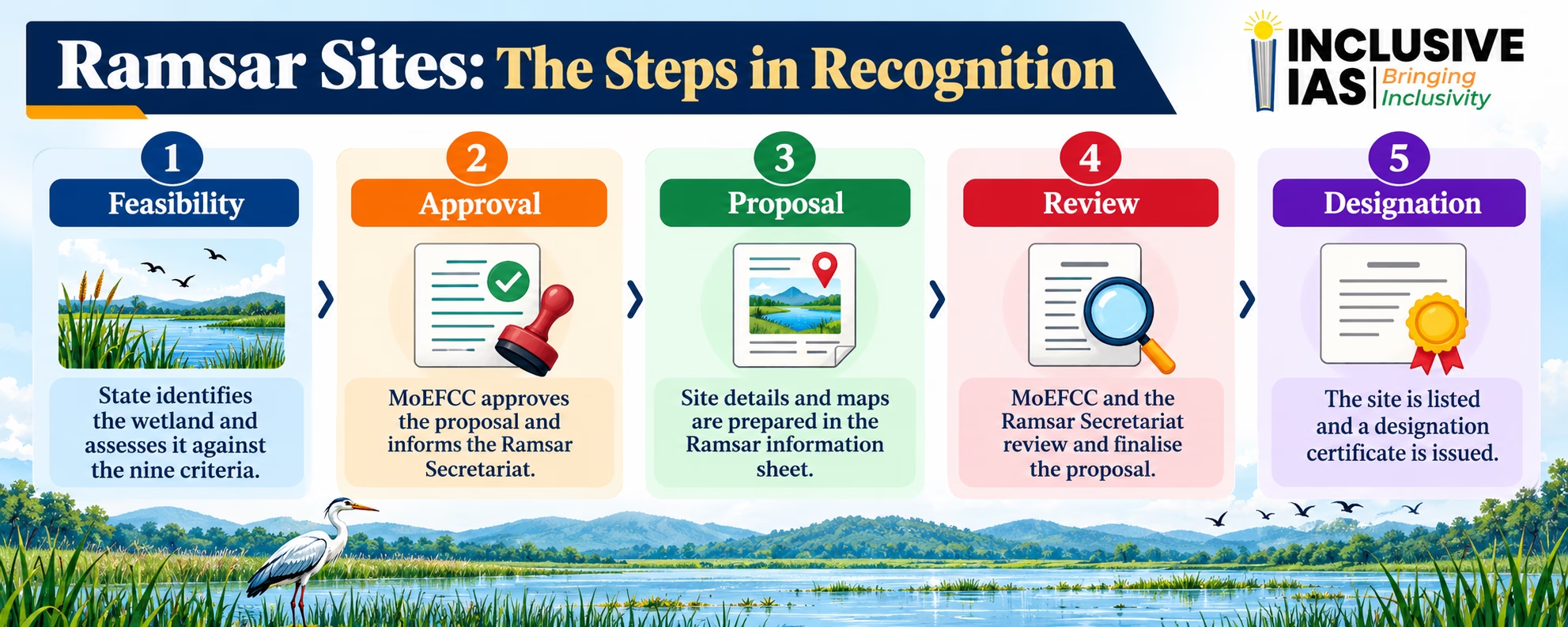
In India, the process begins with the State Government or Union Territory Administration identifying a suitable wetland. The Ministry of Environment, Forest and Climate Change then coordinates approval and forwards the proposal to the Ramsar Secretariat.
- Feasibility: State identifies the wetland and assesses it against the nine criterias
- Approval: MoEFCC approves the proposal and informs the Ramsar Secretariat
- Proposal: Site details and maps are prepared in the Ramsar information system
- Review: MoEFCC and the Secretariat review and finalise the proposal
- Designation: The site is listed and a Designation Certificate is issued
Criteria for Designation as a Ramsar Site
A wetland must meet at least one of nine criteria to qualify as a Wetland of International Importance. The criteria fall into two groups, covering wetland types and the conservation of biological diversity.
| Group | Criteria | A wetland should be considered internationally important |
|---|---|---|
| Group A: Wetland types | ||
| Criterion 1 | If it contains a representative, rare, or unique example of a natural or near-natural wetland type found within the appropriate biogeographic region. | |
| Group B: Biological diversity | ||
| Criteria based on species and ecological communities | Criterion 2 | If it supports vulnerable, endangered, or critically endangered species or threatened ecological communities. |
| Criterion3 | If it supports populations of plant and/or animal species important for maintaining the biological diversity of a particular biogeographic region. | |
| Criterion4 | If it supports plant and/or animal species at a critical stage in their life cycles, or provides refuge during adverse conditions. | |
| Specific criteria based on waterbirds | Criterion5 | If it regularly supports 20,000 or more waterbirds. |
| Criterion6 | If it regularly supports 1% of the individuals in a population of one species or subspecies of waterbird. | |
| Specific criteria based on fish | Criterion7 | If it supports a significant proportion of indigenous fish subspecies, species or families, life-history stages, species interactions and/or populations that are representative of wetland benefits and/ or values and thereby contributes to global biological diversity. |
| Criterion8 | If it is an important source of food for fishes, spawning ground, nursery and/or migration path on which fish stocks, either within the wetland or elsewhere, depend. | |
| Specific criteria based on other taxa | Criterion9 | If it regularly supports 1% of the individuals in a population of one species or subspecies of wetland-dependent non-avian animal species. |
Commitments After Designation
- Designation commits the State or Union Territory to the wise use of the wetland and its resources.
- The site is deemed notified under the Wetlands (Conservation and Management) Rules, 2017, and also the guidelines recommend to be formally notified under these rules with an Integrated Management Plan.
- The Ramsar Information Sheet must be updated every six years, and the site’s ecological character monitored regularly.
Benefits of Designating Wetlands to Ramsar List
- Provides a Platform for International Representation: Enables countries to voice their concerns at the principal intergovernmental forum on wetland conservation and wise use. Enhances Visibility and Recognition: Increases the international visibility and recognition of Ramsar Sites. This can strengthen support for their conservation and wise use.
- Provides Access to International Standards and Guidance: Offers access to the latest information on internationally accepted standards for identifying wetlands of international importance. It also provides guidance on wise use and wetland management planning.
- Facilitates Expert Assistance: Enables access to expert advice on national and site-specific wetland conservation and management challenges. Support is available through the Ramsar Secretariat, its collaborators, and Ramsar Advisory Missions, where appropriate.
- Promotes International Cooperation and Financial Support: Encourages cooperation on wetland conservation and management. It can also facilitate project support through the Convention’s small-grant programmes and links with multilateral and bilateral funding agencies
At the Ramsar 15th Conference of Parties held at Victoria Falls, Zimbabwe, India introduced a Resolution on ‘Promoting Sustainable Lifestyles for the Wise Use of Wetlands’. The resolution was adopted at the Conference.
Montreux Record
- Montreux Record is a register of Ramsar Sites where changes in ecological character have occurred, are occurring or are likely to occur.
- It identifies wetlands requiring priority conservation attention and guides monitoring, remedial action and resource allocation.
- Sites are included in consultation with the concerned country and relevant scientific experts.
- Sites may be removed from the record once successful remedial measures are documented or when the threat of ecological change no longer exists.
Chilika Lake and the Montreux Record
- Chilika Lake in Odisha was included in the Montreux Record because of ecological degradation.
- It was removed from the Record in 2002 following successful ecological restoration.
- The Chilika Development Authority subsequently received the Ramsar Wetland Conservation Award.
State-wise List of Ramsar Sites
| Sl.No | State/UT | Ramsar Site | Important Features |
|---|---|---|---|
| 1. | Andhra Pradesh | Kolleru Lake | Freshwater lake; grey pelican and migratory waterbirds |
| 2. | Arunachal Pradesh | Glaw Lake | Eastern Himalayan Lake; 150+ tree and 49 orchid species |
| 3. | Assam | Deepor Beel | Brahmaputra floodplain wetland; migratory waterbirds |
| 4. | Bihar | Kanwar Jheel (Kabartal) | Floodplain wetland; migratory waterbirds and fish |
| 5. | Nagi Bird Sanctuary | Human-made reservoir; wintering waterbirds | |
| 6. | Nakti Bird Sanctuary | Human-made reservoir; wintering waterbirds | |
| 7. | Gokul Jalashay | Ganga oxbow lake; birds, fisheries and flood buffering | |
| 8. | Udaipur Jheel | Oxbow lake; wintering migratory birds | |
| 9. | Gogabil Lake | Oxbow lake; resident and migratory birds | |
| 10. | Chandigarh | Sukhna Wetland | Rain-fed, peri-urban reservoir; migratory and resident birds |
| 11. | Chhattisgarh | Kopra Jalashay | Reservoir; resident and migratory waterbirds |
| 12. | Goa | Nanda Lake | Freshwater marsh; wintering waterbirds |
| 13. | Gujarat | Nalsarovar | Natural freshwater lake; sarus crane and waterbirds |
| 14. | Wadhvana Wetland | Irrigation reservoir; wintering migratory birds | |
| 15. | Thol Lake Wildlife Sanctuary | Human-made reservoir; waterbirds including sarus crane | |
| 16. | Khijadia Wildlife Sanctuary | Coastal freshwater and salt marsh wetland near Gulf of Kutch; diverse birds | |
| 17. | Chhari Dhand | Seasonal desert wetland near Banni; cranes and flamingos | |
| 18. | Haryana | Sultanpur National Park | Resident and migratory waterbirds |
| 19. | Bhindawas Wildlife Sanctuary | Human-made freshwater wetland; migratory birds | |
| 20. | Himachal Pradesh | Pong Dam Lake | Beas reservoir; wintering waterbirds |
| 21. | Chandertal Wetland | High-altitude lake; snow leopard habitat | |
| 22. | Renuka Wetland | Spring-fed lake; aquatic and forest biodiversity | |
| 23. | Jharkhand | Udhwa Lake Bird Sanctuary | Twin Ganga-linked lakes; migratory and resident waterbirds |
| 24. | Karnataka | Ranganathittu Bird Sanctuary | Kaveri islets; nesting waterbirds and mugger crocodile |
| 25. | Aghanashini Estuary | Estuary and mangroves; fisheries | |
| 26. | Magadi Kere Conservation Reserve | Human-made tank; wintering bar-headed goose | |
| 27. | Ankasamudra Bird Conservation Reserve | Village irrigation tank; nesting waterbirds | |
| 28. | Kerala | Ashtamudi Wetland | Estuarine backwaters; fisheries and mangroves |
| 29. | Sasthamkotta Lake | Spring-fed freshwater lake; drinking water source | |
| 30. | Vembanad-Kol Wetland | Largest brackish wetland on the southwest coast | |
| 31. | Madhya Pradesh | Bhoj Wetlands | Upper and Lower Lakes of Bhopal; water supply and birds |
| 32. | Sirpur Wetland | Human-made wetland in Indore; migratory birds | |
| 33. | Sakhya Sagar | Reservoir in Madhav National Park; mugger crocodile | |
| 34. | Yashwant Sagar | Reservoir near Indore; sarus crane and water supply | |
| 35. | Tawa Reservoir | Reservoir in Satpura Tiger Reserve; aquatic and bird life | |
| 36. | Maharashtra | NandurMadhameshwar | Bird sanctuary; migratory waterbirds |
| 37. | Lonar Lake | Meteorite impact crater lake; saline-alkaline ecosystem | |
| 38. | Thane Creek | Mangroves; flamingos and migratory birds | |
| 39. | Manipur | Loktak Lake | Floating phumdis; habitat of the Sangai deer |
| 40. | Mizoram | Pala Wetland | Largest natural wetland of Mizoram; hoolock gibbon |
| 41. | Odisha | Chilika Lake | Brackish lagoon; Irrawaddy dolphin, waterbirds and 118 fish species |
| 42. | Bhitarkanika Mangroves | Mangroves; saltwater crocodile and olive ridley turtle | |
| 43. | Satkosia Gorge | Mahanadi river gorge; gharial and mugger crocodile | |
| 44. | Tampara Lake | Freshwater lake; fish and waterbirds | |
| 45. | Hirakud Reservoir | Large reservoir; fish and waterbirds | |
| 46. | Ansupa Lake | Mahanadi oxbow lake; birds and fish | |
| 47. | Punjab | Harike Lake | River confluence reservoir; migratory waterbirds |
| 48. | Kanjli Lake | Barrage-formed wetland on Kali Bein; waterbirds | |
| 49. | Ropar Lake | Sutlej barrage reservoir; waterbirds | |
| 50. | Beas Conservation Reserve | River stretch; Indus River dolphin and gharial | |
| 51. | Keshopur-Miani Community Reserve | Community-managed wetland; waterbirds | |
| 52. | Nangal Wildlife Sanctuary | Shivalik foothill reservoir; waterbirds | |
| 53. | Rajasthan | Keoladeo National Park | Waterbirds; historic wintering ground of Siberian crane |
| 54. | Sambhar Lake | Large inland saline lake; flamingos | |
| 55. | Menar Wetland Complex | Community-protected village wetlands; migratory birds | |
| 56. | Khichan Wetland | Wintering demoiselle cranes; community conservation | |
| 57. | Siliserh Lake | Reservoir near Alwar; wetland biodiversity | |
| 58. | Sikkim | Khecheopalri Wetland | Sacred Himalayan Lake with peatland and forest |
| 59. | Tamil Nadu | Point Calimere Wildlife and Bird Sanctuary | Coastal wetland; flamingos and migratory shorebirds |
| 60. | Koonthankulam Bird Sanctuary | Largest waterbird breeding reserve in South India | |
| 61. | Chitrangudi Bird Sanctuary | Breeding and wintering ground for waterbirds | |
| 62. | Karikili Bird Sanctuary | Breeding waterbirds | |
| 63. | Pichavaram Mangrove | One of India’s largest mangroves; fish nursery | |
| 64. | Pallikaranai Marsh Reserve Forest | Urban marsh; flood buffer and birds | |
| 65. | Gulf of Mannar Marine Biosphere Reserve | Coral reefs and dugong | |
| 66. | Vembannur Wetland Complex | Human-made irrigation tank; waterbirds | |
| 67. | Vellode Bird Sanctuary | Waterbirds | |
| 68. | Udhayamarthandapuram Bird Sanctuary | Migratory waterbirds | |
| 69. | Vedanthangal Bird Sanctuary | One of India’s oldest bird-protected areas; heronry | |
| 70. | SuchindramTheroor Wetland Complex | Irrigation tanks; migratory birds | |
| 71. | Vaduvur Bird Sanctuary | Wintering waterbirds | |
| 72. | Kanjirankulam Bird Sanctuary | Nesting herons and painted storks | |
| 73. | Karaivetti Bird Sanctuary | Large inland freshwater lake; nesting waterbirds | |
| 74. | Longwood Shola Reserve Forest | Nilgiris shola forest; endemic birds | |
| 75. | Kazhuveli Bird Sanctuary | Brackish coastal lake; migratory birds | |
| 76. | Nanjarayan Bird Sanctuary | Lake; resident and migratory birds | |
| 77. | Sakkarakottai Bird Sanctuary | Migratory waterbirds | |
| 78. | Therthangal Bird Sanctuary | Nesting waterbirds | |
| 79. | Tripura | Rudrasagar Lake | Reservoir lake; fish and three-striped roof turtle |
| 80. | Uttar Pradesh | Upper Ganga River (Brijghat to Narora) | Gangetic dolphin, gharial and turtles |
| 81. | Nawabganj Bird Sanctuary | Migratory waterbirds | |
| 82. | Sarsai Nawar Jheel | Sarus crane habitat | |
| 83. | Sandi Bird Sanctuary | Freshwater marsh; waterfowl and sarus crane | |
| 84. | Samaspur Bird Sanctuary | Waterbirds | |
| 85. | Parvati Arga Bird Sanctuary | Twin oxbow lakes; waterbirds and vultures | |
| 86. | Saman Bird Sanctuary | Oxbow lake; wintering waterbirds | |
| 87. | Sur Sarovar | Human-made reservoir near Agra; waterbirds | |
| 88. | Haiderpur Wetland | Ganga floodplain; gharial, swamp deer and waterbirds | |
| 89. | Bakhira Wildlife Sanctuary | Largest natural floodplain wetland of eastern UP | |
| 90. | Patna Bird Sanctuary | Waterbirds | |
| 91. | Shekha Jheel Bird Sanctuary | Wintering bar-headed geese and painted storks | |
| 92. | Jai Prakash Narayan Bird Sanctuary (Surha Tal) | Rich avifauna; migratory and resident birds | |
| 93. | Sauj Jheel | Shallow, perennial floodplain wetland; migratory and resident waterbirds | |
| 94. | Uttarakhand | Asan Conservation Reserve | Asan-Yamuna confluence; migratory waterbirds |
| 95. | West Bengal | East Kolkata Wetlands | Wastewater-fed fisheries and agriculture |
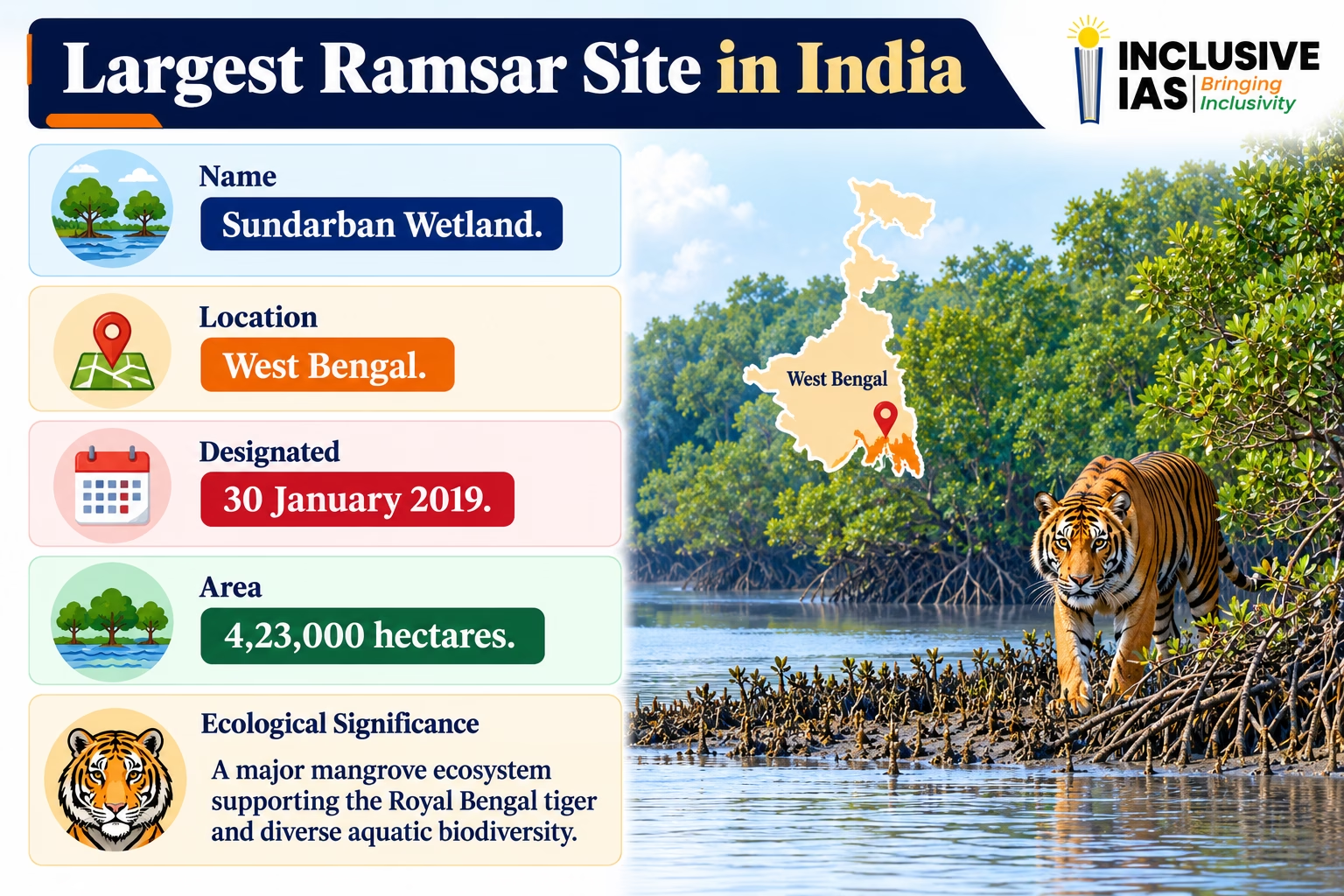
| 96. | Sundarban Wetland | Mangroves; Royal Bengal tiger | |
| 97. | Jammu and Kashmir (UT) | Wular Lake | Large freshwater lake; fisheries |
| 98. | Surinsar-Mansar Lakes | Twin freshwater lakes | |
| 99. | Hokera Wetland | Reedbeds; white-eyed pochard | |
| 100. | Hygam Wetland Conservation Reserve | Flood absorption basin; waterbirds | |
| 101. | Shallbugh Wetland Conservation Reserve | Waterbirds | |
| 102. | Ladakh (UT) | Tsomoriri | High-altitude lake; black-necked crane and bar-headed goose |
| 103. | Tso Kar Wetland Complex | High-altitude lakes; black-necked crane breeding |
Government Initiatives for Wetland Conservation
Wetlands (Conservation and Management) Rules, 2017
- Notified under the Environment (Protection) Act, 1986, these Rules provide the regulatory framework for wetland conservation.
- They establish State/UT Wetlands Authorities and prohibit activities such as encroachment, waste dumping and untreated effluent discharge.
National Plan for Conservation of Aquatic Ecosystems (NPCA)
- NPCA merged the national programmes for lake and wetland conservation into one scheme.
- Updated NPCA Guidelines issued in 2024 give States an integrated and scientific framework for managing wetlands.
Amrit Dharohar
Amrit Dharohar promotes the unique conservation values of India’s Ramsar Sites. It covers species and habitat conservation, nature tourism, wetland livelihoods and wetland carbon assessment.
- Flora and Fauna Inventory: Under this, studies for the inventory of flora and fauna of 75 Ramsar Sites have been conducted by the Botanical Survey of India and the Zoological Survey of India, respectively.
- Carbon Stock Assessment: A ‘Standard Operating Procedure for Assessment of Carbon Stock in Wetlands’ was released, and has been utilised to assess the Carbon stock of 39 Ramsar Sites across the country.
- Mission Sahbhagita and the Save Wetlands Campaign: Mission Sahbhagita promotes participatory conservation.
- Save Wetlands Campaign: Its Save Wetlands Campaign began in Goa on 4 February 2023.
- Achievements: Over 2 million citizen volunteers have helped map more than 1.7 lakh wetlands across the country.
Mangrove Initiative for Shoreline Habitats and Tangible Incomes (MISHTI)
- MISHTI was launched to promote and conserve mangroves as a unique, natural eco-system having very high biological productivity and carbon sequestration potential, besides working as a bio shield.
- MISHTI targets mangrove restoration over 540 square kilometres in nine States and four UTs.
Wetlands of India Portal
- Inaugurated: 2 October 2021.
- The portal serves as a dynamic knowledge repository on India’s wetlands.
- It offers single-point access to information on sites, projects, initiatives and training for managers and citizens.
Wetland City Accreditation
- It is a voluntary Accreditation system that provides an opportunity for cities that value their natural or human-made wetlands to gain international recognition and positive publicity for their efforts.
- It was approved at Uruguay in COP12 of Ramsar Convention (2015).
- Indore and Udaipur became India’s first Ramsar-accredited Wetland Cities in January 2025, joining the global network of Ramsar-accredited Wetland Cities.