


Monetary Policy
Monetary policy refers to the policy actions taken by a country’s central bank to regulate the supply of money, availability of credit, and interest rates with the aim of achieving macroeconomic objectives such as price stability and economic growth.
In India, monetary policy is formulated and implemented by the Reserve Bank of India (RBI).
Objectives
- Price Stability: To control inflation and maintain stability in the general price level.
- Economic Growth: To support economic activity by influencing the availability and cost of credit.
- Financial Stability: To maintain orderly monetary and financial conditions in the economy.
- Exchange Rate Stability: To limit excessive volatility in the exchange rate and maintain orderly conditions in the foreign exchange market.
- Employment Generation: To encourage investment and economic activity, thereby supporting employment generation.
Types of Monetary Policy
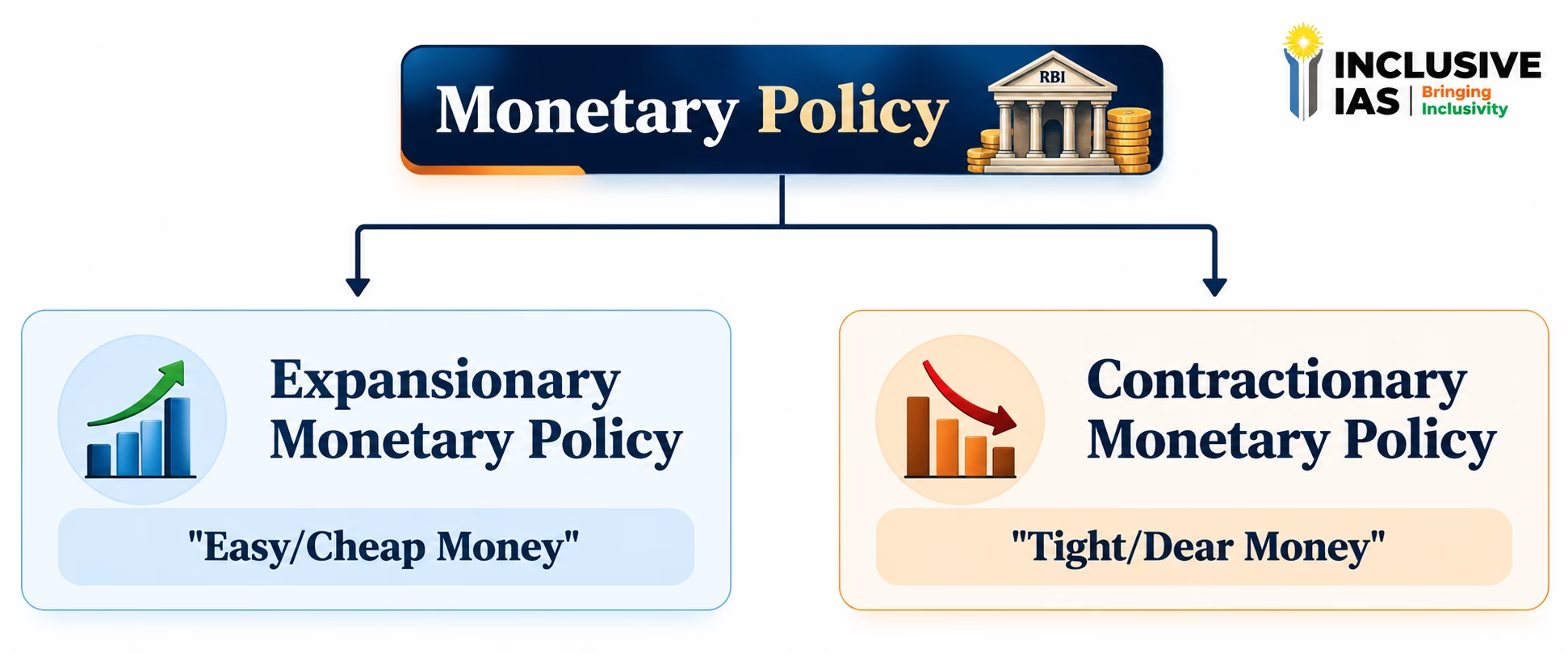
Monetary policy can be either expansionary or contractionary.
- Expansionary Monetary Policy (Cheap Money Policy): It aims to increase the money supply and availability of credit in the economy by lowering interest rates, making borrowing cheaper.
- Contractionary Monetary Policy (Dear Money Policy): It aims to reduce the money supply and availability of credit in the economy by raising interest rates, making borrowing more expensive.
Monetary Policy Transmission
- Monetary policy transmission refers to the process through which changes in monetary policy instruments influence interest rates, borrowing, consumption, investment, aggregate demand and inflation.
- For example, a reduction in the Repo Rate encourages banks to reduce their lending rates, making borrowing cheaper and stimulating economic activity.
Instruments of Monetary Policy
The instruments used by the RBI to regulate the money supply fall into two broad categories:
- Quantitative Tools: These tools are designed to influence the overall cost and volume of credit in the economy.
- Qualitative Tools: These measures focus on directing the use of credit toward desired purposes.
Unlike quantitative tools, qualitative measures do not control the total credit generated by commercial banks. Instead, they distinguish between productive (good) and unproductive (bad) credit, regulating only those forms of credit that can lead to economic instability. For this reason, qualitative tools are also referred to as selective credit control measures.
Quantitative Tools of Monetary Policy
Repo Rate
- The Repo Rate is the interest rate at which the Reserve Bank of India (RBI) loans money to commercial banks.
- More specifically, it is the interest rate at which the Reserve Bank provides liquidity under the liquidity adjustment facility (LAF) to all LAF participants against the collateral of government and other approved securities.
Reverse Repo Rate
- The interest rate at which the Reserve Bank absorbs liquidity from banks against the collateral of eligible government securities under the LAF.
- Following the introduction of SDF, the fixed rate reverse repo operations will be at the discretion of the RBI for purposes specified from time to time.
- Currently, banks are allowed to deposit any amount with the RBI at the reverse repo rate without restriction. However, if necessary, the RBI has the authority to impose a cap on these deposits.
Standing Deposit Facility (SDF) Rate
- The rate at which the Reserve Bank accepts uncollateralised deposits, on an overnight basis, from all LAF participants.
- The SDF is also a financial stability tool in addition to its role in liquidity management.
- The SDF rate is placed at 25 basis points below the policy repo rate.
- With introduction of SDF in April 2022, the SDF rate replaced the fixed reverse repo rate as the floor of the LAF corridor.
- The use of SDF is entirely at the discretion of banks and is available every day of the week, year-round, unlike repo and reverse repo operations, which are conducted at the RBI’s discretion.
Marginal Standing Facility (MSF)
- Marginal Standing Facility, introduced in 2011, allows scheduled commercial banks to borrow additional overnight funds from the Reserve Bank, beyond what they can access through the repo window.
- Under this arrangement, banks can dip into their Statutory Liquidity Ratio (SLR) holdings up to a specified limit (2%) and borrow at a penal rate of interest (Marginal Standing Facility Rate).
- This provides a safety valve against unanticipated liquidity shocks to the banking system.
- The MSF rate is placed at 25 basis points above the policy repo rate.
Bank Rate
- The rate at which the Reserve Bank is ready to buy or rediscount bills of exchange or other commercial papers.
- The Bank Rate acts as the penal rate charged on banks for shortfalls in meeting their reserve requirements (cash reserve ratio and statutory liquidity ratio). The Bank Rate is published under Section 49 of the RBI Act, 1934.
- This rate has been aligned with the MSF rate and changes automatically as and when the MSF rate changes alongside policy repo rate changes.
Liquidity Adjustment Facility (LAF)
- The LAF refers to the Reserve Bank's operations through which it injects/absorbs liquidity into/from the banking system. It consists of overnight as well as term repo/reverse repos (fixed as well as variable rates), SDF and MSF. Apart from LAF, instruments of liquidity management include outright open market operations (OMOs), forex swaps and market stabilisation scheme (MSS).
LAF Corridor
- The LAF corridor has the marginal standing facility (MSF) rate as its upper bound (ceiling) and the standing deposit facility (SDF) rate as the lower bound (floor), with the policy repo rate in the middle of the corridor.
Reserve Requirements (Fractional Reserve Banking)
- Cash Reserve Ratio (CRR): It is the percentage of a bank’s Net Demand and Time Liabilities (NDTL) that it is required to maintain as cash balance with the Reserve Bank of India (RBI).
- Statutory Liquidity Ratio (SLR): It refers to the proportion of deposits that scheduled commercial banks must maintain with themselves daily in the form of safe and liquid assets such as government securities, gold, and cash, relative to their Net Demand and Time Liabilities (NDTL).
Open Market Operations (OMOs)
- It refers to the outright purchase and sale of government securities by the RBI in the open market to inject or absorb durable liquidity from the banking system. When RBI purchases government securities, it injects liquidity, while when RBI sells government securities, it absorbs liquidity.
Qualitative Tools of Monetary Policy
Qualitative tools of monetary policy do not alter the overall quantity of liquidity in the economy but instead aim to regulate the allocation of credit across sectors. Such tools include moral suasion, selective credit controls, and margin requirements, which guide banks to channel credit into priority areas while restraining lending to speculative or undesirable sectors.
Selective credit controls
- Under selective credit controls, RBI encourages flow of credit to certain types of borrowers and discourages bank credit for certain other purposes.
- It can be done by setting limits on credit availability; charging high or low interest, or margin requirement.
Margin Requirement
When banks lend to certain sectors, the central bank may require them to maintain a margin, i.e., to set aside a specified percentage of the loan amount as security. This effectively blocks part of the bank’s funds, making lending to that sector less attractive and reducing credit flow. Conversely, lowering or removing the margin requirement encourages more lending, as banks can deploy more funds without restriction.
Rationing of Credit
Under credit rationing, the central bank sets an upper limit on the total loans and advances that banks can extend to a specific sector. Commercial banks cannot exceed this ceiling, which helps control excessive lending to sectors deemed risky or inflationary. The Reserve Bank of India fixes these ceilings for selected categories of borrowers or activities.
Moral suasion
Moral suasion refers to the central bank’s practice of requesting or advising banks to act in a desired manner without issuing formal directives. This could include appeals to lend more to small businesses or to lower interest rates.
Direct Action
This step is taken by the RBI against banks that don’t fulfil conditions and requirements.

