


Table of Contents
ToggleBlack holes are among the most mysterious and least understood objects in the universe. Despite the name, they are not actual holes but extremely dense concentrations of matter compressed into a tiny region. Their gravity is so intense that, beyond a certain boundary called the event horizon, nothing — not even light — can escape. Unlike a solid surface, the event horizon is simply a boundary enclosing all the matter that forms the black hole.
Factly
Black holes can be divided into three categories according to their mass:
Stellar Mass Black Holes:
Supermassive Black Holes
Intermediate Mass Black Holes
Factly
Black holes form via two distinct ways:
Factly
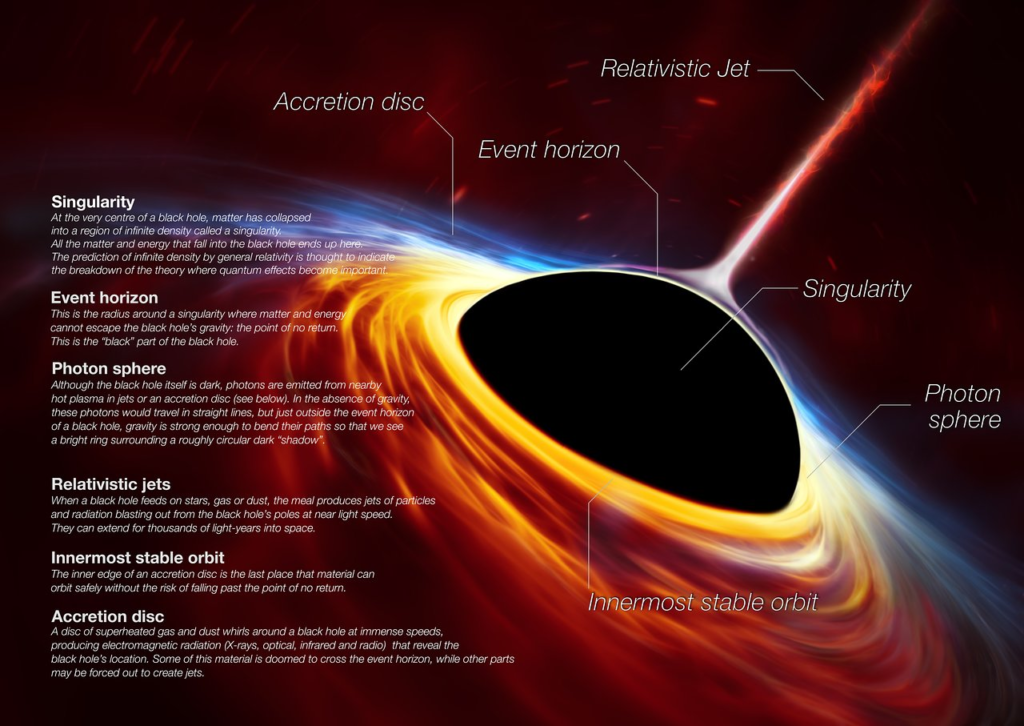
Singularity: A black hole’s entire mass is concentrated in an almost infinitely small and dense point called a singularity.
Event Horizon: The event horizon of a black hole is the boundary around the mouth of the black hole, past which light cannot escape. Once a particle crosses the event horizon, it cannot leave. Gravity is constant across the event horizon.
Black holes don’t emit or reflect light, making them effectively invisible to telescopes. Scientists primarily detect and study them based on how they affect their surroundings:
Factly
1. What is a black hole?
A black hole is a region in space where gravity is so strong that nothing, not even light, can escape it.
2. Who coined the term “black hole”?
The term “black hole” was coined by American astronomer John Wheeler in 1967.
3. What are the types of black holes?
Black holes are categorized as:
Stellar Mass Black Holes
Intermediate Mass Black Holes
Supermassive Black Holes
4. What is Sagittarius A?*
Sagittarius A* is a supermassive black hole located at the center of the Milky Way galaxy.
5. What is an event horizon?
It is the boundary around a black hole beyond which nothing can escape its gravitational pull.
At InclusiveIAS, our editorial team is led by experts who have successfully cleared multiple stages of the UPSC Civil Services Examination, including Mains and Interview. With deep insights into the demands of the exam, we focus on crafting content that is accurate, exam-relevant, and easy to grasp.
Whether it’s Polity, Current Affairs, GS papers, or Optional subjects, our notes are designed to:
Break down complex topics into simple, structured points
Align strictly with the UPSC syllabus and PYQ trends
Save your time by offering crisp yet comprehensive coverage
Help you score more with smart presentation, keywords, and examples
🟢 Every article, note, and test is not just written—but carefully edited to ensure it helps you study faster, revise better, and write answers like a topper.

Empowering UPSC aspirants with structured preparation, exam-focused notes, free tests, and expert guidance — trusted by thousands of serious aspirants.
