


Cash Reserve Ratio (CRR)
Cash Reserve Ratio (CRR) is the percentage of a bank’s Net Demand and Time Liabilities (NDTL) that it is required to maintain as cash balance with the Reserve Bank of India (RBI).
RBI defines Cash Reserve Ratio (CRR) as the average daily balance that a bank is required to maintain with the Reserve Bank as a per cent of its net demand and time liabilities (NDTL) as on the last Friday of the second preceding fortnight that the Reserve Bank may notify from time to time in the Official Gazette.
Net Demand and Time Liabilities
The public’s demand deposits are demand liability of the bank and time deposits are time liability of the banks and the total demand and time deposits of the public is called ‘Net Demand and Time Liabilities (NDTL)’ of the banks.
Objectives of CRR
- Regulate Banking System Liquidity: RBI can increase CRR to absorb excess liquidity and decrease CRR to release liquidity into the banking system.
- Regulate Credit Creation: By changing the amount of funds available with banks for lending, CRR helps RBI control excessive credit expansion or support credit when required.
- Ensure Minimum Cash Reserve: CRR requires banks to maintain a minimum cash reserve with the RBI against their liabilities, helping ensure that a portion of bank funds remains available as cash reserves.
Key Features
- Maintained with RBI: Banks are required to maintain the prescribed proportion of their NDTL as cash balance with the RBI.
- No Interest: RBI does not pay interest on the CRR balances maintained by banks.
- Statutory Basis: Under Section 42(1) of the RBI Act, 1934, the RBI prescribes the CRR for Scheduled Commercial Banks (SCBs), having regard to the need for securing monetary stability in the country. There is no statutory floor or ceiling for the CRR.
For scheduled banks, the maintenance of CRR is governed through The Reserve Bank of India Act 1934 and for Non-Scheduled banks CRR is governed through Banking Regulation Act 1949.
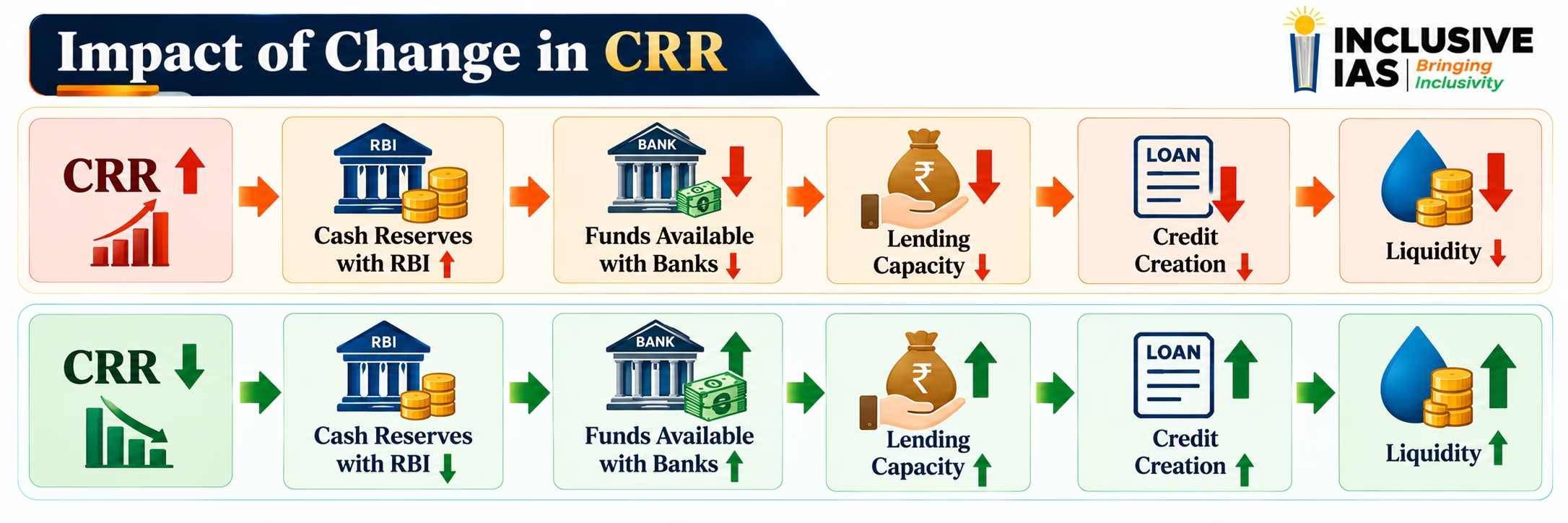
Impact of Change in CRR
- Increase in CRR: An increase in CRR requires banks to maintain a larger proportion of their funds as cash with the RBI, leaving fewer funds available for lending and credit creation. Thus, it has a contractionary effect.
- CRR ↑ → Cash Reserves with RBI ↑ → Funds Available with Banks ↓ → Lending Capacity ↓ → Credit Creation ↓ → Liquidity ↓
- Decrease in CRR: A decrease in CRR requires banks to maintain a smaller proportion of their funds as cash with the RBI, leaving more funds available for lending and credit creation. Thus, it has an expansionary effect.
- CRR ↓ → Cash Reserves with RBI ↓ → Funds Available with Banks ↑ → Lending Capacity ↑ → Credit Creation ↑ → Liquidity ↑
When may RBI increase CRR?
RBI may increase CRR when there is excess liquidity in the banking system, excessive credit growth, or high demand is adding to inflation. A higher CRR reduces the money available with banks for lending. For example:
- Following the demonetisation of ₹500 and ₹1,000 notes in 2016, banks received very large deposits. RBI temporarily imposed an incremental CRR of 100% on the increase in NDTL between September 16 and November 11, 2016 to absorb the resulting surplus liquidity.
When may RBI decrease CRR?
RBI may decrease CRR when there is a shortage of liquidity in the banking system, weak credit conditions, or an economic slowdown requiring monetary support. Reducing CRR releases funds to banks and increases their capacity to lend. For example:
- During the COVID-19 crisis in 2020, RBI reduced CRR from 4% to 3%, releasing about ₹1.37 lakh crore into the banking system.
Cash Reserve Ratio (CRR) vs Statutory Liquidity Ratio (SLR)
| Basis | Cash Reserve Ratio (CRR) | Statutory Liquidity Ratio (SLR) |
|---|---|---|
| Meaning | Percentage of NDTL that banks must maintain as cash balance with RBI | Percentage of NDTL that banks must maintain in specified liquid assets |
| Maintained With | RBI | Banks themselves |
| Form | Only cash | Cash, gold and unencumbered approved securities |
| Interest/Return | RBI does not pay interest on CRR balances | Banks can earn returns on eligible securities held for SLR |
| Statutory Basis | Section 42(1), RBI Act, 1934 for scheduled banks | Section 24, Banking Regulation Act, 1949 |
| Statutory Limit | No statutory floor or ceiling | No statutory minimum; maximum 40% of NDTL |