
New
Latest Articles
InclusiveIAS

NITI Aayog

Shape Image One

NITI Aayog

NITI Aayog

Must Know
Full Form National Institution for Transforming India
Established 1 January 2015
Replaced Planning Commission
Created by Executive Resolution of Union Cabinet
Status Non-constitutional, non-statutory body
Nature Public policy think tank
Chairperson Prime Minister of India
Vice-Chairperson Appointed by Prime Minister
CEO Appointed by Prime Minister; rank of Secretary to Government of India
Governing Council Chief Ministers of States, CMs of UTs with legislatures, Lt. Governors of UTs

The National Institution for Transforming India (NITI Aayog) is the Government of India’s premier public policy think tank established on 1 January 2015 to replace the Planning Commission. It was created through a Union Cabinet Resolution with the objective of fostering cooperative and competitive federalism, promoting evidence-based policymaking, and serving as a catalyst for India’s long-term development. Unlike the Planning Commission, NITI Aayog does not allocate funds to States but acts as a knowledge, innovation, and strategy institution that facilitates policy formulation, monitoring, and implementation.

Establishment of NITI Aayog

On 13 August 2014, the Union Government led by Prime Minister Narendra Modi announced the abolition of the Planning Commission, ending its 65-year-old existence. Subsequently, NITI Aayog (National Institution for Transforming India) was established on 1 January 2015 as its successor.

Unlike a constitutional or statutory body, NITI Aayog was established through an Executive Resolution of the Union Cabinet. Therefore, it is:

  • An extra-constitutional body (not created by the Constitution).
  • A non-statutory body (not created by an Act of Parliament).

NITI Aayog serves as the Government of India’s premier public policy think tank, providing strategic policy direction, technical advice, and long-term developmental inputs to both the Union and State Governments.

Composition of NITI Aayog

The organisational structure of NITI Aayog is designed to promote cooperative federalism by ensuring active participation of the Union Government, States, Union Territories and domain experts.

Chairperson

  • The Prime Minister of India is the Chairperson of NITI Aayog.

Governing Council

The Governing Council is the apex decision-making body of NITI Aayog. It comprises:

  • Chief Ministers of all States.
  • Chief Ministers of Union Territories having Legislatures (Delhi, Puducherry and Jammu & Kashmir).
  • Lieutenant Governors of other Union Territories.

Regional Councils

  • Constituted to address specific issues affecting more than one State or region.
  • Created for a specified tenure.
  • These are convened by the Prime Minister.
  • Comprise the Chief Ministers of the concerned States and Lieutenant Governors of the concerned Union Territories.
  • These are chaired by the Chairperson of the NITI Aayog or his/her nominee.

Special Invitees

  • Experts, specialists and practitioners with domain expertise.
  • Nominated by the Prime Minister.

Full-time Organisational Framework

It comprises, in addition to the Prime Minister as the Chairperson:

Vice-Chairperson

  • Appointed by the Prime Minister.
  • Enjoys the rank of a Cabinet Minister.

Full-time Members

  • Enjoy the rank of a Minister of State.

Part-time Members

  • Maximum of two members.
  • Drawn from leading universities, research organisations and other institutions.
  • Serve in an ex-officio capacity on a rotational basis.

Ex-Officio Members

  • Maximum of four Union Ministers.
  • Nominated by the Prime Minister.

Chief Executive Officer (CEO)

  • Appointed by the Prime Minister for a fixed tenure.
  • Holds the rank of Secretary to the Government of India.

Secretariat

  • Provides administrative and technical support to NITI Aayog.
  • Organised as required for the efficient functioning of the institution.

Objectives

  • To evolve a shared vision of national development priorities, sectors and strategies with the active involvement of States.
  • To foster cooperative federalism through structured support initiatives and mechanisms with the States on a continuous basis, recognizing that strong States make a strong nation
  • To develop mechanisms to formulate credible plans at the village level and aggregate these progressively at higher levels of government
  • To ensure, on areas that are specifically referred to it, that the interests of national security are incorporated in economic strategy and policy.
  • To pay special attention to the sections of our society that may be at risk of not benefiting adequately from economic progress.
  • To design strategic and long-term policy and programme frameworks and initiatives, and monitor their progress and their efficacy. The lessons learned through monitoring and feedback will be used for making innovative improvements, including necessary mid-course corrections.
  • To provide advice and encourage partnerships between key stakeholders and national and international like-minded think tanks, as well as educational and policy research institutions.
  • To create a knowledge, innovation and entrepreneurial support system through a collaborative community of national and international experts, practitioners and other partners.
  • To offer a platform for the resolution of inter-sectoral and inter­ departmental issues in order to accelerate the implementation of the development agenda.
  • To maintain a state-of-the-art resource centre, be a repository of research on good governance and best practices in sustainable and equitable development as well as help their dissemination to stake-holders.
  • To actively monitor and evaluate the implementation of programmes and initiatives, including the identification of the needed resources so as to strengthen the probability of success and scope of delivery.
  • To focus on technology upgradation and capacity building for implementation of programmes and initiatives
  • To undertake other activities as may be necessary in order to further the execution of the national development agenda, and the objectives mentioned above.

Features

NITI Aayog is developing itself as a state-of-the-art resource centre with the necessary knowledge and skills that will enable it to act with speed, promote research and innovation, provide strategic policy vision for the government, and deal with contingent issues. It is supported by an attached office, Development Monitoring and Evaluation Organisation (DMEO), a flagship initiative, Atal Innovation Mission (AIM) and an autonomous body, National Institute of Labour Economics Research and Development (NILERD).

NITI Aayog’s entire gamut of activities can be divided into four main heads:

  1. Policy and Programme Framework
  2. Cooperative Federalism
  3. Monitoring and Evaluation
  4. Think Tank, and Knowledge and Innovation Hub

The different divisions, cells, attached and autonomous bodies of NITI provide the requisite coordination and support framework needed to carry out its mandate.

Guiding Principles

The NITI Aayog is guided by the following principles : 

  1. Antyodaya: Prioritise service and uplift of the poor, marginalised and downtrodden, as enunciated in Pandit Deendayal Upadhyay’s idea of ‘Antyodaya’.
  2. Inclusion: Empower vulnerable and marginalised sections, redressing identity-based inequalities of all kinds—gender, region, religion, caste or class.
  3. Village: Integrate our villages into the development process, to draw on the vitality and energy of the bedrock of our ethos, culture and sustenance.
  4. Demographic dividend: Harness our greatest asset, the people of India; by focussing on their development, through education and skilling, and their empowerment, through productive livelihood opportunities.
  5. People’s Participation: Transform the developmental process into a people-driven one, making an awakened and participative citizenry—the driver of good governance. 
  6. Governance: Nurture an open, transparent, accountable, pro-active and purposeful style of governance, transitioning focus from Outlay to Output to Outcome.
  7. Sustainability: Maintain sustainability at the core of our planning and developmental process, building on our ancient tradition of respect for the environment.

7 Pillars of Effective Governance

The NITI Aayog is based on the 7 pillars of effective Governance. They are:
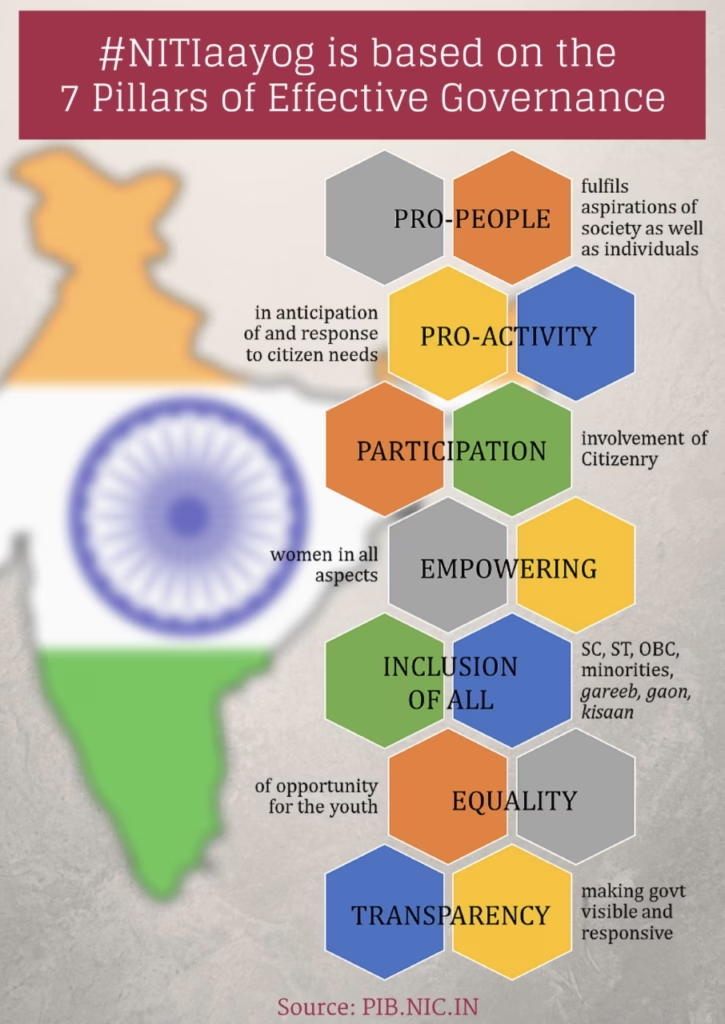
  1. Pro-people: fulfils the aspirations of society as well as individuals
  2. Pro-activity: in anticipation of and response to citizen needs
  3. Participation: involvement of the citizenry
  4. Empowering: Empowering, especially women in all aspects
  5. Inclusion of all: inclusion of all people irrespective of caste, creed, and gender
  6. Equality: providing equal opportunity to all especially for youth
  7. Transparency: making the government visible and responsive

NITI Aayog vs Planning Commission

Basis

Planning Commission

NITI Aayog

Year of Establishment

1950

2015

Created By

Executive Resolution

Executive Resolution

Nature

Central planning body

Public policy think tank

Primary Role

Formulated Five-Year Plans and allocated resources

Provides policy advice, strategic planning, monitoring and innovation

Planning Approach

Top-down planning

Bottom-up planning

Development Model

Centralised planning

Cooperative and Competitive Federalism

Financial Powers

Allocated Plan funds to States

No power to allocate funds

Relationship with States

States had limited role

States are active partners through the Governing Council

Decision-Making

Centralised

Collaborative and consultative

Five-Year Plans

Prepared and implemented Five-Year Plans

Five-Year Plans discontinued; focuses on long-term strategies and policy frameworks

Resource Allocation

Decided Plan expenditure for Ministries and States

No role in financial allocation

Policy Focus

Economic planning and public investment

Policy formulation, innovation, monitoring, evaluation and sustainable development

Federalism

Cooperative federalism was limited

Promotes both cooperative and competitive federalism

State Representation

No institutional platform for regular Centre–State policy dialogue

Governing Council includes Chief Ministers of all States and UTs with Legislatures

Present Status

Abolished in 2015

Continues as India’s premier policy think tank

NITI Aayog represents a paradigm shift from centralised planning to collaborative policymaking. By promoting cooperative federalism, innovation, evidence-based governance and outcome-oriented development, it has emerged as India’s premier public policy institution. Going forward, strengthening its institutional capacity and deepening Centre–State partnerships will be crucial for achieving the vision of Viksit Bharat @2047.

FAQs 

What is NITI Aayog?

NITI Aayog (National Institution for Transforming India) is the Government of India’s premier public policy think tank established on 1 January 2015 to replace the Planning Commission. It provides strategic policy advice and promotes cooperative and competitive federalism.

Is NITI Aayog a constitutional body?

No. NITI Aayog is neither a constitutional nor a statutory body. It was established through an Executive Resolution of the Union Cabinet.

✍️ Curated by InclusiveIAS Editorial Team

At InclusiveIAS, our editorial team is led by experts who have successfully cleared multiple stages of the UPSC Civil Services Examination, including Mains and Interview. With deep insights into the demands of the exam, we focus on crafting content that is accurate, exam-relevant, and easy to grasp.

Whether it’s Polity, Current Affairs, GS papers, or Optional subjects, our notes are designed to:

  • Break down complex topics into simple, structured points

  • Align strictly with the UPSC syllabus and PYQ trends

  • Save your time by offering crisp yet comprehensive coverage

  • Help you score more with smart presentation, keywords, and examples

🟢 Every article, note, and test is not just written—but carefully edited to ensure it helps you study faster, revise better, and write answers like a topper.