UPDATES

Photochemical Smog: Formation, Impacts, Control Measures and Gothenburg Protocol | UPSC Notes

  • Home
  • Photochemical Smog: Formation, Impacts, Control Measures and Gothenburg Protocol | UPSC Notes
Shape Image One

Photochemical Smog: Formation, Impacts, Control Measures and Gothenburg Protocol

Photochemical smog is a type of air pollution formed when sunlight reacts with pollutants such as nitrogen oxides and volatile organic compounds. It is commonly seen in highly urbanised and industrial areas with heavy vehicular emissions, strong sunlight and stagnant air conditions. 

Formation of photochemical smog

  • When fossil fuels are burnt, a variety of pollutants are emitted into the earth’s troposphere. Two of the pollutants that are emitted are hydrocarbons (unburnt fuels) and nitric oxide (NO). When these pollutants build up to sufficiently high levels, a chain reaction occurs from their interaction with sunlight in which NO is converted into nitrogen dioxide (NO2 ). This NO2 in turn absorbs energy from sunlight and breaks up into nitric oxide and free oxygen atom 

                                                 NO2 (g) →NO(g) + O(g) ….(i)

  • Oxygen atoms are very reactive and combine with the O2 in air to produce ozone. 

                                                 O(g) + O2 (g)→ O3 (g) ….(ii)

  • The ozone formed in the above reaction (ii) reacts rapidly with the NO(g) formed in the reaction (i) to regenerate NO2 . NO2 is a brown gas and at sufficiently high levels can contribute to haze. 

                                                NO (g) + O3 (g) → NO2 (g) + O2 (g) ….(iii)
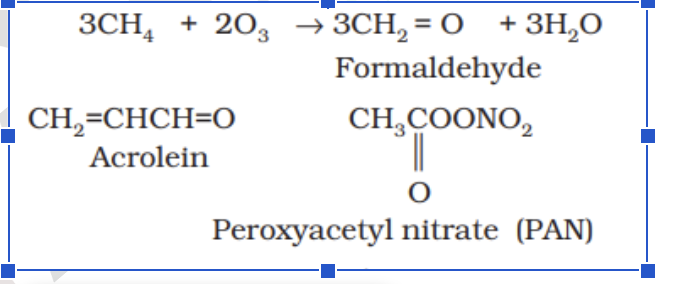
  • Ozone is a toxic gas and both NO2 and O3 are strong oxidising agents and can react with the unburnt hydrocarbons in the polluted air to produce chemicals such as formaldehyde, acrolein and peroxyacetyl nitrate (PAN).

Types of Smog

There are two types of smog: 

  • Classical smog occurs in cool humid climate. It is a mixture of smoke, fog and sulphur dioxide. Chemically it is a reducing mixture and so it is also called as reducing smog. 
  • Photochemical smog occurs in warm, dry and sunny climate. The main components of the photochemical smog result from the action of sunlight on unsaturated hydrocarbons and nitrogen oxides produced by automobiles and factories. Photochemical smog has high concentration of oxidising agents and is, therefore, called as oxidising smog.

Key Components of Photochemical Smog

  • Ground-level Ozone (O₃) — primary harmful component; strong oxidant; damages respiratory system, plants, materials; 
  • Peroxyacyl Nitrates (PANs) — powerful eye irritants; phytotoxic (damage crops); secondary pollutant unique to photochemical smog; travel long distances
  • Nitrogen Dioxide (NO₂) — brown colour of smog; respiratory irritant; acidic; contributes to acid rain
  • Aldehydes — key secondary pollutants in photochemical smog; eye and respiratory irritants 
  • Particulate matter (PM) is a key pollutant present in the smog. 
    • Fine Particulates (PM 2.5) — secondary organic aerosols formed from VOC oxidation; deepest lung penetration

Sulfurous Smog vs Photochemical Smog 

Sulfurous smog

  • Sulfurous smog, which is also called “London smog,” results from a high concentration of sulfur oxides in the air and is caused by the use of sulfur-bearing fossil fuels, particularly coal. 
  • This type of smog is aggravated by dampness and a high concentration of suspended particulate matter in the air. 

Photochemical smog 

  • Photochemical smog, which is also known as “Los Angeles smog,” occurs most prominently in urban areas that have large numbers of automobiles. 
  • It requires neither smoke nor fog. 
  • This type of smog has its origin in the nitrogen oxides and hydrocarbon vapours emitted by automobiles and other sources, which then undergo photochemical reactions in the lower atmosphere. 
  • The highly toxic gas ozone arises from the reaction of nitrogen oxides with hydrocarbon vapours in the presence of sunlight, and some nitrogen dioxide is produced from the reaction of nitrogen oxide with sunlight. 
  • The resulting smog causes a light brownish coloration of the atmosphere, reduced visibility, plant damage, irritation of the eyes, and respiratory distress.

Impacts of Photochemical Smog

  • Health Impacts
    • Eye irritation — Ozone, PAN and aldehydes cause burning sensation, redness and watering of eyes.
    • Respiratory problems — It irritates the throat, nose and lungs, causing coughing, wheezing and breathing difficulty.
      • Both ozone and PAN act as powerful eye irritants. Ozone and nitric oxide irritate the nose and throat and their high concentration causes headache, chest pain, dryness of the throat, cough and difficulty in breathing 
  • Environmental Impacts
    • Ozone— Ozone damages leaf tissues, reduces photosynthesis and affects plant growth.
      • Ground-level ozone, a primary component of smog, severely disrupts plant biology by entering through stomata and causing oxidative stress that damages chloroplasts. 
      • Ozone is a highly reactive oxidant that significantly reduces crop productivity as well as the uptake of atmospheric carbon by vegetation. Its effects on plants include impeded growth and seed production, reduced functional leaf area and accelerated ageing.  
      • Studies have shown that many species of plants are sensitive to ozone, including agricultural crops, grassland species and tree species. These effects damage important ecosystem services provided by plants, including food security, carbon sequestration, timber production, and protection against soil erosion, avalanches and flooding.  
    • PANs — highly phytotoxic even at very low concentrations; cause “silver leaf” damage to crops; affect lettuce, spinach, tomato severely
    • Atmospheric and Climate Impacts
      • Formation of ground-level ozone — Photochemical smog increases tropospheric ozone, which is both an air pollutant and a greenhouse gas.
      • Reduced visibility — Brownish haze reduces visibility and affects road, aviation and urban safety.
  • Atmospheric and Climate Impacts
    • Formation of ground-level ozone — Photochemical smog increases tropospheric ozone, which is both an air pollutant and a greenhouse gas.
      • Ozone absorbs radiation and consequently acts as a strong greenhouse gas. Tropospheric ozone affects the climate beyond increased warming, having impacts on evaporation rates, cloud formation, precipitation levels, and atmospheric circulation.  
    • Reduced visibility — Brownish haze reduces visibility and affects road, aviation and urban safety.
  • Material Damage
    • Damage to rubber and plastics — Ozone and other photochemical oxidants crack rubber, weaken plastics and reduce the life of tyres, cables, seals and synthetic materials.
    • Fading of paints and dyes — Photochemical smog can bleach paints, dyes, fabrics and painted surfaces, reducing their durability and appearance.
    • Corrosion of buildings and monuments — Oxidants and acidic pollutants damage building materials, metals, stone surfaces and monuments over time.
    • Deterioration of textiles and paper — Smog pollutants weaken fibres, fade colours and reduce the quality of paper, cloth and leather goods.
  • Economic Impacts
    • Healthcare costs — Respiratory and eye diseases increase medical expenditure.
    • Loss of productivity — Illness, fatigue and breathing difficulty reduce work efficiency, especially for outdoor workers.
    • Agricultural losses — Crop damage caused by ozone can reduce farmer income.
    • Damage to materials — Ozone and oxidants damage rubber, paints, plastics, textiles and building surfaces.

Measures to Control Photochemical Smog

  • Reduce Vehicular Emissions
    • Promote electric vehicles, cleaner fuels, stricter emission norms, vehicle fitness checks and phasing out of old vehicles.
    • Use of catalytic converters in automobiles prevent the release of nitrogen oxide and hydrocarbons to the atmosphere. 
  • Strengthen Public Transport
    • Metro, buses, suburban rail, cycling infrastructure and walking-friendly streets can reduce private vehicle use.
  • Control Industrial Emissions
    • Industries should adopt cleaner technologies, emission control devices and continuous monitoring systems.
  • Regulate VOC Emissions
    • Petrol pumps, refineries, paint industries, solvent use and chemical units should control volatile organic compound emissions.
  • Traffic Management
    • Reduce congestion through better road design, intelligent traffic systems, parking regulation and freight movement planning.
  • Promote Clean Energy
    • Replace diesel generators and coal-based local energy use with clean electricity, renewables and battery storage.
  • Urban Greening
    • Urban trees, green belts and open spaces can improve air quality, though species selection should avoid high VOC-emitting plants in polluted cities.
    • Certain plants e.g., Pinus, Juniparus, Quercus, Pyrus and Vitis can metabolise nitrogen oxide and therefore, their plantation could help in this matter

The 1999 Gothenburg Protocol to Abate Acidification, Eutrophication and Ground-level Ozone (Gothenburg Protocol)

  • Adopted in 1999
  • Objective
    • The objective of the 1999 Protocol was to control and reduce emissions of sulphur, nitrogen oxides, ammonia and volatile organic compounds that are caused by anthropogenic activities and are likely to cause adverse effects on human health, natural ecosystems, materials and crops, due to acidification, eutrophication or ground-level ozone as a result of long-range transboundary atmospheric transport. 
    • The Protocol is part of the Convention on Long-Range Transboundary Air Pollution. The Convention is an international agreement to protect human health and the natural environment from air pollution by control and reduction of air pollution, including long-range transboundary air pollution.
    • The geographic scope of the Protocol includes Europe, North America and countries of Eastern Europe, Caucasus and Central Asia
  • The Protocol establishes national emission ceilings for four pollutants—sulphur (SO₂), nitrogen oxides (NOₓ), volatile organic compounds (VOCs), and ammonia (NH₃)—covering the period from 2010 to 2020. 
  • The Protocol also establishes stringent limit values for emissions from specific sources, such as combustion plants, electricity production facilities, dry cleaning operations, cars and lorries.
  • It mandates the use of best available techniques (BAT) to reduce emissions, requires cuts to VOC emissions from products like paints and aerosols, and introduces specific measures for farmers to control ammonia emissions.
  • To ensure accountability and continuous improvement, Parties must report their emissions annually and provide projections for future emissions every 4 years.  
  • Amendments in 2012 
    • In 2012, the Protocol was amended to introduce national emission reduction commitments for 2020 and beyond 
    • The revised Protocol is also the first binding agreement to include emission reduction commitments for fine particulate matter (PM₂.₅). 
    • Also for the first time, the Parties have broken new ground in international air pollution policy by specifically including the short-lived climate pollutant black carbon (or soot) as a component of particular matter. 
      • So, now it covers four air pollutants – sulphur (mainly sulphur dioxide), nitrogen oxides, ammonia and volatile organic compounds (VOC) other than methane  – and particulate matter. 
    •  In particular, the amendment includes:
      • emission reductions for black carbon
      • an update of the emission limit values set in the annex to the protocol
      • new standards on the content of non-methane VOCs in products
    • The amended Gothenburg Protocol entered into force on 7 October 2019. 
  • India has not signed the protocol.

Conclusion

Photochemical smog is a modern urban pollution problem caused by the reaction of vehicular and industrial emissions with sunlight. Its harmful pollutants, especially ground-level ozone and PAN, damage human health, crops, forests, materials and visibility. Controlling it requires reducing precursor pollutants, improving public transport, regulating industrial emissions, monitoring ozone and planning cities in a cleaner, climate-sensitive manner.

Sample Mains Question

Q1. Explain the formation of photochemical smog. How is it different from classical smog?
(150 words, 10 marks)

Q2. Photochemical smog is a major urban air pollution problem. Discuss its health, environmental and economic impacts.
(150 words, 10 marks)

✍️ Curated by InclusiveIAS Editorial Team

At InclusiveIAS, our editorial team is led by experts who have successfully cleared multiple stages of the UPSC Civil Services Examination, including Mains and Interview. With deep insights into the demands of the exam, we focus on crafting content that is accurate, exam-relevant, and easy to grasp.

Whether it’s Polity, Current Affairs, GS papers, or Optional subjects, our notes are designed to:

  • Break down complex topics into simple, structured points

  • Align strictly with the UPSC syllabus and PYQ trends

  • Save your time by offering crisp yet comprehensive coverage

  • Help you score more with smart presentation, keywords, and examples

🟢 Every article, note, and test is not just written—but carefully edited to ensure it helps you study faster, revise better, and write answers like a topper.