Home
Our Courses
Blog About Us Contact Us
New
Latest Articles
InclusiveIAS
NOTICE
📝 UPSC Mains 2026 Question Papers — all five papers now available with full PDFs: View All Papers 📝 UPSC Mains 2026 Question Papers — all five papers now available with full PDFs: View All Papers
📝 Download all UPSC Mains 2026 Question Papers

Robotics: Applications, Importance, Challenges and Way Forward

  • Home
  • Robotics: Applications, Importance, Challenges and Way Forward
Shape Image One

Robotics

Robotics has wide applications across sectors because it can perform tasks with speed, precision, consistency and safety. It is used in manufacturing for automation, healthcare for robotic surgery and patient care, agriculture for precision farming, defence for surveillance and bomb disposal, disaster management for rescue operations, and space missions for exploration. Thus, robotics acts as a practical tool for improving efficiency, reducing human risk and solving complex real-life problems.
Importance of Robotics

  • Enhances Industrial Productivity
    • Robots can perform repetitive, complex and time-consuming tasks with high speed and accuracy.
    • They help in increasing production, reducing wastage and improving product quality.
    • This is especially useful in sectors such as automobiles, electronics, pharmaceuticals, textiles, logistics and manufacturing.
      • Maruti Suzuki’s Manesar plant uses 2,000+ robots for welding, painting, assembly 
  • Improves Precision and Quality
    • Robots can perform tasks with greater consistency than human labour in certain areas.
    • They reduce human error and ensure uniform quality in production.
    • For example, robotic arms are widely used in welding, assembling, painting and packaging.
      • Tesla’s Gigafactories use Kuka robotic arms for EV battery assembly 
  • Advanced Manufacturing
    • Robotics can strengthen advanced manufacturing by enabling automation, smart factories and Industry 4.0.
    • It can help industries become globally competitive by improving efficiency and reducing production delays.
  • Reduces Human Exposure to Dangerous Work
    • Reduces human exposure to 3D jobs (Dirty, Dangerous, Dull) — protects worker health.
    • Robots can be used in hazardous environments where human life may be at risk.
    • They can work in mines, nuclear plants, chemical factories, deep-sea areas, disaster sites and war zones.
    • This reduces occupational hazards and improves workplace safety.
  • Important for Defence and Internal Security
    • Robotics has strategic importance in defence, border management and internal security.
    • Robots and unmanned systems can be used for surveillance, bomb disposal, mine detection, logistics support and combat assistance.
    • Drones, unmanned ground vehicles and robotic surveillance systems improve operational capability while reducing risk to soldiers.
      • The Indian Army is currently carrying out field trials of an indigenous robotic system named “Param”, designed to assist soldiers in difficult and high-altitude regions.  Param is built to transport essential military supplies such as ammunition, weapons, and surveillance gear. It is intended to support soldiers by taking over heavy carrying tasks, especially in challenging terrain where movement is slow and exhausting. 
      • DRDO’s Daksh — remotely operated vehicle for bomb disposal, 
      • South Korea’s SGR-A1, a robot with the ability to autonomously identify and destroy targets.  
        • Autonomous sentry robot on South Korea–North Korea border, detects intruders 
  • Helps in Disaster Management
    • Robots can enter disaster-affected areas where humans cannot safely reach.
    • They can be used for search and rescue operations, debris removal, firefighting, flood monitoring and damage assessment.
    • Robotics can improve the speed and accuracy of disaster response.
      • Search-and-rescue robots in earthquake rubble, nuclear/chemical hazard zones. 
      • Snake robot (CMU) — navigates rubble in earthquake zones, locates survivors.The Carnegie Mellon University (CMU) Biorobotics Laboratory developed highly agile, multi-jointed snake robots to slither through confined, hazardous debris. 
  • Transforms Healthcare
    • Robotics has important applications in surgery, rehabilitation, elderly care, hospital management and diagnostics.
    • Robotic surgery allows minimally invasive procedures with greater precision.
    • Robots can also assist in physiotherapy, patient monitoring and delivery of medicines inside hospitals.
      • Da Vinci robotic surgical systems to increase the scale and efficiency of minimally invasive surgery. 
      • TUG robots — autonomous hospital robots delivering medicines, meals, lab samples 
      • Moxi (Diligent Robotics) — hospital logistics robot assisting nurses in US hospitals 
  • Supports Agriculture
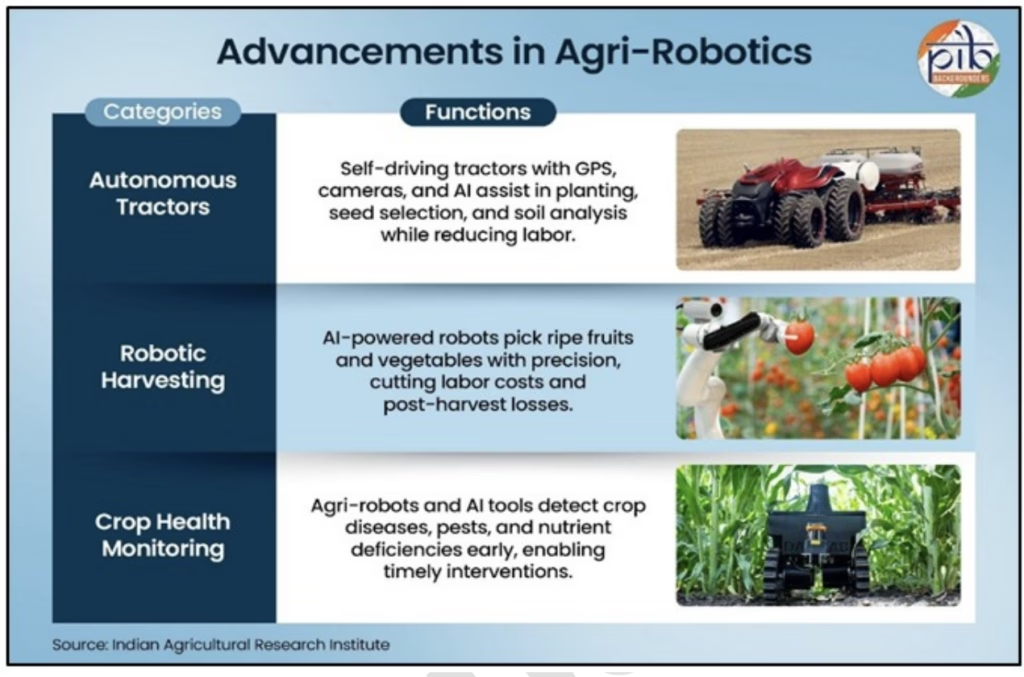
    • Agricultural robots can help in sowing, spraying, harvesting, weeding, soil monitoring and crop surveillance.
    • They can reduce labour shortage and improve efficiency in farming operations.
    • Precision farming using robotics can reduce the use of water, fertilisers and pesticides.
      • Drone-based spraying, automated harvesting, pest detection — addresses farm labour shortage
      • Drone spraying under PM Kisan Drone Yojana
  • Strengthens Space Exploration
    • Robotics is essential for space missions because many tasks are too risky or impossible for humans.
    • Rovers, robotic arms and autonomous systems are used for planetary exploration, satellite servicing and sample collection.
    • Robotics helps in expanding scientific knowledge of space.
      • Vyommitra (India) — Vyommitra is a human-like robot developed by ISRO to serve astronauts during manned space missions. 
        • During the mission, Vyommitra will operate control panels, monitor the cabin environment, and send real-time data to ISRO’s control centre 
      • The Chandrayaan-3 mission’s Pragyan rover solidified India’s capacity in autonomous robotic exploration by successfully traversing the unexplored lunar south polar region. 
      • Curiosity & Perseverance Rovers (Mars) — AI-enabled autonomous navigation, rock drilling, sample collection; Perseverance collected first Mars rock cores for future return mission 
  • Improves Public Service Delivery
    • Robots can be used in sanitation, waste management, sewer cleaning, crowd management and public safety.
    • For example, robotic machines can reduce manual scavenging and protect sanitation workers from unsafe conditions.
      • HomoSEP Atom is India’s septic tank and manhole cleaning robot
    • This makes governance more humane and technologically advanced.
  • Supports Elderly and Disabled Persons
    • Assistive robots can help elderly persons and persons with disabilities in mobility, communication, rehabilitation and daily activities.
    • This improves independence, dignity and quality of life.
      • ReWalk Exoskeleton — wearable robotic suit enabling paraplegic patients to stand, walk, and climb stairs 
      • Ekso Bionics — robotic exoskeleton for stroke and spinal cord injury rehabilitation 
      • Mitra Robot (Invento, India) — deployed in some Indian hospitals to assist non-verbal patients in communicating with doctors 
  • Important for Environmental Management
    • Robots can monitor pollution, clean water bodies, inspect pipelines, detect forest fires and assist in wildlife conservation.
    • They can collect data from difficult terrains and help in evidence-based environmental governance.

Challenges Associated with Robotics

  • Job Displacement
    • Excessive automation may replace low-skilled and repetitive jobs, especially in manufacturing and services.
    • This can increase unemployment if workers are not reskilled.
      • Foxconn had replaced 60,000 workers with robots in Chinese iPhone assembly lines 
  • High Initial Cost
    • Robotics requires high investment in machines, software, maintenance and skilled manpower.
    • Small and medium enterprises may find it difficult to adopt robotics.
  • Skill Gap
    • Robotics requires trained professionals in engineering, coding, AI, electronics and maintenance.
    • Lack of skilled workforce can slow down adoption.
  • Dependence on Imported Technology
    • Many advanced robotic components such as sensors, chips, actuators and precision hardware are imported.
    • This can create technological dependence.
  • Ethical and Legal Issues
    • Robotics raises concerns related to accountability, safety, privacy and misuse.
    • For example, autonomous weapons and surveillance robots can create ethical dilemmas.
  • Cybersecurity Risks
    • Connected robots can be hacked or misused.
    • This is especially risky in defence, healthcare, manufacturing and critical infrastructure.

Way Forward

  • Promote Indigenous Research and Development
    • Greater investment is needed in robotics research, AI, sensors, semiconductors and advanced manufacturing.
    • Collaboration among government, industry and academia should be strengthened.
  • Develop Skill Ecosystem
    • Robotics should be integrated with technical education, ITIs, engineering colleges and vocational training.
    • Workers must be reskilled to adapt to automation.
  • Support MSMEs
    • Affordable robotic solutions, subsidies, shared automation centres and technology support can help MSMEs adopt robotics.
  • Strengthen Regulation
    • Clear rules are needed for safety, liability, privacy, autonomous systems and ethical use of robotics.
  • Encourage Start-ups
    • Innovation hubs, incubation centres and funding support should be provided to robotics start-ups.
  • Focus on Socially Useful Robotics
    • Robotics should be promoted in sectors such as sanitation, healthcare, agriculture, disaster management and disability support.
    • This will ensure that technology serves human welfare.

Robotics is a transformative technology with the potential to improve productivity, safety, healthcare, agriculture, defence and governance. However, its adoption should not be seen only as automation, but as a tool for human welfare and sustainable development. A balanced approach involving innovation, regulation, skilling and ethical safeguards is necessary to ensure that robotics becomes inclusive, safe and socially beneficial.

Sample UPSC Mains Questions

  1. Robotics can enhance productivity, safety and public-service delivery, but may also intensify job displacement and ethical concerns. Discuss. (15 Marks, 250 Words)
  2. Examine the applications of robotics in healthcare, agriculture, defence, disaster management and space exploration. (15 Marks, 250 Words)

✍️ Curated by InclusiveIAS Editorial Team

At InclusiveIAS, our editorial team is led by experts who have successfully cleared multiple stages of the UPSC Civil Services Examination, including Mains and Interview. With deep insights into the demands of the exam, we focus on crafting content that is accurate, exam-relevant, and easy to grasp.

Whether it’s Polity, Current Affairs, GS papers, or Optional subjects, our notes are designed to:

  • Break down complex topics into simple, structured points

  • Align strictly with the UPSC syllabus and PYQ trends

  • Save your time by offering crisp yet comprehensive coverage

  • Help you score more with smart presentation, keywords, and examples

🟢 Every article, note, and test is not just written—but carefully edited to ensure it helps you study faster, revise better, and write answers like a topper.