The goals of the SCO are:
- to strengthen mutual trust, friendship and good-neighborliness between the Member States;
- to encourage the effective cooperation between the Member States in such spheres as politics, trade, economy, science and technology, culture, education, energy, transport, tourism, environmental protection, etc;
- to jointly ensure and maintain peace, security and stability in the region; and
- to promote a new democratic, fair and rational international political and economic international order.
Internally, the SCO adheres to the “Shanghai spirit”, namely, mutual trust, mutual benefit, equality, consultation, respect for diversity of civilizations and pursuit of common development; and externally, it upholds non-alignment, non-targeting at other countries or regions and the principle of openness.
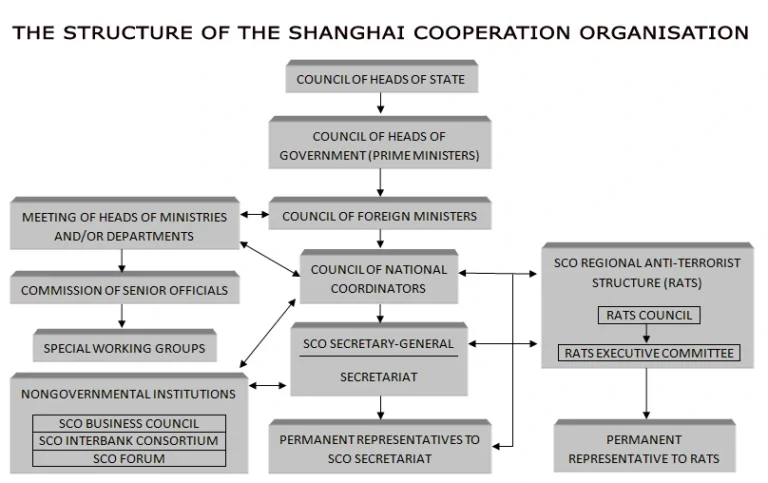
Council of Heads of States (CHS)
- The Heads of State Council (HSC) is the highest decision-making body in the SCO. It meets once every year to take decisions and give instructions on all important issues regarding SCO activity.
The Council of Heads of Government (Prime Ministers) (CHG)
- It meets once a year to discuss the strategy of multilateral cooperation and priority areas within the Organization, determine fundamental and topical issues in economic and other spheres, and approve the budget of the SCO.
The Council of Ministers of Foreign Affairs
- The Council of Ministers of Foreign Affairs considers issues related to day-to-today activities of the Organisation, preparation of meetings of the Heads of State Council and holding of consultations on international problems within the Organisation.
- The Council may, as appropriate, make statements on behalf of SCO.
Secretariat
- The Secretariat of the SCO is the primary executive body of the organization.
- It is a permanent organ of the SCO.
- It serves to implement organizational decisions and decrees, documents (such as declarations and agendas), functions as a document depository for the organization, arranges specific activities within the SCO framework, and promotes and disseminates information about the SCO.
- It is located in Beijing.
- Each Member State has a Permanent Representative to the SCO
Regional Anti-Terrorist Structure (RATS)
- It is headquartered in Tashkent, Uzbekistan
- It is a permanent organ of the SCO which serves to promote cooperation of member states against terrorism, separatism and extremism.
- Each member state also sends a permanent representative to RATS
The SCO Secretary General and the Director of the RATS Executive Committee are appointed by the CHS for a three-year term. |
SCO Business Council:
- The Business Council of the Shanghai Cooperation Organisation was founded on June 14, 2006 in Shanghai.
- It is a nongovernment entity that unites the highly authoritative business community representatives of the SCO member states with an eye towards expanding economic cooperation, establishing direct relations and a dialogue between the business and financial communities, and facilitating the practical promotion of multilateral projects.
- The SCO Business Council is an independent institution capable of taking advisory decisions and giving expert assessments regarding the involvement of members of the business communities of the SCO member states in trade, economic and investment interaction within the framework of the Organisation.
- Annual Session is the highest body of the Business Council that sets priorities and formulates the primary targets for its activity and decides on important issues concerning links with business associations from other states.
- The SCO Business Council’s Permanent Secretariat is headquartered in Moscow.
SCO Interbank Consortium:
- The SCO Interbank Consortium (SCO IBC) was established by the Council of Heads of Government on 26 October 2005 to provide funding and bank services for investment projects sponsored by the governments of the SCO member states.
- The SCO IBC Council meets ad hoc upon the consensus of all of the parties at least once per year.
- The Presidency of the Council is carried out on a rotational basis.
- The members of the SCO IBC are
- The Development Bank of Kazakhstan
- The State Development Bank of China
- The Settlement & Savings Company of the Kyrgyz Republic “RSK Bank”
- The Bank for Development and Foreign Economic Affairs of the Russian Federation “Vnesheconombank”
- The State Savings Bank of the Republic of Tajikistan “Amonatbonk”
- The National Bank for Foreign Economic Activity of the Republic of Uzbekistan
The Council of National Coordinators
- It is the SCO coordination mechanism.
- Key body coordinating and managing the SCO’s current activities.
- Conducts the necessary preparations for the meetings of the Council of Heads of State, the Council of Heads of Government, and the Council of Foreign Ministers
FAQs
1. What is the Shanghai Cooperation Organisation (SCO)?
The SCO is a Eurasian political, economic, and security alliance founded in 2001. It is the successor of the Shanghai Five and aims to foster regional cooperation and combat threats like terrorism.
2. Where is the SCO Secretariat located?
The SCO Secretariat is headquartered in Beijing, China. It functions as the executive body of the organization.
3. Who are the permanent members of the SCO?
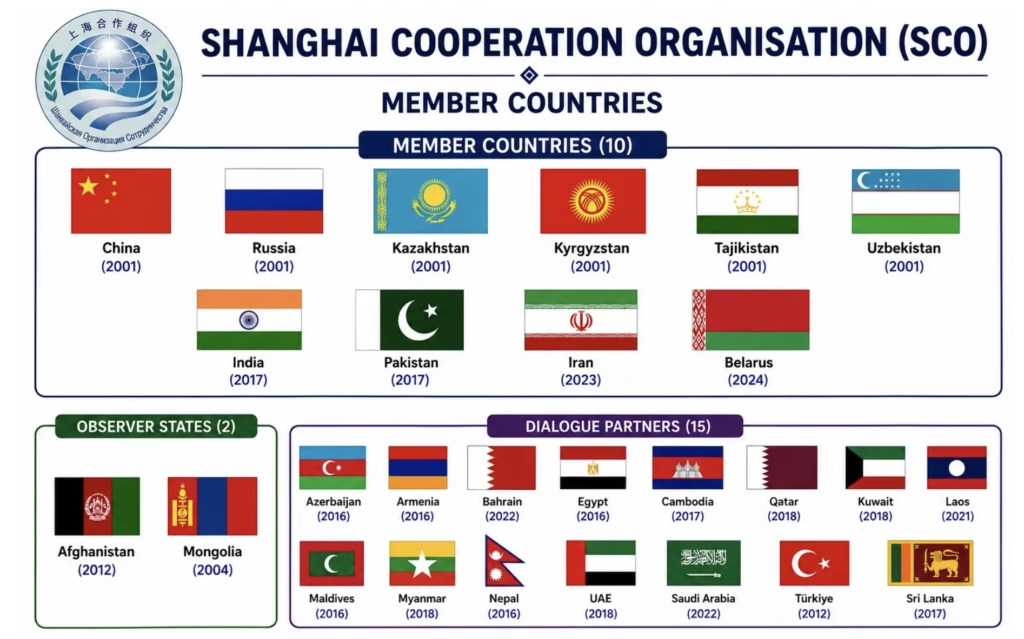
As of 2024, SCO has 10 member countries: China, Russia, Kazakhstan, Kyrgyzstan, Tajikistan, Uzbekistan, India, Pakistan, Iran, and Belarus.
4. What are the official languages of the SCO?
The official languages of the SCO are Russian and Chinese.
At InclusiveIAS, our editorial team is led by experts who have successfully cleared multiple stages of the UPSC Civil Services Examination, including Mains and Interview. With deep insights into the demands of the exam, we focus on crafting content that is accurate, exam-relevant, and easy to grasp.
Whether it’s Polity, Current Affairs, GS papers, or Optional subjects, our notes are designed to:
Break down complex topics into simple, structured points
Align strictly with the UPSC syllabus and PYQ trends
Save your time by offering crisp yet comprehensive coverage
Help you score more with smart presentation, keywords, and examples
🟢 Every article, note, and test is not just written—but carefully edited to ensure it helps you study faster, revise better, and write answers like a topper.