Types of Goods : Intermediate Goods, Final Goods, Consumption Goods and Capital Goods

  • Home
  • Types of Goods : Intermediate Goods, Final Goods, Consumption Goods and Capital Goods
Shape Image One

Type of Goods

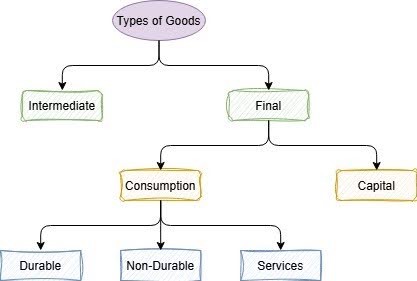
Goods are products or resources that satisfy human wants and provide utility. In economics, goods are classified based on their role in production and consumption. Understanding different types of goods helps explain production processes, investment, national income, and macroeconomic activity.
1. Intermediate Goods

Intermediate goods are goods that have undergone some production process but are not ready for final use. They are used as inputs for producing other goods and services and generally undergo further transformation.

Features

  • Used in further production
  • Not directly consumed by final consumers
  • Become part of another product or production process

Examples

  • Steel sheets used in automobile manufacturing
  • Cotton used in textile production
  • Flour used in bakery production
  • Timber used in furniture manufacturing

2. Final Goods

Final goods are goods that have completed all stages of production and do not undergo further economic transformation.Once sold, they move out of the production process and are either consumed by individuals or used as investment goods.

Final goods can be classified into:

  • Consumption Goods
  • Capital Goods

Why are they called Final Goods?

  • Final goods are called final because after they are purchased, they move out of the production process and do not undergo any further economic transformation by producers. Their journey in the market ends with the ultimate user.
  • However, a final good may still be physically transformed by the consumer during use. For example, tea leaves bought by a household are used to prepare tea before consumption, and vegetables purchased from the market are cooked before being eaten. Such transformations do not count as economic production because the resulting products are not created for sale in the market.
  • The same good can lose its status as a final good if it is used for commercial production. For instance, tea leaves used by a household for preparing tea remain a final good, but tea leaves purchased by a restaurant become an intermediate good because they are used as inputs in producing tea that will be sold to customers.
  • Therefore, whether a good is final or intermediate depends not on the physical nature of the good itself, but on the purpose and economic use of that good.
  • Example:
    • Tea leaves purchased by a household β†’ Final Good
    • Tea leaves purchased by a restaurant β†’ Intermediate Good

A.Consumption Goods

Consumption goods are goods and services used by ultimate consumers to satisfy their wants directly.

They can be classified into three categories:

(i) Durable Consumption Goods

  • These are consumption goods that do not get exhausted immediately and can be used repeatedly over a relatively long period.
  • Generally, their useful life extends over several years.
  • Life of consumer durables is generally more than 3 years.
  • Examples:
    • Refrigerator
    • Television
    • Furniture
    • Air conditioner

(ii) Non-Durable Consumption Goods

  • These goods are consumed quickly or have a relatively short lifespan.
  • Life of non-consumer durables is generally less than 3 years.
  • Examples:
    • Food items
    • Petrol
    • Soap
    • Cosmetics
    • Clothing

(iii) Services

  • Services are intangible products consumed at the time they are provided. Unlike physical goods, services cannot be stored or physically possessed.
  • Examples:
    • Education services
    • Healthcare services
    • Banking services
    • Telecommunication services

B.Capital Goods

  • Capital goods are durable produced assets that help in producing other goods and services.
  • A good is considered a capital good only if it satisfies the following conditions:
    • Produced by human effort:The asset should be produced through a production process.
    • Used as an input in further production:It should assist in producing other goods and services.
    • Not consumed immediately:While acting as an input, it does not get transformed or consumed
  • Examples
    • Tractor
    • Industrial machines
    • Factory equipment
    • Power generators

Tractor (Capital Good)

A tractor qualifies as a capital good because:

  • It is produced in a factory
  • It helps in agricultural production
  • It continues functioning over several years without being consumed during production

Important Note: Capital Goods vs Consumer Durables

  • Consumer durables such as televisions, refrigerators, and cars may resemble capital goods because they last for many years.
  • However, they are not capital goods because they are purchased for final consumption, not for further production.

Intermediate Good or a Final Good

  • The same good may be classified as either an intermediate good or a final good depending on its use. The key criterion for distinguishing between them is the last transaction in the market.
  • If a good is purchased for further production or resale, it is treated as an intermediate good. If the good reaches its ultimate user and no further economic value addition takes place, it is considered a final good.Β 
  • Thus, the classification depends not on the physical nature of the product, but on its economic use and the point at which the last market transaction occurs.

Examples:

Sugar

  • Sugar purchased by a bakery β†’ Intermediate Good
    (The last market transaction is the sale of cakes, pastries, or other products made using sugar. Sugar itself is used as an input for further production.)
  • Sugar purchased by a household β†’ Final Good
    (The last market transaction is the purchase of sugar by the household itself because no further economic production or value addition takes place.)

Tea Leaves

  • Tea leaves purchased by a restaurant β†’ Intermediate Good
    (The last market transaction is the sale of tea to customers. Tea leaves are used as inputs in further production.)
  • Tea leaves purchased by a household β†’ Final Good
    (The last market transaction is the purchase of tea leaves by the household itself because no further economic value addition takes place.)

Quick Revision Table

Basis

Capital Goods

Consumer Durables

Purpose

Production of other goods

Final consumption

Used by

Firms and producers

Households

Examples

Machines, tractors

TV, refrigerator

Goods form the foundation of economic activity because they satisfy human wants and contribute to the processes of production and consumption. Based on their role and economic use, goods can be classified into intermediate goods, final goods, consumption goods, and capital goods. This classification is important for understanding concepts such as production, investment, GDP measurement, and national income accounting. It is also essential to remember that the same good can be classified differently depending upon its economic use and the point at which the last market transaction takes place. The distinction between intermediate and final goods is particularly important because only final goods are included in GDP calculations to avoid double counting.

FAQs

1. What are goods in economics?

Goods are products or resources that satisfy human wants and provide utility to consumers.

2. What are intermediate goods?

Intermediate goods are goods used as inputs in the production of other goods and services and generally undergo further transformation.

Examples:

  • Steel used in automobile manufacturing
  • Cotton used in textile production

3. What are final goods?

Final goods are goods that have completed the production process and are purchased for final consumption or investment purposes.

Examples:

  • Refrigerator purchased by a household
  • Tractor used for agricultural production

✍️ Curated by InclusiveIAS Editorial Team

At InclusiveIAS, our editorial team is led by experts who have successfully cleared multiple stages of the UPSC Civil Services Examination, including Mains and Interview. With deep insights into the demands of the exam, we focus on crafting content that is accurate, exam-relevant, and easy to grasp.

Whether it’s Polity, Current Affairs, GS papers, or Optional subjects, our notes are designed to:

  • Break down complex topics into simple, structured points

  • Align strictly with the UPSC syllabus and PYQ trends

  • Save your time by offering crisp yet comprehensive coverage

  • Help you score more with smart presentation, keywords, and examples

🟒 Every article, note, and test is not just writtenβ€”but carefully edited to ensure it helps you study faster, revise better, and write answers like a topper.