Minimum Support Price (MSP): Meaning, Objectives, Significance and Challenges | UPSC Economy Notes

  • Home
  • Minimum Support Price (MSP): Meaning, Objectives, Significance and Challenges | UPSC Economy Notes
Shape Image One

Minimum Support Price (MSP)

Minimum Support Price is the price announced by the Government of India to protect farmers against a sharp fall in market prices. It acts as a price assurance mechanism under which the government declares a minimum price for selected agricultural crops before the sowing season. 
Institutional Mechanism

  • The Commission for Agricultural Costs and Prices (CACP) recommends MSP for major agricultural commodities. 
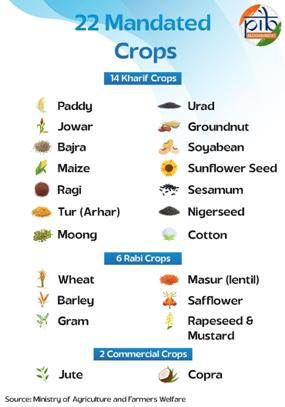
    • Annually, the Government announces Minimum Support Prices (MSPs) for 22 mandated agricultural crops based on the recommendations of the Commission for Agricultural Costs & Prices (CACP), after considering the views of the concerned State Governments and Central Ministries/Departments. In addition, MSP for Toria and de-husked coconut is also fixed on the basis of MSPs of rapeseed & mustard, and copra, respectively. 
  • The final decision on MSP is taken by the Government of India through the Cabinet Committee on Economic Affairs.
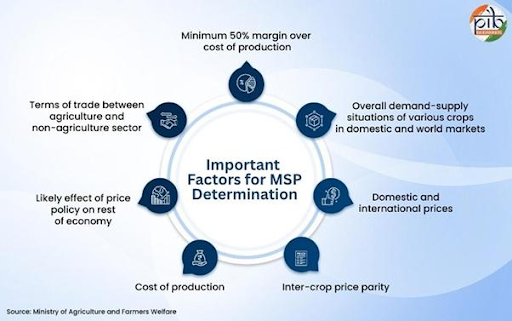
  • While recommending MSP, CACP considers important factors, i.e., cost of production, overall demand-supply situations of various crops in domestic and world markets, domestic and international prices, inter-crop price parity, terms of trade between agriculture and non-agriculture sector, likely effect of price policy on rest of economy and a minimum of 50 per cent as the margin over the cost of production.
  • Further, the production cost computed by CACP includes all paid out costs such as those incurred on account of hired human labour, bullock labour/machine labour, rent paid for leased land, expenses incurred on use of material inputs like seeds, fertilizers, manures, irrigation charges, depreciation on implements and farm buildings, interest on working capital, diesel/electricity for operation of pump sets etc, miscellaneous expenses and imputed value of family labour. The cost formula used for calculating MSP is uniform for all 22 mandated crops and states. Notably, this calculation includes considerations such as family labour, acknowledging the collective efforts of entire farming households rather than solely focusing on individual farmers.
  • Since 2018-19, the Government has been increasing MSPs for all mandated crops in line with the Union Budget 2018-19 announcement for setting up MSP at least 1.5 times the cost of production. This ensures a minimum return of 50% over the all-India weighted average cost of production for all crops. 

Objectives of MSP

  • Price Assurance to Farmers
    • MSP protects farmers from distress sale when market prices fall sharply after harvest.
  • Income Support
    • It provides a minimum assured return to farmers and helps stabilise farm income.
  • Food Security
    • MSP-backed procurement of rice and wheat supports the Public Distribution System and food security programmes.
  • Incentive for Production
    • MSP encourages farmers to produce essential food grains, pulses, oilseeds and commercial crops.
  • Market Intervention
    • It acts as a policy tool to correct market failure when private traders offer low prices.
  • Strategic Buffer Stock
    • Procurement at MSP helps the government maintain food stocks for welfare schemes and emergencies.

Significance of MSP

  • Income Security for Farmers
    • Price Assurance: MSPs provide farmers with a guaranteed price for their produce, protecting them from sharp price fluctuations and market volatility. This assurance helps stabilize their income and encourages continued agricultural production.
    • Reduction in Distress Sales: By ensuring a minimum price, MSPs help prevent farmers from selling their produce at very low prices during periods of glut or when they lack immediate cash.
  • Promotion of Agricultural Production
    • Encouragement to Grow Specific Crops: MSPs incentivize the cultivation of certain crops by ensuring a minimum return. This helps the government manage the supply of essential food grains and maintain food security.
    • Crop Diversification: By setting MSPs for a variety of crops, the government can encourage farmers to diversify their cropping patterns, promoting better soil health and reducing the risk of pest attacks and crop failures.
  • Food Security
    • Buffer Stock Management: MSPs enable the government to procure food grains for buffer stocks, which are essential for maintaining food security, especially during times of crisis like droughts, floods, or other emergencies.
    • Public Distribution System (PDS): The food grains procured at MSPs are used to supply the PDS, ensuring that subsidized food is available to economically disadvantaged sections of society.
  • Rural Development and Poverty Alleviation
    • Economic Stability: By providing a stable income to farmers, MSPs contribute to the overall economic stability and development of rural areas, reducing poverty and supporting rural livelihoods.
    • Employment Generation: Stable and assured incomes from agriculture can lead to higher rural employment, both directly on farms and indirectly through related sectors such as transportation, storage, and marketing.
  • Reduction of Exploitation by Middlemen
    • Direct Purchases by Government: MSPs reduce farmers’ dependence on middlemen, who often exploit them by offering lower prices for their produce. Government procurement agencies purchasing directly from farmers at MSPs help mitigate this issue.
      • Cereals and coarse cereals are procured by the Food Corporation of India (FCI) and designated State Agencies. 
  • Market and Price Stabilization
    • Price Benchmarking: MSPs act as a benchmark for market prices, preventing prices from falling below a certain level. This helps stabilize market prices and protects both producers and consumers from extreme price fluctuations.
  • Promotion of Sustainable Farming Practices
    • Incentivizing Environmentally Friendly Crops:
      • By offering MSPs for a variety of crops, including pulses and oilseeds, the government can promote sustainable farming practices, reduce dependency on water-intensive crops like rice, and encourage crop rotation.

Challenges

  • Procurement and Infrastructure Issues
    • Limited Procurement Coverage: The government procurement infrastructure is not uniformly distributed across the country. Regions with inadequate procurement centers often see farmers unable to sell their produce at MSP, limiting the policy’s reach.
    • Storage and Transportation: Insufficient storage facilities and poor transportation infrastructure leads to post-harvest losses. 
  • Financial Burden
    • Fiscal Strain:The cost of procuring crops at MSP and maintaining buffer stocks is a significant financial burden on the government. This can divert resources from other critical areas like healthcare, education, and infrastructure development.The subsidies provided through MSP can strain the national budget, especially if the program is not efficiently managed. Over time, this can lead to increased fiscal deficits and economic instability.
  • Market Distortion
    • Overproduction of Certain Crops: MSPs lead to the overproduction of certain crops, such as wheat and rice, due to the assured prices. This can result in imbalances in the agricultural sector, with some crops being overproduced and others being underproduced.
  • Environmental Impact:
    • The focus on MSP-supported crops encourages monocropping, which depletes soil nutrients and reduces biodiversity. Over-reliance on water-intensive crops like rice can exacerbate water scarcity issues.
  • Equity and Reach
    • Benefits Skewed Towards Larger Farmers: Larger farmers, who have more marketable surplus, tend to benefit more from MSP than small and marginal farmers. Smallholders often lack access to procurement centers or the means to transport their produce, limiting their ability to benefit from MSP.
  • Regional Disparities:
    • MSP benefits are more accessible in states with better procurement infrastructure, such as Punjab and Haryana, while farmers in states like Bihar and Odisha receive fewer benefits due to inadequate procurement facilities.
  • Implementation and Monitoring
    • Inefficient Implementation: The effective implementation of MSP requires robust administrative machinery, which is often lacking. This results in delays in payments to farmers and reduced effectiveness of the MSP program.
    • Corruption and Mismanagement: Corruption and inefficiencies in the procurement process leads to farmers not receiving the full benefits of MSP.
  • Lack of Awareness
    • Farmer Awareness: Many farmers, especially small and marginal ones, are not fully aware of MSPs or the procurement process. This lack of awareness limits their ability to benefit from the scheme.
  • Market Access:
    • Farmers in remote and inaccessible areas often struggle to reach procurement centers, reducing their ability to sell at MSP and benefit from the policy.

Way Forward

  • Expand Procurement Network: 
    • Establish more procurement centers in regions currently underserved, especially in states like Bihar, Odisha, and others where the reach of MSP is limited.
  • Enhance Storage Facilities: 
    • Invest in modern storage facilities, including cold storage, to reduce post-harvest losses and ensure that procured produce is preserved effectively.
  • Decentralised Procurement
    • States should be encouraged to procure locally relevant crops based on agro-climatic conditions.
  • Price Deficiency Payment
    • If market price falls below MSP, the government can pay the difference directly to farmers instead of physically procuring the crop.This reduces storage burden.
  • Improve Transportation: 
    • Develop better transportation networks to facilitate the efficient movement of agricultural produce from farms to procurement centers and storage facilities.
  • Diversify Funding Sources:
    • Explore alternative funding sources, such as public-private partnerships, to reduce the fiscal burden on the government.
  • Encourage Crop Diversification:
    • Set MSPs for a broader range of crops, including millets, and implement MSPs for all the crops covered to encourage farmers to diversify their cropping patterns and reduce dependency on water-intensive crops like rice.
  • Promote Sustainable Practices:
    • Link MSPs with the adoption of sustainable farming practices, such as organic farming, conservation tillage, and efficient water use, to mitigate environmental impacts.
  • Targeted Support for Small Farmers:
    • Develop specific schemes to ensure that small and marginal farmers can access MSP benefits. This can include mobile procurement units and decentralized procurement centers in remote areas.
  • Farmer Cooperatives:
    • Encourage the formation of farmer cooperatives and producer organizations to strengthen farmers’ bargaining power and ensure they receive fair prices for their produce.
  • Transparent Processes:
    • Implement transparent and digitized procurement processes to reduce corruption and inefficiencies. Use technology like blockchain for tracking transactions and payments.
  • Timely Payments:
    • Ensure that payments to farmers are made promptly, reducing delays and financial stress for farmers.
  • Regular Audits:
    • Conduct regular audits of the procurement process to identify and address issues promptly.
  • Awareness Campaigns:
    • Conduct awareness campaigns to educate farmers about MSPs, the procurement process, and their rights. Use local languages and multiple media channels to reach a broader audience.
  • Training and Capacity Building:
    • Provide training programs for farmers on the benefits of MSP and how to access it, including the necessary documentation and procedures.
  • Market Linkages:
    • Develop better market linkages to ensure that farmers can access not only government procurement centers but also private buyers and markets.
    • Platforms like e-NAM can help farmers discover better prices beyond local mandis. 
  • E-Marketing Platforms:
    • Promote e-marketing platforms that allow farmers to sell their produce online, providing them with a wider market and potentially better prices.
  • Review MSP Calculation:
    • Regularly review and update the methodology for calculating MSP to ensure it reflects the current cost of production and market conditions.
  • Policy Consistency:
    • Ensure consistency and predictability in MSP policy to reduce uncertainty and allow farmers to plan their cropping patterns effectively.

MSP remains an important safety net for Indian farmers, but its future lies in reform rather than mere expansion. A balanced approach must combine price assurance with crop diversification, market reforms, sustainable agriculture, decentralised procurement and direct income support to make Indian agriculture both remunerative and resilient.

Sample UPSC Mains Questions

Question 1

Minimum Support Price has played an important role in protecting farmers from price volatility, but its benefits remain uneven across crops and regions. Discuss.

Question 2

Examine the role of Minimum Support Price in ensuring food security in India. What are the challenges associated with MSP-based procurement?

Question 3

MSP is an important safety net for farmers, but it has also contributed to crop concentration and environmental stress. Critically analyse.

✍️ Curated by InclusiveIAS Editorial Team

At InclusiveIAS, our editorial team is led by experts who have successfully cleared multiple stages of the UPSC Civil Services Examination, including Mains and Interview. With deep insights into the demands of the exam, we focus on crafting content that is accurate, exam-relevant, and easy to grasp.

Whether it’s Polity, Current Affairs, GS papers, or Optional subjects, our notes are designed to:

  • Break down complex topics into simple, structured points

  • Align strictly with the UPSC syllabus and PYQ trends

  • Save your time by offering crisp yet comprehensive coverage

  • Help you score more with smart presentation, keywords, and examples

🟢 Every article, note, and test is not just written—but carefully edited to ensure it helps you study faster, revise better, and write answers like a topper.