Indian Banking and Financial Architecture
The Indian banking and financial architecture is the backbone of the country’s economic development and financial inclusion. It comprises a wide spectrum of institutions ranging from commercial banks and cooperative banks to non-banking financial companies (NBFCs), each with distinct roles, regulations, and reach. Understanding the structure, types, and functioning of these institutions is essential for comprehending the delivery of credit, mobilization of savings, and policy implementation in India’s financial system.
Indian Financial System Overview
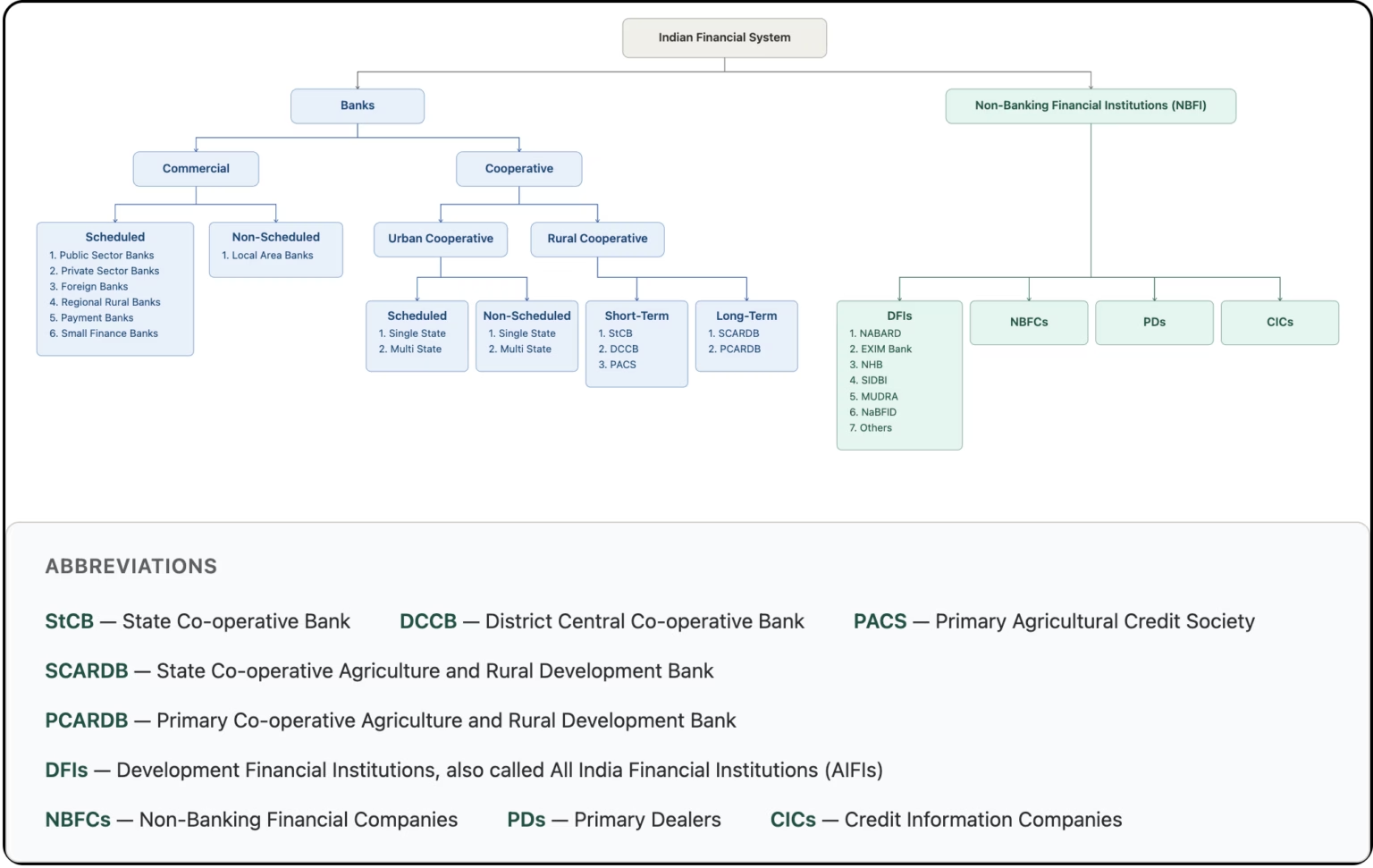
Financial institutions are broadly divided into two categories:
- Banks
- Non-Banking Financial Institutions (NBFIs)
Key Differences between Banks and Non-Banking Financial Institutions (NBFIs):
- Banks accept demand deposits (savings/current accounts), allowing depositors to withdraw money on demand and issue cheques.
- NBFIs do not accept demand deposits and cannot issue cheques drawn on themselves.
- Examples of NBFIs: NBFCs, Development Financial Institutions etc.
Types of Banks
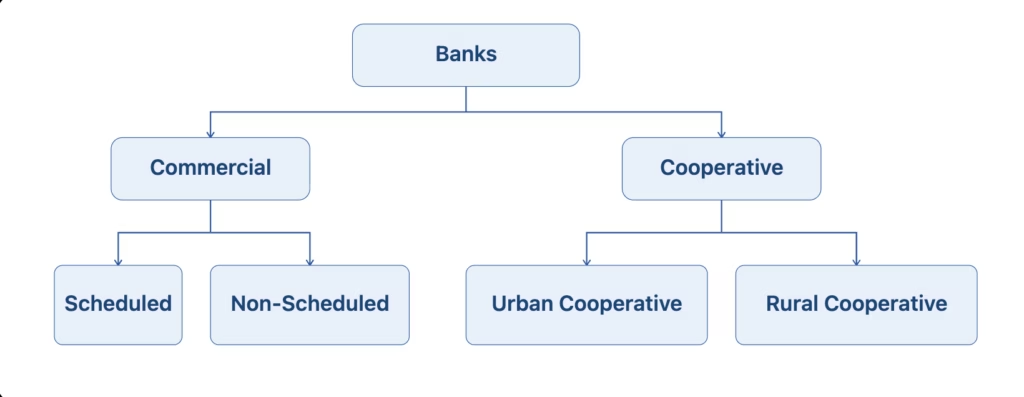
Banks are classified into:
- Commercial Banks
- Operate on commercial principles (profit motive).
- Provide banking services to individuals, businesses, and government.
- It takes demand deposits- current account and savings account- from people.
- Cooperative Banks
- Operate on cooperative principles, emphasizing service to members and society.
- They are owned by their customers and follow the cooperative principle of one person one vote.
- Cooperative banks also take demand deposits from people
- Generally offer higher interest rates on deposits compared to commercial banks.
Commercial Banks
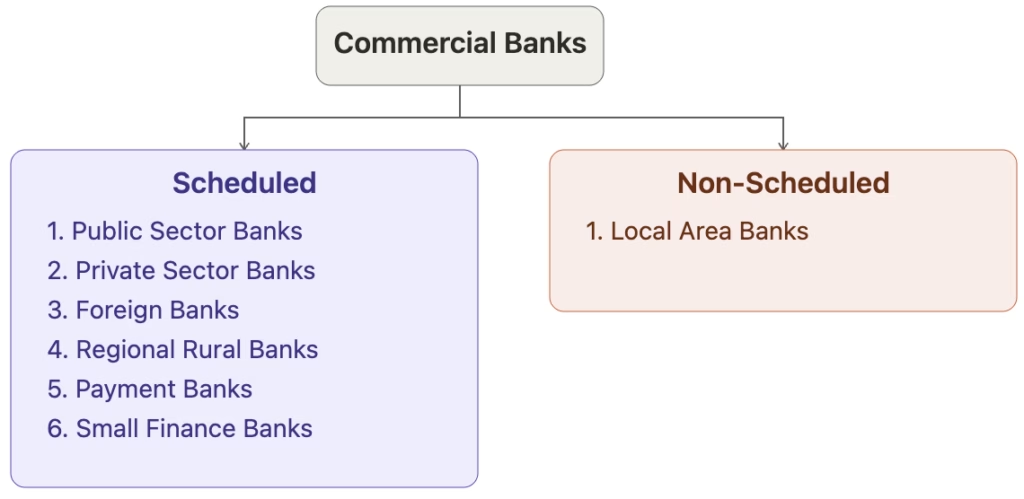
Commercial Banks are of two main types:
1.Scheduled Commercial Banks(SCBs)
- Scheduled commercial banks are those banks included in the Second Schedule of the Reserve Bank of India Act, 1934.
- They are regulated by the Banking Regulation Act, 1949
- Conditions for Scheduled Status:
- To be included in the Second Schedule of the RBI Act, a bank must satisfy the following conditions:
- Minimum Capital: They must maintain paid-up capital and reserves aggregating at least ₹5 lakh.
- Sound Management: They must satisfy the Reserve Bank of India that their affairs are not conducted in a manner detrimental to the interests of depositors.
- Benefits of Scheduled Status:
- Every Scheduled Commercial Bank enjoys two types of principal facilities: –
- It becomes eligible for debts/loans at the bank rate from the RBI
- It automatically acquires the membership of clearing house.
- Types of Scheduled Commercial Banks: Scheduled Commercial banks includes Public Sector Banks, Private Sector Banks, Foreign Banks, Regional Rural Banks, Small Finance Banks and Payment Banks.
2.Non-Scheduled Commercial Banks
- Non-Scheduled Commercial Banks are not listed in the second schedule of the RBI Act.
- They can only conduct limited banking operations.
- They cannot deal in foreign exchange.
- They must maintain reserve requirements (as per the Banking Regulation Act, 1949), but reserves may not necessarily be with RBI.
Co-operative Banks
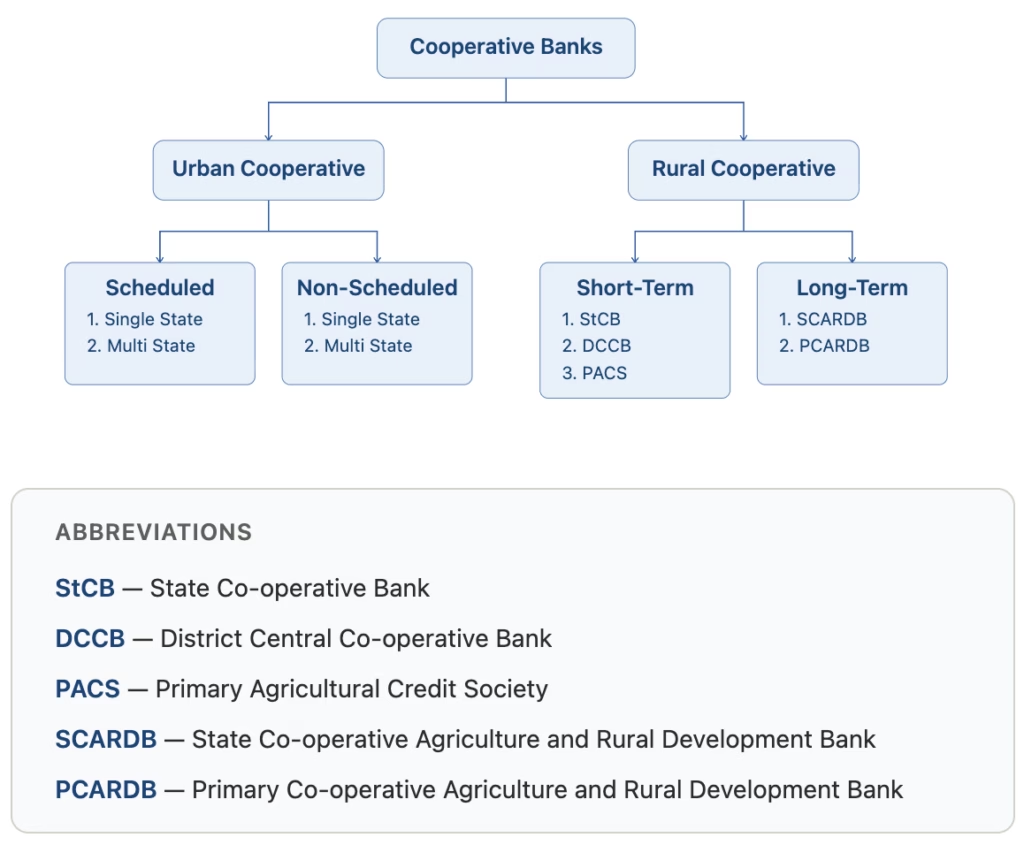
The co-operative banking sector is divided into Urban Co-operative Banks (UCBs) and Rural Co-operative Banks.
1.Urban Co-operative Banks (UCBs)
- The term Urban Co-operative Banks (UCBs), though not formally defined, refers to primary cooperative banks located in urban and semi-urban areas. These banks, till 1996, were allowed to lend money only for non-agricultural purposes. This distinction does not hold today. These banks were traditionally centred around communities, localities work place groups. They essentially lent to small borrowers and businesses. Today, their scope of operations has widened considerably.
- Classification:
- UCBs are again classified into Scheduled and Non-scheduled categories, which are then further classified into single state and multi state.
- Single-State UCBs: Registered under the State Government Cooperative Societies Act and regulated by the State Registrar of Cooperative Societies (RCS).
- Multi-State UCBs: Registered under the Multi-State Cooperative Societies Act, 2002 and regulated by the Central Registrar of Cooperative Societies (CRCS).
2.Rural Co-operative Banks
- Mandate: Primarily serve agricultural credit needs.
- Structure:
- It consists of both short-term and long-term cooperative credit structures.
- Short-Term Credit Structure (Three-tier):
- State Cooperative Banks (StCBs) – State level
- District Central Cooperative Banks (DCCBs) – District level
- Primary Agricultural Credit Societies (PACS) – Village level grassroots units that directly lend to rural borrowers and collect repayments.
- Long-Term Credit Institutions:
- State Cooperative Agriculture and Rural Development Banks (SCARDBs)
- Primary Cooperative Agriculture and Rural Development Banks (PCARDBs)
Public Sector Banks
- Public Sector Banks (PSBs) are banks owned by the Central or State governments having more than 51% ownership with the government.
- PSBs means banks constituted under the State Bank of India Act, 1955 and Banking Companies (Acquisition and Transfer of Undertakings) Act, 1970/Banking Companies (Acquisition and Transfer of Undertakings) Act, 1980.
- Examples: SBI, PNB, Canara Bank etc.
Foreign Bank
- It refers to banks established in India but owned by foreign entity/entities.
- It is a bank that has its headquarters outside India but runs its offices as a private entity at any other locations in India.
- These banks are under an obligation to operate under the regulations provided by RBI as well as the rule prescribed by the parent organization located outside India.
- Example: Citibank, Standard Chartered Bank etc
Private Sector Banks
- Private Sector Banks are banks owned by private individuals.
- These are banking companies licensed to operate under Banking Regulation Act, 1949.
- Example:HDFC bank, ICICI bank, Axis Bank etc.
Regional Rural Banks
- Regional Rural Banks (RRBs) are the banks established under the Regional Rural Banks Act, 1976 with the aim of ensuring sufficient institutional credit for agriculture and other rural sectors.
- The area of operation of RRBs is limited to the area notified by the Central Government.
- RRBs are owned jointly by the Government of India, the State Government and Sponsor Banks in proportion of 50:15:35.
- RRBs are under the supervision of NABARD.
Small Finance Banks (SFBs)
- Small Finance Banks are licensed under Banking Regulation Act, 1949 and created with an objective of furthering financial inclusion by primarily undertaking basic banking activities to un-served and underserved sections including small business units, small and marginal farmers, micro and small enterprises and other underserved sections.
Payment Banks
- Payment Banks are public limited companies licensed under Banking Regulation Act, 1949, with specific licensing conditions restricting its activities mainly to acceptance of demand deposits and provision of payments and remittance services.
Local Area Banks (LABs)
- Local Area Banks (LABs) are small private banks designed as low-cost institutions to serve rural and semi-urban areas efficiently.LABs were set up to enable the mobilization of rural savings by local institutions and, at the same time, to make them available for investments in the local areas.
- Origin and Purpose:
- Announced: Union Budget, August 1996
- The intention of the government was to set up new private local banks with jurisdiction over two or three contiguous districts.
- Objective:
- LABs were set up to enable the mobilization of rural savings by local institutions and, at the same time, to make them available for investments in the local areas.
- Legal Status:
- Each local Area bank is registered as a public limited company under the Companies Act, 1956.
- They are licensed under the Banking Regulation Act, 1949.
- Key Features:
- LABs were required to have a minimum capital of Rs. 5 crore.
- The promoters of the bank may comprise of private individuals, corporate entities, trusts and societies with a minimum capital contribution of Rs. 2 crore.
- LABs are required to observe the priority sector lending targets.
- The area of operation of LAB is limited to a maximum of three geographically contiguous districts and are allowed to open branches only in its area of operation.
- Conversion into Small Finance Banks:
- In 2014, RBI allowed LABs to convert into Small Finance Banks if they meet eligibility criteria.
Non-Banking Financial Institutions (NBFIs)
- All India Financial Institutions (AIFIs), Non-Banking Financial Companies (NBFCs), and Primary Dealers (PDs) together represent the three major components of India’s Non-Banking Financial Institutions (NBFIs) sector.These entities play a crucial role in credit delivery, investment, and market development and are regulated and supervised by the Reserve Bank of India to ensure financial stability and sound practices.
- Credit Information Companies (CIC) are also a category of Non-Banking Financial Institutions (NBFIs) regulated by RBI.
India’s financial architecture has evolved into a complex and inclusive system that serves diverse sectors, from rural agriculture to urban industry. With the RBI at its core, the system ensures stability, efficiency, and innovation. Cooperative banks and new-age institutions like Small Finance and Payment Banks play a crucial role in furthering financial inclusion, while NBFCs and LABs cater to niche credit needs. A sound understanding of this framework is indispensable for UPSC aspirants aiming to tackle questions on banking, economy, and governance.
Frequently Asked Questions (FAQ)
1. What is the key difference between banks and non-banking financial institutions (NBFIs)?
Banks accept demand deposits (like savings and current accounts) and allow withdrawals via cheques. NBFIs do not accept demand deposits and cannot issue cheques drawn on themselves.
2. What are Scheduled Commercial Banks (SCBs)?
Scheduled Commercial Banks are included in the Second Schedule of the RBI Act, 1934. They must maintain a minimum capital and reserves and meet RBI’s prudential norms. Examples include Public Sector Banks, Private Sector Banks, Foreign Banks, RRBs, Small Finance Banks, and Payment Banks.
3. What are Cooperative Banks?
Cooperative Banks operate on cooperative principles. They are owned by members and classified into Urban Cooperative Banks (UCBs) and Rural Cooperative Banks. They can also accept demand deposits like commercial banks.
✍️ Curated by InclusiveIAS Editorial Team
At InclusiveIAS, our editorial team is led by experts who have successfully cleared multiple stages of the UPSC Civil Services Examination, including Mains and Interview. With deep insights into the demands of the exam, we focus on crafting content that is accurate, exam-relevant, and easy to grasp.
Whether it’s Polity, Current Affairs, GS papers, or Optional subjects, our notes are designed to:
Break down complex topics into simple, structured points
Align strictly with the UPSC syllabus and PYQ trends
Save your time by offering crisp yet comprehensive coverage
Help you score more with smart presentation, keywords, and examples
🟢 Every article, note, and test is not just written—but carefully edited to ensure it helps you study faster, revise better, and write answers like a topper.