
Biomagnification vs Bioaccumulation – Meaning, Differences, Examples

  • Home
  • Biomagnification vs Bioaccumulation – Meaning, Differences, Examples
Shape Image One

Biomagnification vs Bioaccumulation

Bioaccumulation and biomagnification are two interrelated processes that explain how pollutants persist and intensify within ecosystems. Bioaccumulation refers to the gradual buildup of toxic substances, such as heavy metals or persistent organic pollutants (POPs), within the tissues of a single organism over time. Biomagnification, on the other hand, describes how these toxins become increasingly concentrated as they pass along the food chain, from prey to predator. Together, these processes highlight how pollutants that are non-biodegradable, lipophilic, and environmentally persistent pose long-term risks to ecosystems and human health.
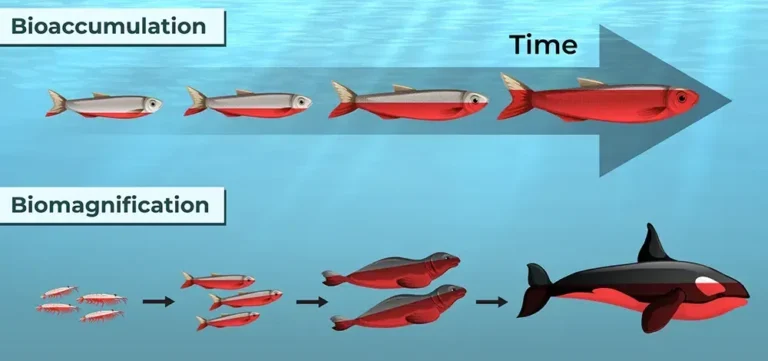
Bioaccumulation

  • The gradual build-up of toxic substances (pesticides, heavy metals) in the tissues of a single organism over its lifetime.
  • It occurs when an organism absorbs a substance faster than it can be lost or eliminated by catabolism and excretion.
  • Key Point: Happens within one organism.
  • Example: A fish continuously absorbs mercury from water → mercury accumulates in its body.

Features of Bioaccumulation

  • Occurs within a single organism
    • Toxic substances build up in one organism over its lifetime.
  • Rate of absorption > Rate of excretion
    • Pollutants accumulate because the body absorbs them faster than it can eliminate.
  • Metabolic/Excretion Rate
    • Species with slower metabolism or poor excretion (e.g., large, long-lived fish like trout) bioaccumulate more than small, short-lived species.
  • Fat-soluble & persistent pollutants
    • Substances like DDT, PCBs, and mercury are not easily broken down, so they keep storing in fatty tissues.
    • Fat-loving (lipophilic) substances accumulate in fatty tissues and sediments, prolonging retention. Example: organochlorine pesticides.
  • Longer lifespan = higher accumulation
    • Older organisms usually show greater accumulation since exposure continues over time.
  • Affects health of the individual
    • Can cause reduced growth, reproductive issues, organ damage, or even death in the organism.
  • Environmental Persistence
    • Chemicals that remain in the environment for long periods (persistent organic pollutants like DDT, PCBs) tend to bioaccumulate more. Quickly degradable substances do not.
  • Duration of Exposure
    • The longer an organism is exposed to a contaminant, the higher the buildup.
  • Biotransformation Ability
    • Organisms that can convert chemicals into water-soluble forms excrete them faster, reducing accumulation.
  • Species Variation
    • Different species show different patterns. For example, aquatic organisms often accumulate heavy metals more than terrestrial ones.

Biomagnification

  • The progressive increase in concentration of toxic substances at each successive trophic level in a food chain.
  • Key Point: Happens across the food chain (from prey → predator).
  • Example: Mercury enters plankton → small fish → big fish → humans → concentration keeps increasing.

Features of Biomagnification

  • Trophic Level Increase
    • Concentration of toxic substances increases as they move up the food chain (from producers → herbivores → carnivores → top predators).
  • Non-Biodegradable Pollutants
    • Substances that do not break down (like DDT, PCBs, mercury) are most prone to biomagnification.
  • Higher Concentration at Apex Predators
    • Organisms at the top of the food chain (e.g., tuna, eagles, humans) contain the maximum concentration.
  • Independent of Direct Exposure
    • Even if top predators are not directly exposed to pollutants, they accumulate them by consuming contaminated prey.

Both bioaccumulation and biomagnification underscore the dangers of persistent environmental contaminants. While bioaccumulation reveals the vulnerability of individual organisms to toxic buildup, biomagnification shows the cascading effects across trophic levels, eventually threatening top predators and humans. Combating these problems requires stricter regulation of hazardous chemicals, promotion of eco-friendly alternatives, and global cooperation through frameworks like the Stockholm Convention. Addressing these issues is vital for protecting biodiversity, ensuring food safety, and maintaining ecological balance.

FAQs

Q1. What is bioaccumulation?

Bioaccumulation is the process by which toxic substances, such as pesticides or heavy metals, gradually build up in the tissues of a single organism over time, often because the body cannot metabolize or excrete them efficiently.

Q2. What is biomagnification?

Biomagnification refers to the increasing concentration of toxic substances as they move up the food chain, where top predators accumulate the highest toxin levels.

Q3. How are bioaccumulation and biomagnification different?

Bioaccumulation occurs within an individual organism, while biomagnification occurs across trophic levels in a food chain. For example, mercury builds up in a single fish (bioaccumulation), and when larger fish or humans eat many such fish, the mercury concentration magnifies (biomagnification).

✍️ Curated by InclusiveIAS Editorial Team

At InclusiveIAS, our editorial team is led by experts who have successfully cleared multiple stages of the UPSC Civil Services Examination, including Mains and Interview. With deep insights into the demands of the exam, we focus on crafting content that is accurate, exam-relevant, and easy to grasp.

Whether it’s Polity, Current Affairs, GS papers, or Optional subjects, our notes are designed to:

  • Break down complex topics into simple, structured points

  • Align strictly with the UPSC syllabus and PYQ trends

  • Save your time by offering crisp yet comprehensive coverage

  • Help you score more with smart presentation, keywords, and examples

🟢 Every article, note, and test is not just written—but carefully edited to ensure it helps you study faster, revise better, and write answers like a topper.