The Election Commission of India (ECI) has initiated a Special Intensive Revision (SIR) of the Electoral Rolls in Bihar (2025) to ensure accuracy, inclusiveness, and integrity of the voter list. The last intensive revision in Bihar was conducted in 2003.
Electoral Rolls: An Electoral Roll (also known as a Voter List or Electoral Register) is the official list of all eligible and registered voters within a specific constituency. |
What is an ‘intensive’ revision, and how does it differ from other revisions?
- An intensive revision involves a full, fresh preparation of electoral rolls through house-to-house enumeration. Enumerators visit every household to record eligible electors as of a qualifying date, without reference to existing rolls.
- This is done when the ECI determines that the current rolls are outdated, inaccurate, or require complete rebuilding — typically before major elections or after administrative exercises such as delimitation of constituencies.
- This is routine annual updating, in which existing rolls are published as drafts, and citizens file claims for inclusion, deletion, or correction. There are no door-to-door visits.
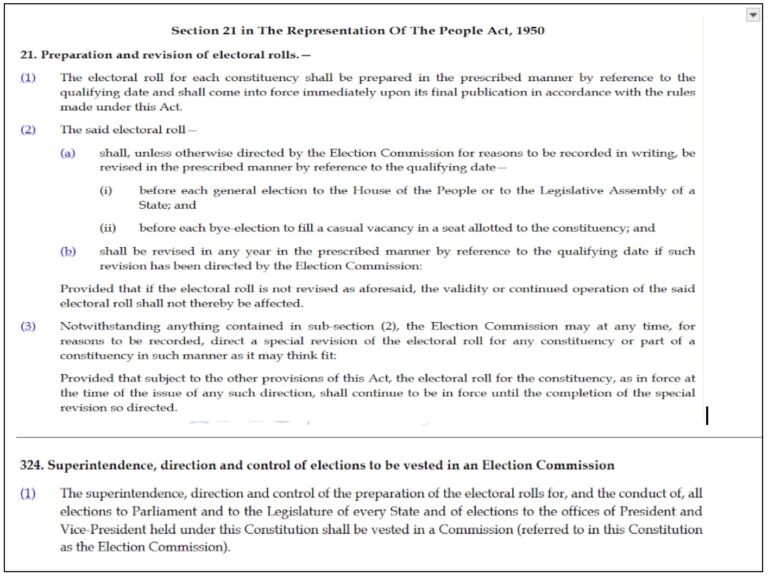
- A third type, “special” revision, is undertaken in exceptional cases such as missed areas, large-scale errors, or legal or political exigencies. The ECI may, under Section 21(3) of the Representation of the People Act, 1950, conduct a special revision using either summary or intensive methods, or a combination of both.
Each kind of revision has a specific purpose: intensive is for comprehensive overhaul; summary for routine maintenance; special for addressing specific deficiencies or extraordinary circumstances requiring tailored approaches.
But why is the ongoing exercise in Bihar called a special intensive revision?
- The nomenclature “Special Intensive Revision” (SIR) indicates that the ECI is exercising its discretionary powers under Section 21(3) of the 1950 law, which permits it to revise electoral rolls “in such manner as it thinks fit”.
- For this exercise, the ECI has adopted a hybrid approach — combining door-to-door field verification that is characteristic of an intensive revision with elements of a summary revision, such as the reliance on existing electoral rolls to distribute enumeration forms.
- What has set the ongoing SIR apart, however, is the introduction of a new step — the requirement of documentary proof at the enumeration stage itself. This is a striking departure from past practice.
- The “special” in this intensive revision in effect signals its methodological flexibility
Has the Election Commission of India (ECI) undertaken intensive revisions of electoral rolls in the past?
Intensive revisions of electoral rolls, in all or some parts of the country, have been undertaken earlier in 1952-56, 1957, 1961, 1965, 1966, 1983-84, 1987-89, 1992, 1993, 1995, 2002, 2003 and 2004. Each revision has reflected the ECI’s evolving priorities — from correcting early administrative flaws to addressing migration, delimitation, and concerns over the quality of the rolls.
Constitutional & Legal Basis of Special Intensive Revision
In exercise of its powers under Article 324 of the Constitution & Section 21 of the RP Act 1950, the Election Commission of India has directed the Special Intensive Revision (SIR) in the state of Bihar with 01.07.2025 as the qualifying date.
Objective of Special Intensive Revision (SIR)/Why?
Maintaining the integrity of the Electoral Roll (ER) is fundamental for the conduct of free & fair elections
- To ensure that the names of all eligible citizens are included in the Electoral Roll (ER) so as to enable them to exercise their franchise
- To ensure that no ineligible voter is included in the electoral rolls
- To introduce complete transparency in the process of addition or deletion of electors in the electoral rolls.
Reasons for Special Intensive Revision (SIR) of Electoral Rolls
- Rapid Urbanisation – shifting population in cities makes rolls outdated quickly.
- Frequent Migration – voters often change residence, leading to inaccurate rolls.
- Newly Eligible Voters – young citizens turning 18 need to be added.
- Non-reporting of Deaths – deceased persons’ names continue to appear.
- Inclusion of Foreign Illegal Immigrants – inflates rolls and affects integrity.
How? (Process of SIR)
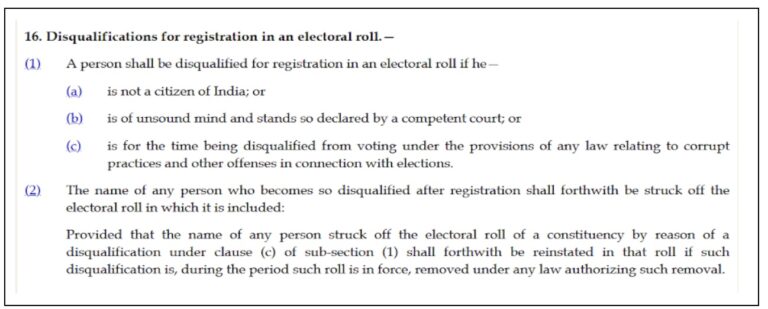
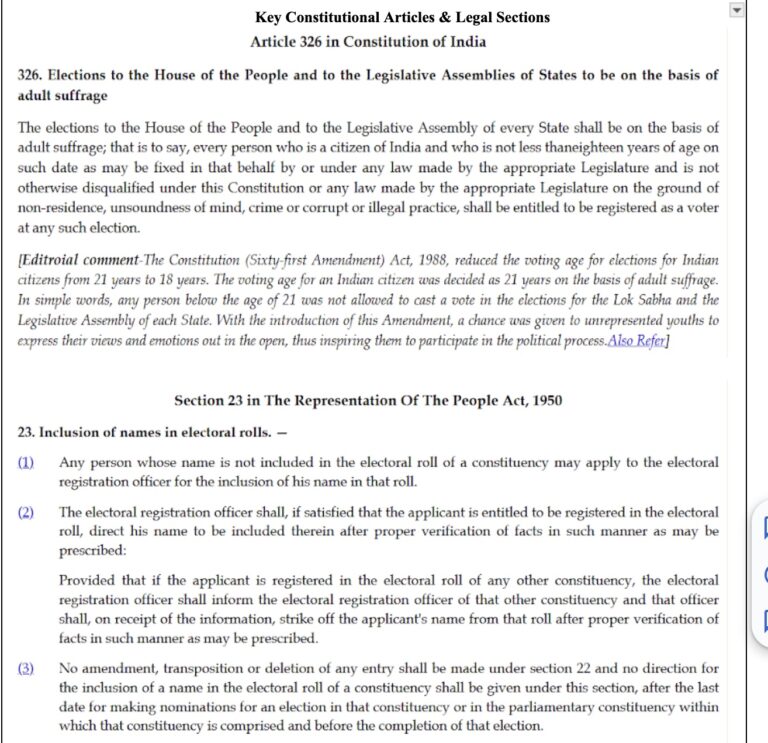
While conducting the special revision, the ECI shall be scrupulously adhering to the Constitutional and legal provisions regarding eligibility to be registered as a voter and disqualifications for registration in an electoral roll which are clearly laid down in Article 326 of the Constitution of India and Section 16 of the Representation of the People Act, 1950 respectively.
Process:
- Electoral registration officers(EROs) to print pre-filled Enumeration Form (EF) for all existing electors as on the date of the order and give it to BLOs
- Booth Level Officers (BLOs) to distribute EFs to all existing electors through House-to-House visit
- EF will be available on the ECI website/ECINET which can be downloaded by an elector whose name is in the electoral roll as on the date of the order
- Booth Level Agents(BLAs) appointed by all recognised National & State political parties to be associated in the entire process
- BLOs to guide the public on filling up of EF
- CEO (Chief Electoral Officer)/DEOs (District Election Officers)/EROs/BLOs would take care that genuine electors, particularly old, sick, Persons with Disabilities (PwD), poor and other vulnerable groups are not harassed and are facilitated to the extent possible, including through deployment of volunteers.
- BLOs to collect EFs from the public along with required documents
- Alternatively, existing elector can also upload the EF and documents online
- BLO Supervisor to check the BLO’s qualitative & quantitative output
- Draft Electoral Roll to be prepared of all electors whose EF have been received
- Copies of the Draft Electoral Roll to be shared with all recognised National & State political parties & also put on ECI/CEO website
- Claims & objections for any addition/deletion of names can be filed by any elector or by any political party
- AERO (Assistant Electoral Registration Officer) will inquire into any complaint on the exclusion of any eligible persons or inclusion of any ineligible persons
- After decision on claims & objections, the Final Electoral Roll will be published by the ERO
- Copies of the Final Electoral Roll to be shared with all recognised National & State political parties & also put on ECI/CEO website
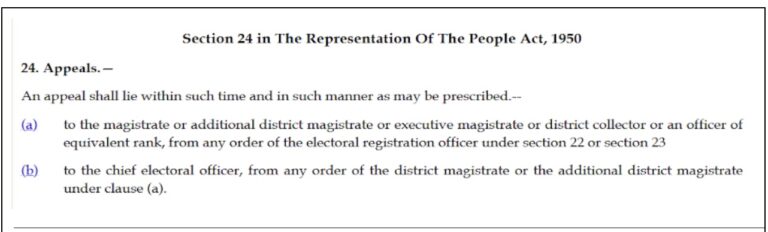
- Under Section 24 of the Act, an appeal against the order of ERO can also be made to the District Magistrate and the second appeal to the Chief Electoral Officer.
Verification and Transparency Measures
- As per Section 23 of RPA, 1950, eligibility to enrol as an elector is verified by the Electoral Registration Officer (ERO).
- Now, documents forming the basis of ERO’s satisfaction must also be uploaded in ECINET for transparency.
- These documents will be accessible only to authorised election officials, keeping in mind privacy concerns.
Arguments in Favour of the SIR
- Ensuring Electoral Integrity
- Aims to cleanse the electoral rolls of errors such as duplicate entries, fake voters, and names of deceased persons.
- Strengthens the principle of “one person, one vote”, thereby upholding democratic legitimacy.
- Responding to Demographic Shifts
- Rapid urbanisation, migration, and population mobility often distort voter lists.
- SIR allows systematic updating to ensure genuine representation.
- Legal & Constitutional Backing
- Exercise is conducted under Article 326 of the Constitution and Sections 16, 23, and 24 of the Representation of People Act, 1950, providing clear legal safeguards.
- By uploading supporting documents on ECINET, accountability is enhanced while privacy is protected (accessible only to authorised officials).
- Precedent & Periodic Revision
- Electoral roll revision is a regular constitutional exercise; the SIR is only a more intensive version given Bihar’s unique issues.
- Intensive revisions of electoral rolls, in all or some parts of the country, have been undertaken earlier in 1952-56, 1957, 1961, 1965, 1966, 1983-84, 1987-89, 1992, 1993, 1995, 2002, 2003 and 2004. Each revision has reflected the ECI’s evolving priorities — from correcting early administrative flaws to addressing migration, delimitation, and concerns over the quality of the rolls.
- Enhancing Public Trust
- By ensuring error-free rolls, SIR reassures citizens that elections are conducted on a fair and credible voter base, boosting participation.
- Addresses concerns of “bogus voting,” a frequent complaint during elections.
Arguments Against SIR of Electoral Rolls
- Burden Shift on Voters:
- The SIR process flips the traditional burden of proof: instead of objectors, now voters themselves must prove their eligibility
- Strict Documentation Requirements May Exclude Vulnerable Groups:
- The SIR mandates documents like birth certificates, passports etc, which are often difficult to obtain in Bihar due to low literacy rates. Critics argue these requirements could systematically disenfranchise the poor and marginalized, especially minority communities like Muslims.
- Many voters lack formal documentation (birth certificates), even though they possess Aadhaar or EPIC. The exclusion of such individuals risks widespread disenfranchisement.
- Vulnerability of Accepted Documents:
- Critics argue that none of the 11 documents specified by the Election Commission are foolproof; many are susceptible to forgery, creating risks of manipulation and wrongful exclusion of genuine voters.
- Arbitrary Post-2003 Divide:
- Only voters enrolled after 2003 face strict checks—an illogical cutoff lacking legal precedent.
- Political Timing & Selective Targeting:
- Conducted solely in Bihar just before Assembly elections, the SIR has been branded by opposition parties as strategically timed. Allegations suggest the exercise is aimed at targeting specific voter groups to influence outcomes.
- Lack of Transparency & Accountability:
- Opponents have demanded the ECI publicly share the list of the 65 lakh deleted voters to verify fairness. Without transparency, the process remains opaque and prone to manipulation.
- Recently the Supreme Court, while hearing petitions against the SIR, had directed the Election Commission to publish the details of those whose names were deleted from the draft rolls and the reasons for the deletion.In compliance, the Bihar CEO has published the comprehensive list
- Limited State Capacity:
- The Indian state’s record-keeping limitations and inability to uniformly provide documents constrain citizens. Many required proofs, such as birth certificates, were never systematically issued in earlier decades, especially in rural and marginalised regions.
- Document Access & Intergenerational Gaps:
- Citizens face multiple barriers in securing documents, especially where earlier generations never collected official records. This risks the disenfranchisement of already disadvantaged communities, deepening exclusion.
- A single-point, user-friendly digital platform developed by the Election Commission of India to serve electors and stakeholders such as election officials, political parties, and civil society.
- The new one-stop platform, ECINET, will integrate and reorient over 40 of ECI’s existing mobile and web applications.ECINET will subsume existing Apps like the Voter Helpline App, Voter Turnout App, cVIGIL, Suvidha 2.0, ESMS, Saksham and KYC App
- ECINET will also enable users to access relevant electoral data on their desktops or smartphones. To ensure that data is as accurate as possible, the data on ECINET will be entered solely by the authorized ECI official.
- The data provided through ECINET will be strictly aligned within the legal framework established by the Representation of People Act 1950, 1951, Registration of Electoral Rules, 1960 Conduct of Election Rules, 1961 and instructions issued by ECI from time to time.
- Election Commission of India has operationalised the new digital platform ECINET in the recently concluded bye-elections in the five Assembly Constituencies in the states of Kerala, Gujarat, Punjab and West-Bengal.
Note:
The SIR is not limited to Bihar. On June 24, the ECI announced that it would carry out an intensive verification of electoral rolls across the country. This would be the first such exercise in more than two decades, and the process has begun with Bihar, where Assembly elections are due before November.
UPSC Spot-Check
Prelims
With reference to the revision of electoral rolls in India, consider the following statements:
- Article 324 of the Constitution vests the Election Commission of India with the power of superintendence, direction, and control over the preparation of electoral rolls.
- Section 16 of the Representation of the People Act, 1950, lays down grounds for disqualification for registration in an electoral roll.
- Intensive revision of electoral rolls has been conducted only once since 1950, during the first general elections.
- Under Section 24 of the Representation of the People Act, 1950, an appeal against the order of an ERO can be made to the Chief Election Commissioner directly.
How many of the above statements are correct?
- Only one
- Only two
- Only three
- All four
Mains
Q.The Election Commission of India has introduced Special Investigation Reports (SIR) as part of its efforts to ensure transparency and accountability in electoral roll management. Critically examine the significance of SIR in strengthening electoral integrity, with special reference to its implementation in Bihar.(10 Marks, 150 Words)
At InclusiveIAS, our editorial team is led by experts who have successfully cleared multiple stages of the UPSC Civil Services Examination, including Mains and Interview. With deep insights into the demands of the exam, we focus on crafting content that is accurate, exam-relevant, and easy to grasp.
Whether it’s Polity, Current Affairs, GS papers, or Optional subjects, our notes are designed to:
Break down complex topics into simple, structured points
Align strictly with the UPSC syllabus and PYQ trends
Save your time by offering crisp yet comprehensive coverage
Help you score more with smart presentation, keywords, and examples
🟢 Every article, note, and test is not just written—but carefully edited to ensure it helps you study faster, revise better, and write answers like a topper.