


Table of Contents
ToggleGoods are products or resources that satisfy human wants and provide utility. In economics, goods are classified based on their role in production and consumption. Understanding different types of goods helps explain production processes, investment, national income, and macroeconomic activity.
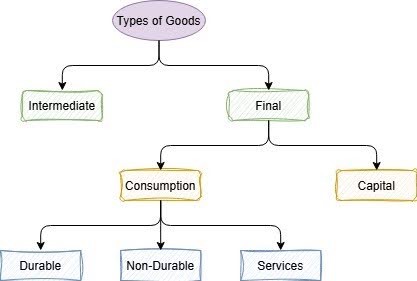
Intermediate goods are goods that have undergone some production process but are not ready for final use. They are used as inputs for producing other goods and services and generally undergo further transformation.
Features
Examples
Intermediate Goods are Not Counted in GDP to Avoid Double Counting
Final goods are goods that have completed all stages of production and do not undergo further economic transformation.Once sold, they move out of the production process and are either consumed by individuals or used as investment goods.
Final goods can be classified into:
Why are they called Final Goods?
A.Consumption Goods
Consumption goods are goods and services used by ultimate consumers to satisfy their wants directly.
They can be classified into three categories:
(i) Durable Consumption Goods
(ii) Non-Durable Consumption Goods
(iii) Services
B.Capital Goods
Tractor (Capital Good)
A tractor qualifies as a capital good because:
Can a Particular Good Be Both a Consumer Good and a Capital Good?
Yes, a particular good can be both a consumer good and a capital good, depending on how it is used.
Good | As a Consumer Good (Used for Personal Consumption) | As a Capital Good (Used in Production) |
Car | A family buys a car for personal use. | A taxi company buys a car for commercial transport. |
Laptop | A student buys a laptop for studying and entertainment. | A company buys laptops for employees to work. |
Furniture | A person buys a table for home use. | A restaurant buys tables for customer seating. |
Oven | A person buys an oven for home cooking. | A bakery buys an oven to make and sell bread. |
Camera | A person buys a camera for photography as a hobby. | A photographer buys a camera for professional shoots. |
Intermediate Good or a Final Good
Examples:
Sugar
Tea Leaves
Basis | Capital Goods | Consumer Durables |
Purpose | Production of other goods | Final consumption |
Used by | Firms and producers | Households |
Examples | Machines, tractors | TV, refrigerator |
Goods form the foundation of economic activity because they satisfy human wants and contribute to the processes of production and consumption. Based on their role and economic use, goods can be classified into intermediate goods, final goods, consumption goods, and capital goods. This classification is important for understanding concepts such as production, investment, GDP measurement, and national income accounting. It is also essential to remember that the same good can be classified differently depending upon its economic use and the point at which the last market transaction takes place. The distinction between intermediate and final goods is particularly important because only final goods are included in GDP calculations to avoid double counting.
Goods are products or resources that satisfy human wants and provide utility to consumers.
Intermediate goods are goods used as inputs in the production of other goods and services and generally undergo further transformation.
Examples:
Final goods are goods that have completed the production process and are purchased for final consumption or investment purposes.
Examples:
At InclusiveIAS, our editorial team is led by experts who have successfully cleared multiple stages of the UPSC Civil Services Examination, including Mains and Interview. With deep insights into the demands of the exam, we focus on crafting content that is accurate, exam-relevant, and easy to grasp.
Whether it’s Polity, Current Affairs, GS papers, or Optional subjects, our notes are designed to:
Break down complex topics into simple, structured points
Align strictly with the UPSC syllabus and PYQ trends
Save your time by offering crisp yet comprehensive coverage
Help you score more with smart presentation, keywords, and examples
🟢 Every article, note, and test is not just written—but carefully edited to ensure it helps you study faster, revise better, and write answers like a topper.

Empowering UPSC aspirants with structured preparation, exam-focused notes, free tests, and expert guidance — trusted by thousands of serious aspirants.
