NOTICE
✅ Answer Writing Program solutions will be uploaded regularly in the InclusiveIAS App. Download the app now: Download Now ✅ Answer Writing Program solutions will be uploaded regularly in the InclusiveIAS App. Download the app now: Download Now

Fishing Cat : Habitat, Distribution, Adaptations & Conservation Status | UPSC Notes

  • Home
  • Fishing Cat : Habitat, Distribution, Adaptations & Conservation Status | UPSC Notes
Shape Image One
Species in News · The Green Radar

Fishing Cat —
The Wetland Hunter

🐱 Wild Cat 🐟 Hyper-carnivore ⚠️ Vulnerable (IUCN)

🔍 Quick Facts

TypeWild cat (feline)
Size~2x domestic cat
DietHyper-carnivore
BehaviourNocturnal, solitary
HabitatWetlands, mangroves
IUCN StatusVulnerable
← Back to The Green Radar
Fishing Cat
🐱Introduction

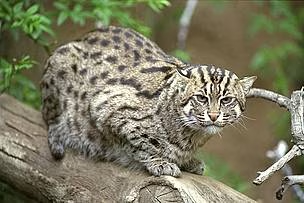
Fishing Cat is a highly elusive wild cat feline species.

📋Characteristics
Size: Almost twice the size of a domestic house cat.
The fishing cat is an elusive nocturnal mammal.
They show strong sexual dimorphism. Males are considerably larger.
Adept swimmers: The fishing cat is an adept swimmer and enters water frequently to prey on fish as its name suggests. It is known to even dive to catch fish.
Diet: Like all other cats, they are hyper-carnivores—animals that get over 70% of their nutrition from meat—making them excellent predators. It mainly feeds on fish, but also preys on frogs, crustaceans, snakes, birds and scavenges on carcasses of larger animals.
Breeding: It is capable of breeding all year round. But in India, its peak breeding season is known to be between March and May.
It lives mostly in the vicinity of wetlands, along rivers, streams, oxbow lakes, in swamps and mangroves where it preys mostly on fish.
The fishing cat hunts alone.
Adaptations:
Double-layered coat to keep the skin underneath dry when they dive into the water
Close-set eyes to help them focus on prey in water
Small ears whose inner folds keep out water
Crude webbing between their feet which help anchor them to muddy banks while grabbing fish
🔬Sexual Dimorphism

Sexual dimorphism is the condition where different sexes of the same species exhibit different morphological characteristics, including characteristics not directly involved in reproduction.

🌍Distribution & Habitat

The Fishing Cat lives mainly in the vicinity of wetlands, rivers, streams, oxbow lakes, swamps and mangroves, where it feeds predominantly on fish.

  • Global Distribution
    • They are found in South and Southeast Asia.
  • India
    • In India, fishing cats are mainly found in the mangrove forests of the Sundarbans, on the foothills of the Himalayas along the Ganga and Brahmaputra river valleys and in the Western Ghats.
🛡️Conservation Status
  • IUCN Red List: Vulnerable
  • Wildlife Protection Act of 1972: Schedule I
  • CITES: Appendix II

Practice Environment Tests

MCQ-based tests on Environment & Ecology — free on website & app

Go to Environment Tests →
🛡️ Conservation Status
IUCN Red ListVulnerable
Wildlife Protection ActSchedule I
CITESAppendix II
📋 Quick Facts
TypeWild cat (feline)
Size~2x domestic cat
DietHyper-carnivore
ActivityNocturnal
Social behaviourSolitary hunter
Breeding peak (India)March–May
🌿 The Green Radar

Track all Environment & Ecology current affairs in one place.

Open Green Radar →