
New
Latest Articles
InclusiveIAS

Financial Markets: Capital Market & Money Market

  • Home
  • Financial Markets: Capital Market & Money Market
Shape Image One

Financial Markets: Capital Market & Money Market

Financial Market

A financial market is a marketplace where individuals and institutions buy and sell financial assets or securities, such as shares, bonds, currencies and derivatives.

Financial markets facilitate the transfer of funds from those having surplus funds to those who need funds, thereby helping in the efficient allocation of financial resources in the economy.

Financial markets can be broadly divided into two main segments:
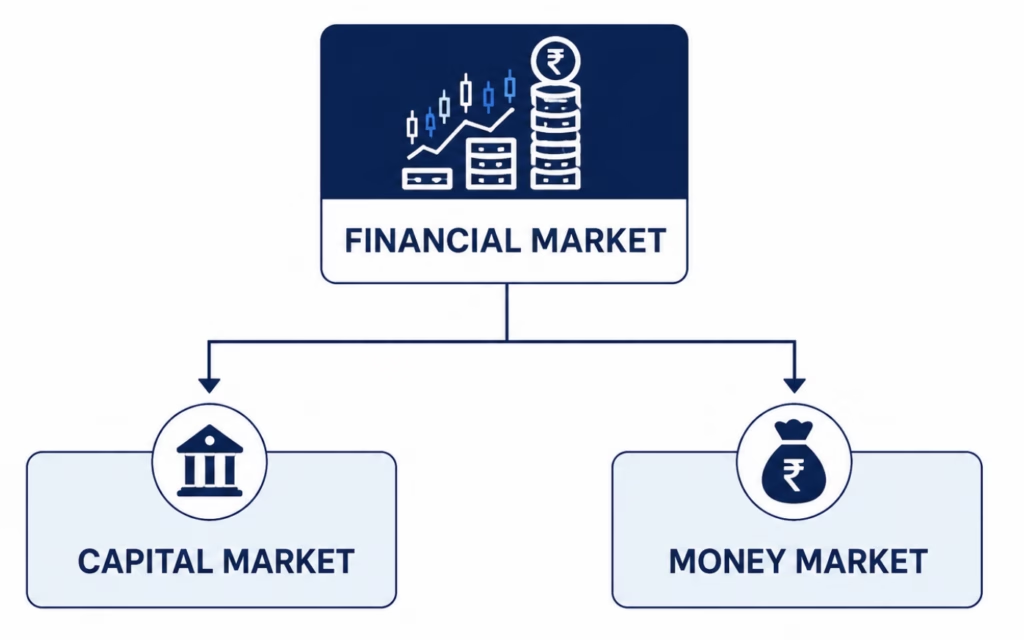
  1. Capital Market
  2. Money Market

1. Capital Market

The capital market is the segment of the financial market where medium-term and long-term securities, generally having a maturity of more than one year, are issued and traded.It facilitates the mobilisation of long-term funds through instruments such as shares and bonds.

  • Capital Market Instruments:
    • Equity Instruments: Equity Shares, Preference Shares
    • Corporate Debt: Bonds, Debentures
    • Government Debt: Dated Government Securities, State Development Loans
    • Pooled Investment Instruments:Mutual Fund Units, ETFs
  • Regulator:The Securities and Exchange Board of India (SEBI) serves as India’s main capital market regulator. It is a statutory body established in 1992 to protect investor interests, promote the orderly growth of the securities market, and regulate stock exchanges, mutual funds, and market brokers
  • The capital market consists of two major segments:
    • Primary Market
      • The primary market is the market where new securities are issued for the first time to raise funds.
      • In this market, the transaction takes place between the issuer of the security and the investors.
      • For example, when a company issues shares to the public through an Initial Public Offering (IPO), the shares are sold in the primary market.
      • Company issuing securities β†’ Investors
      • Thus, the primary market helps companies and other issuers raise fresh capital.
    • Secondary Market
      • The secondary market is the market where securities that have already been issued in the primary market are subsequently bought and sold among investors.
      • The original issuer does not normally receive funds from these transactions because the securities are being transferred from one investor to another.
      • For example, when investors buy and sell already-issued shares through a stock exchange such as the National Stock Exchange , the transaction takes place in the secondary market.
      • Investor β†’ Investor
      • The secondary market provides liquidity and marketability to existing securities.

Primary Market and Secondary Market (Example)

Suppose ABC Ltd. wants to raise β‚Ή100 crore from the public to expand its business.

Primary Market

  • ABC Ltd. issues new shares to investors through an Initial Public Offering (IPO).
  • Suppose Ravi applies for the IPO and receives 100 shares at β‚Ή100 per share. He pays β‚Ή10,000, and the money ultimately goes towards the capital raised by ABC Ltd.
  • ABC Ltd. issues new shares β†’ Ravi buys shares β†’ Company raises fresh capital
  • This is a primary market transaction because the shares are being issued to investors for the first time.

Secondary Market

  • After the IPO, ABC Ltd.'s shares are listed on a stock exchange.
  • A few months later, Ravi decides to sell his 100 shares. Priya purchases these shares from Ravi through the stock exchange for β‚Ή120 per share.
  • Priya pays β‚Ή12,000 to acquire Ravi's shares. ABC Ltd. does not receive this β‚Ή12,000, because the company is not issuing new shares; existing shares are simply changing hands between investors.
  • Ravi sells existing shares β†’ Priya buys them β†’ ABC Ltd. receives no fresh capital
  • This is a secondary market transaction.

Easy Way to Remember

  • Primary Market: Company ↔ Investor β†’ Company raises fresh funds
  • Secondary Market: Investor ↔ Investor β†’ Existing securities change hands

Components of Capital Markets:

  • Capital markets comprise different segments based on the type of financial instrument being issued or traded. The major components are:
    • Equity Market
      • The equity market deals in shares or stocks that represent ownership in a company.
      • When investors purchase equity shares, they become part-owners of the company and may earn returns through:
        • Dividends
        • Capital appreciation, if the market price of the shares increases
      • Equity investors generally bear higher risk because returns are not fixed.
    • Debt Market
      • The debt market deals in bonds, debentures and other debt securities.
      • By purchasing a debt security, an investor effectively lends money to the issuer, which may be a government, public authority or company.
      • In return, the investor generally receives:
        • Interest payments, and
        • Repayment of principal at maturity
      • Unlike equity, debt securities do not normally confer ownership rights in the issuing entity.
    • Derivatives Market
      • The derivatives market deals in financial contracts whose value is derived from an underlying asset, security, index, interest rate, currency or commodity.
      • Common derivative instruments include:
        • Futures
        • Options
      • Futures: A futures contract is an agreement to buy or sell an underlying asset at a predetermined price on a specified future date.Both the buyer and seller are generally obligated to fulfil the contract.
      • Options: An options contract gives the buyer the right, but not the obligation, to buy or sell an underlying asset at a predetermined price within or at the end of a specified period.

Key Elements of a Capital Market

  • Issuers: Companies and governments that raise funds by issuing securities such as shares and bonds.
  • Investors: Individuals and institutions that provide funds by purchasing securities.
  • Intermediaries: Brokers, merchant bankers and other entities that facilitate the issuance and trading of securities.
  • Stock Exchanges: Platforms such as the NSE and BSE that facilitate trading, liquidity and price discovery.
  • Regulators: Bodies such as SEBI that regulate the securities market and protect investor interests.

How Do Capital Markets Operate?

Capital markets operate through an organised system in which issuers raise long-term funds and investors buy and sell securities such as shares, bonds and other financial instruments.

The functioning of the capital market involves several participants.

1. Issuers

Issuers are entities that raise funds from the capital market.

They may include:

  • Companies
  • Governments
  • Public Sector Enterprises
  • Financial institutions

Issuers raise funds by issuing:

  • Equity shares, which represent ownership
  • Bonds or debentures, which represent debt

The funds raised may be used for expansion, infrastructure, investment, research, debt repayment or other long-term purposes.

2. Investors

Investors provide funds by purchasing securities issued in the capital market.

They include:

  • Retail investors
  • Mutual funds
  • Pension funds
  • Insurance companies
  • Foreign investors
  • Other institutional investors

Investors participate with the objective of earning returns through dividends, interest or capital appreciation.

3. Intermediaries

Financial intermediaries facilitate the issuance and trading of securities.

Examples include:

  • Stock brokers, who execute trades on behalf of investors.
  • Merchant bankers or investment bankers, who assist issuers in raising capital and managing public issues.
  • Depositories and depository participants, which facilitate holding and transfer of securities in electronic form.
  • Stock exchanges, which provide organised platforms for trading securities.

4. Regulators

The capital market is regulated primarily by the Securities and Exchange Board of India (SEBI).

SEBI seeks to:

  • Protect investors
  • Promote fair and transparent trading
  • Regulate intermediaries
  • Prevent fraudulent and manipulative practices
  • Promote orderly development of the securities market

Operation of the Primary Market

In the primary market, new securities are issued for the first time.

For example, a company seeking to raise capital may issue shares through an Initial Public Offering (IPO).

The process generally involves:

Company needs funds β†’ Issues securities β†’ Investors subscribe β†’ Funds flow to the company

The primary market therefore facilitates the mobilisation of fresh capital.

Operation of the Secondary Market

After securities are issued in the primary market, they may subsequently be traded in the secondary market.

Here, existing securities are bought and sold among investors through stock exchanges.

Investor A sells securities β†’ Investor B purchases securities

The issuing company generally does not receive fresh funds from these transactions.

The secondary market provides:

  • Liquidity
  • Marketability
  • Price discovery
  • An exit opportunity for investors

Price Discovery in the Capital Market

The prices of securities in the secondary market are largely determined by demand and supply.

If demand for a security rises relative to its supply, its price generally increases. If supply exceeds demand, its price may fall.

Prices are also influenced by factors such as:

  • Company's financial performance
  • Interest rates
  • Economic conditions
  • Government policies
  • Investor expectations
  • Global developments

Capital Market Flow at a Glance

Issuers β†’ Primary Market β†’ Investors β†’ Secondary Market β†’ Trading among Investors

2. Money Market

The money market is the segment of the financial market where short-term financial instruments, having a maturity of up to one year, are issued and traded.

  • Classification of Money Market by Tenor: Depending on the maturity period (tenor) of the transaction, the money market can be classified into:
    • Overnight Market: Transactions have a maturity of one working day.
    • Notice Money Market: Transactions have a maturity ranging from 2 days to 14 days.
    • Term Money Market: Transactions have a maturity ranging from 15 days to one year.
  • The money market is characterized by high liquidity and short maturity.Β 
  • Secured and Unsecured Transactions: Money market transactions could be both secured (with collateral) and unsecured (clean, without collateral).
  • Participants in the Money Market: The money market has a wide range of participants, including:
    • Reserve Bank of India (RBI)
    • Banks
    • Primary Dealers
    • Financial Institutions
    • Mutual Funds
    • Insurance Companies
    • Provident Funds
    • Pension Funds
    • Corporates etc.
  • Regulation of the Money Market:The Reserve Bank of India plays the principal regulatory and developmental role in major segments of India’s money market.
  • Money Market Instruments: Major Money Market Instruments include
    • Call and Notice Money
    • Treasury Bills
    • Cash Management Bills
    • Commercial Paper
    • Certificates of Deposit
    • Repurchase Agreements (Repos)
    • Collateralized Borrowing and Lending Obligations
  • Functions of Money Market:
    • Providing Short-Term Funds: The money market enables borrowers to raise funds for short-term requirements, such as temporary cash-flow mismatches etc.
    • Facilitating Liquidity Management: The money market allows financial institutions to manage temporary surpluses and shortages of funds. Institutions with surplus funds can lend them for short periods, while those facing temporary shortages can borrow funds.
Capital Market vs Money Market
FeatureCapital MarketMoney Market
PurposeIt facilitates medium-term and long-term financing and investment.It facilitates short-term borrowing, lending and liquidity management.
InstrumentsShares, bonds and debentures are major capital-market instruments.Treasury Bills, Commercial Paper and Certificates of Deposit are major money-market instruments.
MaturityInstruments have a maturity of more than one year.Instruments have a maturity of up to one year.
RiskInstruments generally involve relatively higher risk due to market fluctuations.Instruments generally involve relatively lower risk due to short-term nature.
ReturnsThe potential return is generally higher, but may fluctuate considerably.Returns are generally lower and relatively more stable.
Major ParticipantsCompanies, governments, retail investors and institutional investors are major participants.Banks, financial institutions, primary dealers, mutual funds and eligible corporates are major participants.
RegulationThe capital market is primarily regulated by the SEBI.The money market is primarily regulated by the RBI.

FAQs

1. What is a financial market?
A financial market is a marketplace where financial assets and securities such as shares, bonds, currencies and derivatives are issued or traded. It facilitates the transfer of funds between savers and borrowers.

2. What are the two major types of financial markets?
Financial markets are broadly divided into the capital market and the money market. The capital market primarily deals with longer-term financing, while the money market deals with short-term funds.

3. What is the primary market?
The primary market is where new securities are issued to investors for the first time. Funds raised through such issuance flow to the issuer. An IPO is a common example.

4. What is the secondary market?
The secondary market is where securities already issued are bought and sold among investors. The issuing company generally receives no fresh funds from these transactions.

5. What is a money market?
The money market is the segment of the financial market where short-term financial instruments, generally having maturities of up to one year, are issued and traded.

6. What are the major money market instruments in India?
Major instruments include Treasury Bills, Commercial Paper, Certificates of Deposit, Call and Notice Money, Cash Management Bills and repo-related instruments.

✍️ Curated by InclusiveIAS Editorial Team

At InclusiveIAS, our editorial team is led by experts who have successfully cleared multiple stages of the UPSC Civil Services Examination, including Mains and Interview. With deep insights into the demands of the exam, we focus on crafting content that is accurate, exam-relevant, and easy to grasp.

Whether it’s Polity, Current Affairs, GS papers, or Optional subjects, our notes are designed to:

  • Break down complex topics into simple, structured points

  • Align strictly with the UPSC syllabus and PYQ trends

  • Save your time by offering crisp yet comprehensive coverage

  • Help you score more with smart presentation, keywords, and examples

🟒 Every article, note, and test is not just writtenβ€”but carefully edited to ensure it helps you study faster, revise better, and write answers like a topper.