


Table of Contents
ToggleA financial market is a marketplace where individuals and institutions buy and sell financial assets or securities, such as shares, bonds, currencies and derivatives.
Financial markets facilitate the transfer of funds from those having surplus funds to those who need funds, thereby helping in the efficient allocation of financial resources in the economy.
Financial markets can be broadly divided into two main segments:
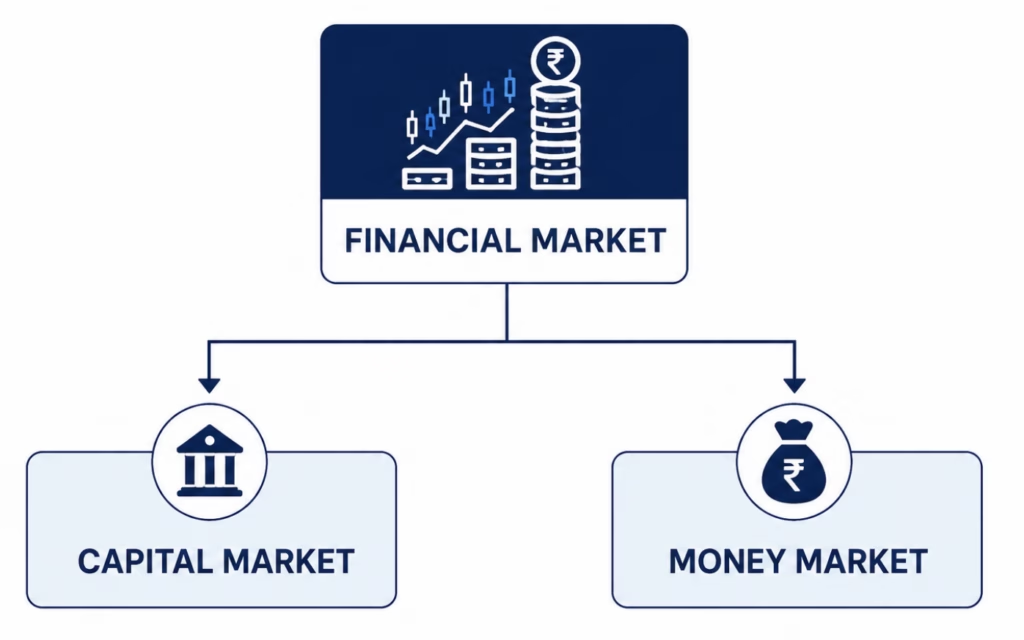
The capital market is the segment of the financial market where medium-term and long-term securities, generally having a maturity of more than one year, are issued and traded.It facilitates the mobilisation of long-term funds through instruments such as shares and bonds.
Suppose ABC Ltd. wants to raise ₹100 crore from the public to expand its business.
Components of Capital Markets:
Key Elements of a Capital Market
Capital markets operate through an organised system in which issuers raise long-term funds and investors buy and sell securities such as shares, bonds and other financial instruments.
The functioning of the capital market involves several participants.
Issuers are entities that raise funds from the capital market.
They may include:
Issuers raise funds by issuing:
The funds raised may be used for expansion, infrastructure, investment, research, debt repayment or other long-term purposes.
Investors provide funds by purchasing securities issued in the capital market.
They include:
Investors participate with the objective of earning returns through dividends, interest or capital appreciation.
Financial intermediaries facilitate the issuance and trading of securities.
Examples include:
The capital market is regulated primarily by the Securities and Exchange Board of India (SEBI).
SEBI seeks to:
In the primary market, new securities are issued for the first time.
For example, a company seeking to raise capital may issue shares through an Initial Public Offering (IPO).
The process generally involves:
Company needs funds → Issues securities → Investors subscribe → Funds flow to the company
The primary market therefore facilitates the mobilisation of fresh capital.
After securities are issued in the primary market, they may subsequently be traded in the secondary market.
Here, existing securities are bought and sold among investors through stock exchanges.
Investor A sells securities → Investor B purchases securities
The issuing company generally does not receive fresh funds from these transactions.
The secondary market provides:
The prices of securities in the secondary market are largely determined by demand and supply.
If demand for a security rises relative to its supply, its price generally increases. If supply exceeds demand, its price may fall.
Prices are also influenced by factors such as:
Issuers → Primary Market → Investors → Secondary Market → Trading among Investors
The money market is the segment of the financial market where short-term financial instruments, having a maturity of up to one year, are issued and traded.
| Feature | Capital Market | Money Market |
|---|---|---|
| Purpose | It facilitates medium-term and long-term financing and investment. | It facilitates short-term borrowing, lending and liquidity management. |
| Instruments | Shares, bonds and debentures are major capital-market instruments. | Treasury Bills, Commercial Paper and Certificates of Deposit are major money-market instruments. |
| Maturity | Instruments have a maturity of more than one year. | Instruments have a maturity of up to one year. |
| Risk | Instruments generally involve relatively higher risk due to market fluctuations. | Instruments generally involve relatively lower risk due to short-term nature. |
| Returns | The potential return is generally higher, but may fluctuate considerably. | Returns are generally lower and relatively more stable. |
| Major Participants | Companies, governments, retail investors and institutional investors are major participants. | Banks, financial institutions, primary dealers, mutual funds and eligible corporates are major participants. |
| Regulation | The capital market is primarily regulated by the SEBI. | The money market is primarily regulated by the RBI. |
1. What is a financial market?
A financial market is a marketplace where financial assets and securities such as shares, bonds, currencies and derivatives are issued or traded. It facilitates the transfer of funds between savers and borrowers.
2. What are the two major types of financial markets?
Financial markets are broadly divided into the capital market and the money market. The capital market primarily deals with longer-term financing, while the money market deals with short-term funds.
3. What is the primary market?
The primary market is where new securities are issued to investors for the first time. Funds raised through such issuance flow to the issuer. An IPO is a common example.
4. What is the secondary market?
The secondary market is where securities already issued are bought and sold among investors. The issuing company generally receives no fresh funds from these transactions.
5. What is a money market?
The money market is the segment of the financial market where short-term financial instruments, generally having maturities of up to one year, are issued and traded.
6. What are the major money market instruments in India?
Major instruments include Treasury Bills, Commercial Paper, Certificates of Deposit, Call and Notice Money, Cash Management Bills and repo-related instruments.
At InclusiveIAS, our editorial team is led by experts who have successfully cleared multiple stages of the UPSC Civil Services Examination, including Mains and Interview. With deep insights into the demands of the exam, we focus on crafting content that is accurate, exam-relevant, and easy to grasp.
Whether it’s Polity, Current Affairs, GS papers, or Optional subjects, our notes are designed to:
Break down complex topics into simple, structured points
Align strictly with the UPSC syllabus and PYQ trends
Save your time by offering crisp yet comprehensive coverage
Help you score more with smart presentation, keywords, and examples
🟢 Every article, note, and test is not just written—but carefully edited to ensure it helps you study faster, revise better, and write answers like a topper.

Empowering UPSC aspirants with structured preparation, exam-focused notes, free tests, and expert guidance — trusted by thousands of serious aspirants.
