


Balance of Payments (BoP)
Balance of Payments
- The Balance of Payments (BoP) is a systematic record of all economic transactions between the residents of a country and the rest of the world during a given period, usually one year.
- It includes transactions undertaken by individuals, businesses, governments and other resident entities with non residents.
- India’s BoP records economic transactions between Indian residents and non residents or foreign entities.
- In India, the Reserve Bank of India (RBI) is responsible for compiling the Balance of Payments.
Components of Balance of Payments
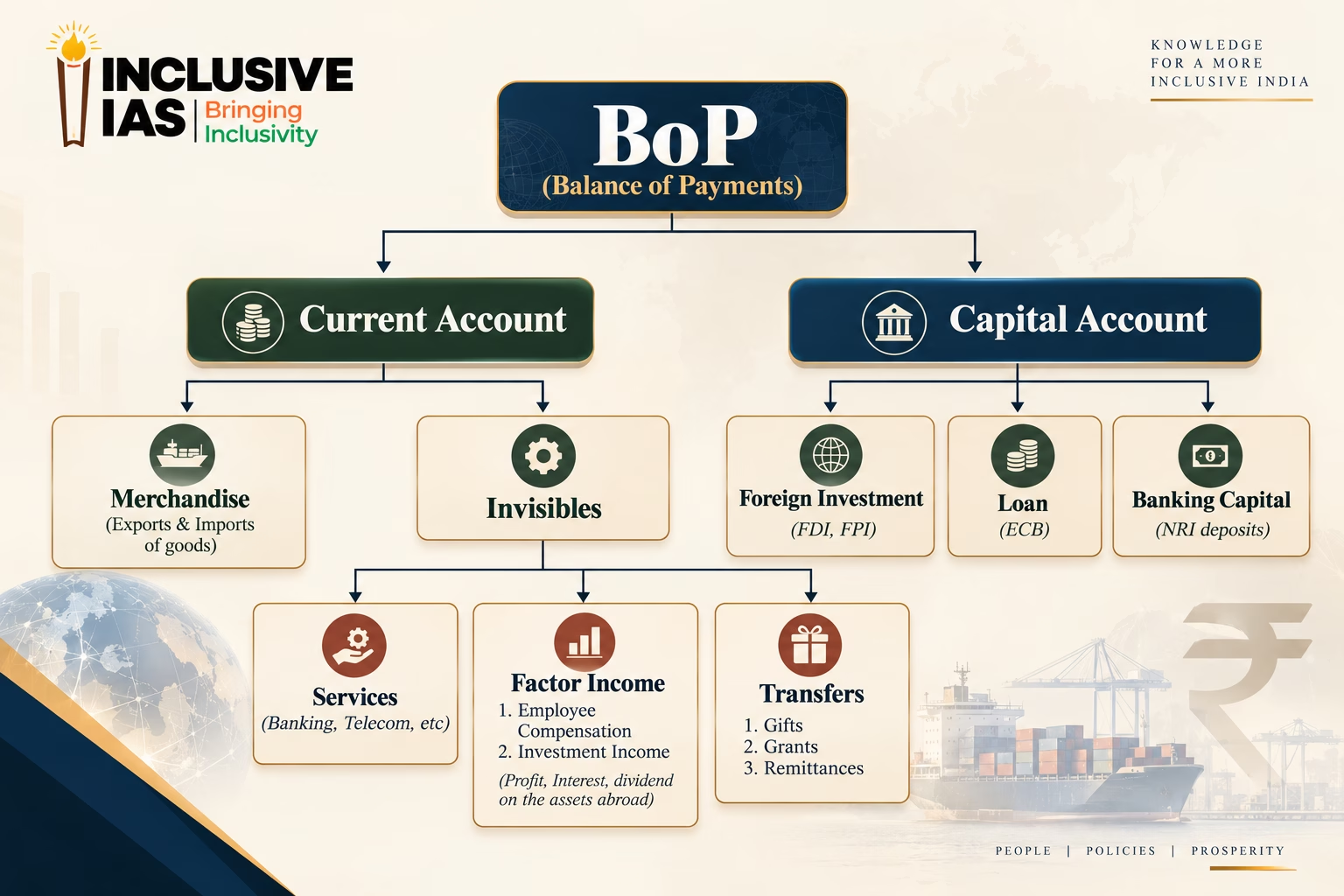
BoP has two main components:
- Current Account and
- Capital Account.
Current Account
Current account deals in those transactions which do not alter Indian residents’ assets or liabilities, including contingent liabilities, outside India and foreign resident’s assets or liabilities inside India.
Current Account comprises:
- Visible Trade: Export and Import of Goods
- Invisible Trade: Export and Import of Services
- Current Transfers/Unilateral Transfers
- Investment Income: Income Earned from Factors of Production such as Land, Foreign Shares, Loans etc.
Thus, Current Account = Visible Trade + Invisibles (Services + Investment Income + Current Transfers)
A. Trade Balance
- The Trade Balance is the difference between the value of a country’s exports and imports of goods.
- Trade balance relates only to goods, not services.
- If exports exceed imports then the country has a trade surplus and the trade balance is said to be positive.
- If imports exceed exports, the country or area has a trade deficit and its trade balance is said to be negative.
- Exports > Imports → Trade Surplus
- Imports > Exports → Trade Deficit
B. Invisibles
Invisibles are international transactions that do not involve the physical movement of goods. They broadly include:
- Services: Travel, transportation, insurance, Government Not Included Elsewhere (GNIE) and miscellaneous services such as communication, construction, financial services, software, news agency services, royalties, management and business services. Trade in services is said to be invisible as they cannot be seen to cross national borders.
- Income: Includes investment income, such as interest, dividends and profits, and compensation of employees.
- Current Transfers/Unilateral Transfers: Transfers where nothing is directly received in return such as grants, gifts, remittances, etc.
Current Account Deficit
- A Current Account Deficit occurs when a country’s total payments on the current account exceed its total receipts from the current account during a given period.
- In simple terms:
- Current Account Receipts < Current Account Payments → Current Account Deficit
- Example:
- Suppose India receives $100 billion from exports of goods and services, income and transfers, but makes $120 billion in payments for imports and other current account transactions.
- Current Account Receipts = $100 billion
- Current Account Payments = $120 billion
- CAD = $20 billion
- Thus, Payments > Receipts → Current Account Deficit.
Current Account Surplus
- A Current Account Surplus occurs when a country’s total receipts on the current account exceed its total payments on the current account.
- Current Account Receipts > Current Account Payments → Current Account Surplus
- Example:
- Suppose India receives $120 billion from exports of goods and services, income and transfers, but makes $100 billion in payments for imports and other current account transactions.
- Current Account Receipts = $120 billion
- Current Account Payments = $100 billion
- Current Account Surplus = $20 billion
- Thus, Receipts > Payments → Current Account Surplus.
Capital Account
- This account is a record of the inflows and outflows of capital that directly affect a country’s foreign assets and liabilities.
- Capital account transactions are those transactions which alter Indian residents’ assets or liabilities, including contingent liabilities, outside India and foreign resident’s assets or liabilities inside India.
- Capital Account broadly comprises flows such as Foreign Direct Investment (FDI), Foreign Portfolio Investment (FPI), External Commercial Borrowings, Short Term Credit and Banking Capital such as NRI deposits.
Balance of Payment
Balance of Payments = Current Account Balance + Capital Account Balance
- The overall BoP is in surplus when the combined balance of the Current Account and Capital Account is positive.
- The overall BoP is in deficit when their combined balance is negative.
Example
- Current Account = −$10 billion
- Capital Account = +$15 billion
- Overall BoP = +$5 billion → BoP Surplus
Understanding Balance of Payments
The difference can be understood easily by looking at what happens to assets and liabilities.
- Buying Foreign Shares: If an Indian buys shares of a foreign company, the person acquires a foreign asset. Therefore, it is recorded in the Capital Account. (Buying Foreign Shares → Foreign Asset Created → Capital Account)
- Dividend from Foreign Shares: If the person later receives a dividend from those shares, it is simply income earned from the investment. The shares continue to be owned by the person. Therefore, the dividend is recorded in the Current Account. (Dividend Received → Income Earned → Current Account)
- Taking a Foreign Loan: If an Indian company takes a loan from a foreign bank or international agency, it creates a liability that has to be repaid in the future. Therefore, it is recorded in the Capital Account. (Foreign Loan → Liability Created → Capital Account)
- Paying Interest on Foreign Loan: Interest is the cost paid for using the borrowed money. It does not repay the original loan amount. Therefore, interest payment is recorded in the Current Account. (Interest Payment → Income Payment → Current Account)
- Gifts, Grants and Remittances: These generally do not create an obligation to repay the money in the future. Current transfers such as remittances, gifts and grants are therefore recorded in the Current Account. (Remittances/Gifts/Grants → No Repayment Obligation → Current Account)
Simple Rule
- Creation or change in Foreign Asset/Liability → Capital Account
- Income, Services and Current Transfers → Current Account
Balance of Payment and Forex Reserves
Current Account Balance + Capital Account Balance = Overall BoP Balance
- If the combined balance is positive, there is a BoP surplus, which can lead to an increase in forex reserves.
- If the combined balance is negative, there is a BoP deficit, which can lead to a decline in forex reserves.
- BoP Surplus → Added to Forex Reserves
- BoP Deficit → Met by Drawing Down Forex Reserves
Example:
Suppose RBI has $650 billion of forex reserves.
During the year:
- Current Account = −$100 billion
- Capital Account = +$150 billion
- Overall BoP = −100 + 150 = +$50 billion —> India has received $50 billion more foreign exchange than it paid out.
Forex Reserves = $650 billion + $50 billion = $700 billion
Thus:
- BoP Surplus → Forex Reserves tend to increase
- BoP Deficit → Forex Reserves tend to decrease
Factors Affecting Balance of Payments
The factors affecting the Balance of Payments can be understood separately in terms of:
- Current Account and
- Capital Account.
A. Factors Affecting the Current Account
- Relative Rate of Inflation
- If inflation in the domestic economy is higher than in its trading partners, domestic goods become relatively more expensive.
- Foreign goods become relatively cheaper, which can increase imports.
- Domestic exports become relatively more expensive in foreign markets, which can reduce exports.
- Higher Relative Inflation → Imports ↑ + Exports ↓ → Current Account may deteriorate
- National Income
- An increase in national income raises the purchasing power of domestic residents and can increase their demand for foreign goods and services.
- Higher imports lead to greater foreign exchange outflows and may worsen the current account.
- However, if higher national income is accompanied by an increase in productive capacity and exportable surplus, exports may also increase and improve the current account.
- Income ↑ → Import Demand ↑ → Current Account may deteriorate
- Import Restrictions by Government
- Tariffs increase the domestic price of imported goods and can reduce their demand.
- Import quotas directly restrict the quantity of goods that can be imported.
- Lower imports can improve the trade balance and consequently the current account, other things remaining constant.
- Tariffs/Quotas → Imports ↓ → Current Account may improve
- Exchange Rate
- Appreciation of domestic currency makes imports relatively cheaper and exports relatively more expensive, which may worsen the trade balance.
- Depreciation or devaluation of domestic currency makes imports relatively more expensive and exports relatively cheaper, which may improve the trade balance.
B. Factors Affecting the Capital Account
Capital Account broadly includes flows such as FDI, portfolio investment, external commercial borrowings, short term credit and banking capital.
- Taxation of Income from Foreign Investments
- Higher taxation of income earned by domestic residents from investments abroad reduces their post tax returns.
- This may discourage residents from investing abroad and thereby reduce capital outflows.
- Higher Tax on Foreign Investment Returns → Overseas Investment less attractive → Capital Outflow may decline
- Example: If an Indian investor earns dividends, interest or capital gains from investments in foreign shares, bonds or funds, higher taxation of such income reduces the investor’s net return from investing abroad.
- Economic Liberalisation
- Liberalisation generally involves relaxation of restrictions on foreign investment, borrowing and movement of capital.
- FDI liberalisation can make it easier for foreign companies to invest in India.
- FPI liberalisation can facilitate foreign investment in Indian shares and bonds.
- Liberalisation of Capital Flows → Greater Cross Border Investment → Capital Flows may increase
- Expected Changes in Exchange Rate
- Expectations regarding future exchange rates affect the expected returns from foreign investments.
- An expected appreciation of a country’s currency can make its financial assets more attractive to foreign investors.
- An expected depreciation can reduce expected returns and discourage capital inflows, other things remaining constant.
- Expected Currency Appreciation → Domestic Assets more attractive → Capital Inflows may increase
- Example: If the Rupee is Expected to Appreciate
- At the time of investment: $1 = ₹100
- So, $1,000 = ₹1,00,000
- The investor uses ₹1,00,000 to buy Indian shares.
- Suppose after one year the value of the investment remains ₹1,00,000, but the rupee appreciates: $1 = ₹80
- When the investor converts ₹1,00,000 back into dollars: ₹1,00,000 ÷ 80 = $1,250
- So, even without any increase in the value of the shares:
- Initial Investment = $1,000
- Amount Received = $1,250
- The investor gains because the rupee appreciated against the dollar.
- Interest Rate Differentials
- Higher domestic interest rates relative to other countries can make domestic financial assets more attractive to foreign investors.
- This may encourage capital inflows.
- Lower relative interest rates may have the opposite effect.
- Higher Relative Interest Rates → Domestic Assets more attractive → Capital Inflows may increase
