



Budget
A Government Budget is an annual financial statement detailing the estimated receipts and expenditures for a specific financial year. In India, the term "Budget" is not explicitly mentioned in the Constitution; instead, it is constitutionally recognized as the Annual Financial Statement under Article 112.
In India, the financial year begins on 1 April and ends on 31 March of the following year.
Constitutional Provisions
- Article 112: The President causes the Annual Financial Statement, containing the estimated receipts and expenditure of the Government of India, to be laid before both Houses of Parliament.
- Article 265: No tax shall be levied or collected except by authority of law.
- Article 266: Money cannot be withdrawn from the Consolidated Fund of India except in accordance with the Constitution and the law.
- Article 113: Provides for the parliamentary procedure relating to estimates of expenditure and Demands for Grants.
- Article 114: Provides for the Appropriation Bill, which authorises withdrawals from the Consolidated Fund of India.
*Important: The Constitution uses the term Annual Financial Statement rather than Budget.
Preparation of the Union Budget
The Union Budget is prepared by the Budget Division of the Department of Economic Affairs, Ministry of Finance.
Figures Presented in the Budget
Every Union Budget generally presents three sets of figures:
| Type | Meaning |
|---|---|
| Budget Estimates (BE) | Estimated receipts and expenditure for the upcoming financial year. |
| Revised Estimates (RE) | Updated estimates of receipts and expenditure for the current financial year. |
| Actuals | Actual receipts and expenditure recorded in the preceding financial year. |
Example: Union Budget 2026–27
- Budget Estimates: 2026–27
- Revised Estimates: 2025–26
- Actuals: 2024–25
Budget Procedure
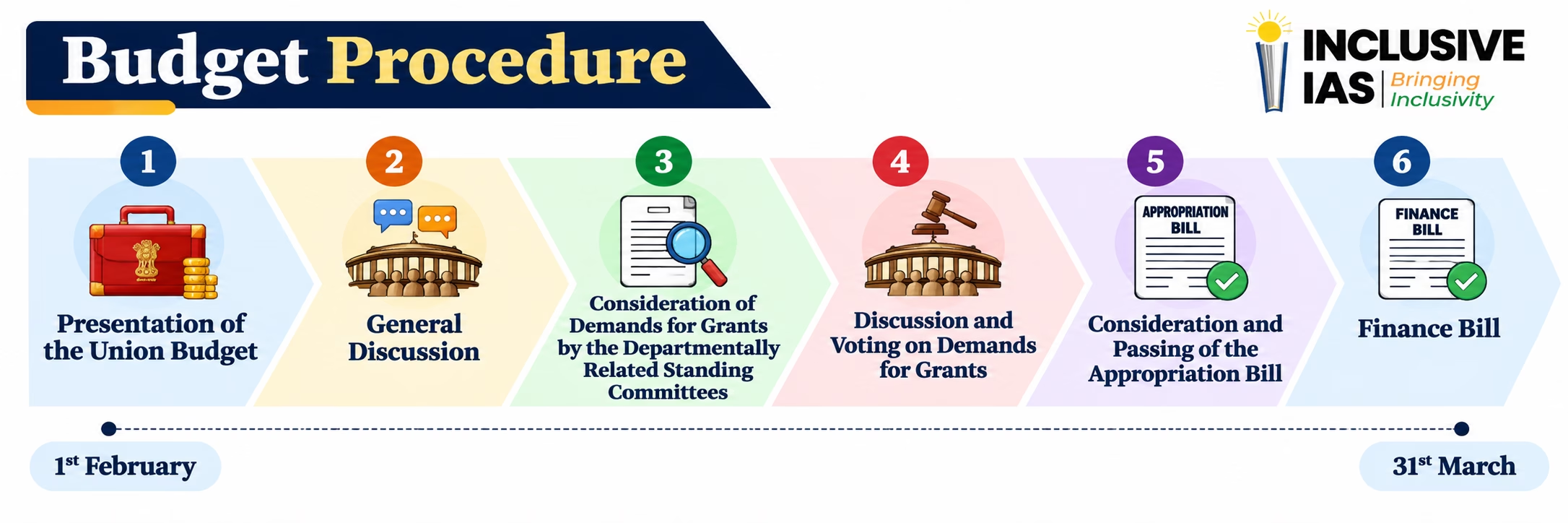
1. Presentation of the Union Budget
- The Union Budget is ordinarily presented in Parliament on 1 February at 11:00 AM.
- The Finance Minister presents the Budget in the Lok Sabha and delivers the Budget Speech.
- After the speech it is presented in the Rajya Sabha.
- No discussion takes place on the day the Budget is presented.
Major Budget Documents
Apart from the Finance Minister’s Budget Speech, the main Budget documents presented to Parliament include:
- Annual Financial Statement: Contains the estimated receipts and expenditure of the government.
- Demands for Grants: Present ministry-wise expenditure proposals requiring approval of the Lok Sabha.
- Appropriation Bill: Seeks parliamentary authorisation to withdraw money from the Consolidated Fund of India.
- Finance Bill: Gives effect to the government’s taxation proposals.
*Budgets are discussed in two stages – the General Discussion followed by detailed discussion and voting on the demands for grants.
2. General Discussion
- General discussion on the Budget is usually initiated first in the Lok Sabha and then in the Rajya Sabha as it is the prerogative of the Lok Sabha to discuss it and make modifications.
- General discussion takes place in both the Lok Sabha and Rajya Sabha.
- The general discussion on the Budget is held on the day following its presentation by the Finance Minister.
- The scope of discussion is confined to an examination of the general scheme and structure of the Budget, whether the items of expenditure ought to be increased or decreased, the policy of taxation as expressed in the Budget and in the speech of the Finance Minister.
- The Finance Minister has the general right of reply at the end of the discussion.
3. Consideration of Demands for Grants by the Departmentally Related Standing Committees (DRSCs)
- After the General Discussion on the Budget is over, the House is adjourned for a fixed period.
- During this period, the Demands for Grants of the Ministries/Departments are considered by the Departmentally Related Standing Committees.
- These Committees are required to make their reports to the House within a specified period without asking for more time and make separate reports on the Demands for Grants of each Ministry.
- Their recommendations help in informed debate, although they are not binding
4. Discussion and Voting on Demands for Grants
- The Demands for Grants are presented to Lok Sabha along with the Annual Financial Statement.
- These are not generally moved in the House by the Minister concerned.
- The Demands are assumed to have been moved and are proposed from the Chair to save the time of the House.
- After the reports of the Standing Committees are presented to the House, the House proceeds to the discussion and voting on Demands for Grants, Ministry-wise.
- The scope of discussion at this stage is confined to a matter which is under the administrative control of the Ministry and to each head of the Demand as is put to the vote of the House.
- At this stage, cut motions can be moved to reduce any demand for grant but no amendments to a motion seeking to reduce any demand is permissible.
- The time for discussion and voting of Demands for Grants is allocated by the speaker in consultation with the leader of the house.
- Guillotine: On the last of the allotted days for the discussion and voting on demands for grants, at the appointed time the Speaker puts every question necessary to dispose of all the outstanding matters in connection with the demands for grants. This is known as guillotine. The guillotine concludes the discussion on demands for grant
- It concludes the Government Budgeting discussion on demand for grants.
- In Rajya Sabha, there is only a General Discussion on the budget. It does not vote on the Demand for Grants.
Cut Motions
- The motions to reduce the amounts of demands for grants are called Cut Motions. The object of a cut motion is to draw the attention of the House to the matter.
- Cut Motions may be divided into the following three categories:-
- Disapproval of Policy Cut
- Economy Cut
- Token Cut.
- It is the Speaker who decides whether a cut motion is or not admissible.
5. Consideration and Passing of the Appropriation Bill
- After the Demands for Grants have been passed by the House, a Bill (Appropriation Bill) to provide for the appropriation out of the Consolidated Fund of India of all moneys required to meet the grants and the expenditure charged on the Consolidated Fund of India is introduced, considered and passed.
- The introduction of such a Bill cannot be opposed.
- No amendment can be proposed to an Appropriation Bill which will have the effect of varying the amount or altering the destination of any grant so made or of varying the amount of any expenditure charged on the Consolidated Fund of India and the decision of the Speaker as to whether such an amendment is admissible is final.
- An amendment to an Appropriation Bill for omission of a demand voted by the House is out of order.
Demands for Grants of Union Territories
- The Demands for Grants of Union Territories without legislatures are included in the Union Budget and approved by Parliament.
- Tax revenues collected from these Union Territories are credited to the Consolidated Fund of India.
Charged Expenditure (Article 113)
- Expenditure charged upon the Consolidated Fund of India is not subject to voting in Parliament.
- However, such expenditure can be discussed in either House of Parliament.
Voted Expenditure
- Expenditure other than charged expenditure is submitted to the Lok Sabha in the form of Demands for Grants.
- The Lok Sabha has the power to approve, reject or reduce the amount of any Demand for Grant.
6. Finance Bill
- Finance Bill means a Bill ordinarily introduced every year to give effect to the financial proposals of the Government of India for the next following financial year and includes a Bill to give effect to supplementary financial proposals for any period.
- The Finance Bill is introduced after the Budget is presented and the statements under the Fiscal Responsibility and Budget Management Act, 2003 are laid.
- The introduction of the Bill cannot be opposed. The Appropriation Bills and Finance Bills may be introduced without prior circulation of copies to members.
- The Finance Bill usually contains a declaration under the Provisional Collection of Taxes Act, 2023, allowing certain provisions relating to the imposition or increase of customs or excise duties to take effect immediately after the day on which the Bill is introduced.
- To ensure that these provisions remain in force beyond 75 days, the Finance Bill must be passed by Parliament and receive the President’s assent within 75 days of its introduction.
- As the Finance Bill contains taxation proposals, it is considered and passed by the Lok Sabha only after the Demands for Grants have been voted and the total expenditure is known.
- The scope of discussion on the Finance Bill is vast and members can discuss any action of the Government of India. The whole administration comes under review.
Appropriation and Finance Bills
- Both the Appropriation Bill and the annual Finance Bill are Money Bills.
- After being passed by the Lok Sabha, these Bills are sent to the Rajya Sabha, which must return them within 14 days, with or without recommendations.
- The Lok Sabha has the power to accept or reject the recommendations of the Rajya Sabha.
- Irrespective of whether the Lok Sabha accepts or rejects these recommendations, the Bills are deemed to have been passed by both Houses of Parliament.
Supplementary Demand for Grants
- If the amount authorized to be expended for a particular service for the current financial year is found to be insufficient for the purpose of that year or when a need has arisen during the current financial year for supplementary or additional expenditure upon some 'new service' not contemplated in the budget for that year then the President causes to be laid before both the Houses of Parliament another statement showing the estimated amount of that expenditure which is called "Supplementary Demand for Grants".
- The Supplementary Demands for Grants are presented to and passed by the House before the end of the financial year.
Demand for Excess Grants
- If any money has been spent on any service during a financial year in excess of the amount granted for the service for that year, the President causes to be presented to Lok Sabha a demand for such excess (which is called "Demand for Excess Grants").
- All cases involving such excesses are brought to the notice of Parliament by the CAG through a report on the Appropriation Accounts.
- The excesses are then examined by the Public Accounts Committee which makes recommendations regarding their regularisation in its report to the House.
- The "Demands for Excess Grants" are made after the expenditure has actually been incurred and after the financial year to which it relates has expired.
Types of Budget Based on the Period Covered
1. Full Budget
- A Full Budget presents the government’s estimated receipts and expenditure for the entire financial year.
- It provides a comprehensive account of the government’s financial position, taxation proposals and expenditure plans.
2. Interim Budget
- An Interim Budget is generally presented by the outgoing government during an election year, before the formation of a new government.
- Interim Budget presents a complete statement of estimated receipts and expenditure, similar to a Full Budget, but only for a part of the year. When the new government will be formed, it shall prepare the full budget.
- The presentation of an Interim Budget is a parliamentary convention rather than a constitutional requirement.
3. Vote on Account
- A Vote on Account is a provision under Article 116 of the Constitution that allows the government to obtain parliamentary approval for expenditure for a limited period until the full Budget is passed.
- Unlike a Full Budget or Interim Budget, a Vote on Account deals only with the expenditure side of the government’s finances.
- Before 2017: Since the Union Budget was presented on the last working day of February, Parliament could not complete the budgetary process before the beginning of the new financial year. Therefore, a Vote on Account was required to ensure continuity of government expenditure.
- Duration: Normally, the Vote on Account was taken for two months for a sum equivalent to one-sixth of the estimated expenditure for the entire year under various Demands for Grants.
- Vote on Account was passed by Lok Sabha after the General Discussion on the Budget (General and Railway) was over and before the discussion on the Demands for Grants was taken up.
- Since 2017: With the advancement of the Budget presentation to 1 February, the Demands for Grants and Appropriation Bill are generally passed before the beginning of the new financial year, reducing the need for a Vote on Account.
- During Election Years: However, during an election year, the Vote on Account may be necessary and taken for a longer period, say, 3 to 4 months if it is anticipated that the main demands and the Appropriation Bill will take longer than two months to be passed by the House.
Types of Budget Based on Budgeting Approach
1. Zero-Based Budgeting
- Zero-Based Budgeting is a method of preparing a budget in which all expenditures are calculated afresh, starting from zero, rather than simply increasing the previous year’s budget allocations by a certain percentage.
- Example: While preparing the budget for a ministry or department, all expenses are calculated afresh instead of simply increasing the previous year’s expenditure by a certain percentage.
2. Gender Budgeting
- Gender Budgeting is an approach to budgeting that integrates gender considerations into the planning, allocation and utilisation of government resources to promote gender equality.
- It aims to translate the government’s commitments towards gender equality and women’s empowerment into concrete budgetary allocations across different sectors.
- It is based on the premise that fiscal policies can affect growth, equity and the potential of human capital.
- National Policy for Empowerment of Women, 2001: As a policy tool, Gender Budgeting found its institutional basis in the National Policy for Empowerment of Women, 2001, which emphasised that “time-bound action plans to be drawn up by Ministries should specifically include, among other things, a gender perspective in the budgeting process”.
- Introduction in 2005–06: Gender Budgeting was formally adopted by the Government of India in 2005-06 as a tool for promoting gender equality and ensuring continued investments through Government planning and budgeting. Financing for gender equality is central to mitigate gender inequalities, and GB is a critical strategy in this endeavour.
- Since 2005-06, gender budgeting has been institutionalized in the Government of India annual budget. Central Ministries and Departments have been mandated to set up Gender Budgeting Cells to initiate and take forward this budgetary strategy.
3. Outcome Budgeting
- Outcome Budgeting is a method of budgeting that focuses on the results achieved through government expenditure, rather than merely the amount of money spent.
- It aims to convert financial allocations (outlays) into measurable results (outcomes) by setting specific targets for government schemes and programmes.
- It promotes transparency and accountability by assessing whether government expenditure has achieved its intended objectives.
- Outcome-based budgeting was first introduced in India in the year 2005-06.
- Example:
- Pradhan Mantri Fasal Bima Yojana (2025–26)
- Financial Outlay: ₹12,242.27 crore allocated for the scheme.
- Output: Increasing crop insurance coverage, with a target of 14 crore farmer applications.
- Outcome: Improving financial protection against agricultural risks
- Pradhan Mantri Fasal Bima Yojana (2025–26)