
Home
Our Courses
Blog Contact Us

Derivatives

Shape Image One

Derivatives

Derivatives refers to the financial instruments which derive their value from an underlying security or financial instrument. The underlying products can be equity, commodity, currency, etc.Derivatives are traded on stock exchanges like NSE, BSE, etc. and the over-the-counter (OTC) market.

Example

Suppose Ravi enters into a contract today to buy shares of Company X after one month at ₹1,000 per share.

  • If the market price after one month becomes ₹1,200, buying at ₹1,000 is advantageous to Ravi.
  • If the market price falls to ₹800, the contract may result in a loss or disadvantage depending on the type and terms of the derivative.

Thus, the value of the derivative changes with the value of the underlying share.
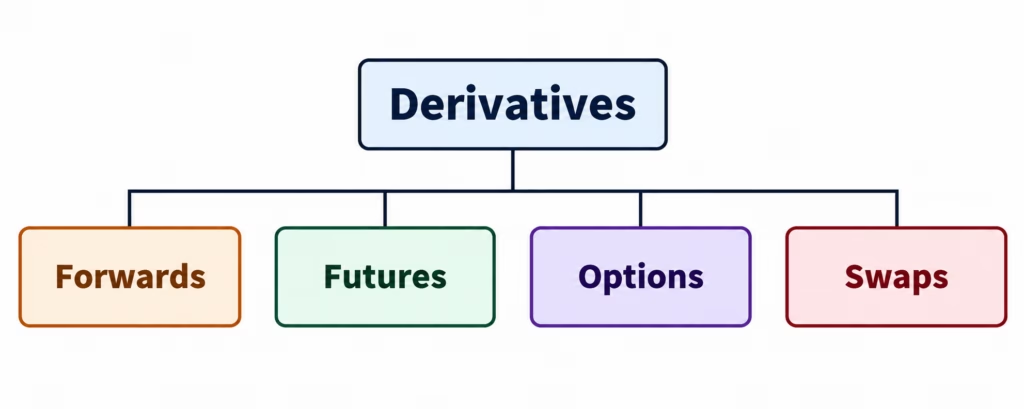
Major Types of Derivatives

  • Futures: Standardised contracts to buy or sell an underlying asset at a predetermined price on a specified future date.
  • Forwards: Similar to futures but are generally privately negotiated contracts between parties rather than standardised exchange traded contracts.
  • Options: Give the buyer the right, but not the obligation, to buy or sell the underlying asset at a predetermined price within or on a specified period/date.
  • Swaps: Agreements in which parties exchange specified cash flows, such as fixed interest payments for floating interest payments.

Futures

  • Futures contracts are standardised agreements between two parties to buy or sell an underlying asset at a pre-agreed price on a specified date. 
  • These contracts are traded on exchanges, which standardise their terms, including lot size and expiration date.
  • Credit risk is reduced with futures contracts because they are settled through clearing houses, which guarantee the transaction by acting as the counterparty for both sides.
  • Futures may be based on stocks, stock indices, commodities, currencies, interest rates and other permitted underlying assets.

Forwards

  • Forward contracts are similar to futures but are private agreements between two parties to buy or sell an asset at a fixed price on a future date.
  • Forwards offer flexibility in customisation, making them suitable for tailor-made hedging solutions.
  • Unlike futures, they are not standardised and generally do not have a clearing corporation guaranteeing the transaction.

Options

  • Options provide the buyer with the right, but not the obligation, to buy (call option) or sell (put option) an underlying asset at a predetermined price within a specified time. 
    • The most crucial element of this options contract is that it only gives you the right to conduct a transaction but does not make it necessary for you to indulge in it.
  • Types:
    • Call option: The call option gives the buyer the right to buy the underlying security from the seller at a predefined price on the date of settlement/expiry. 
      • Traders usually buy call options when they expect the underlying security’s price to rise in the future or to hedge against such an increase in prices.
    • Put option: This options contract gives the buyer the right to sell the underlying asset at a predefined price on the maturity date of such a contract.
      • Traders usually buy put options when they expect the underlying security’s price to decline in the future or to hedge against such a decrease in prices.

Swaps

  • A swap is a derivative contract where two parties exchange cash flows or liabilities of financial instruments.
  • In swap contracts, the principal amount usually is not transferred.

Uses of Derivatives

  • Hedging or Risk Management:Derivatives help individuals and businesses protect themselves against adverse movements in prices, interest rates, exchange rates or commodity prices.
  • Price Certainty: They allow parties to fix or lock in a future price, reducing uncertainty about future costs or revenues.
  • Speculation: Traders can use derivatives to profit from expected increases or decreases in the price of an underlying asset.
  • Arbitrage: Traders can benefit from price differences for the same or related assets across different markets by buying at a lower price and selling at a higher price.
  • Price Discovery: Trading in derivatives reflects market expectations about future prices, helping in price discovery.

FAQs

1. What is a derivative?
A derivative is a financial instrument whose value depends upon an underlying asset, security, rate or financial variable.

2. What can be the underlying asset of a derivative?
Underlying assets or variables can include shares, stock indices, commodities, currencies and interest rates.

✍️ Curated by InclusiveIAS Editorial Team

At InclusiveIAS, our editorial team is led by experts who have successfully cleared multiple stages of the UPSC Civil Services Examination, including Mains and Interview. With deep insights into the demands of the exam, we focus on crafting content that is accurate, exam-relevant, and easy to grasp.

Whether it’s Polity, Current Affairs, GS papers, or Optional subjects, our notes are designed to:

  • Break down complex topics into simple, structured points

  • Align strictly with the UPSC syllabus and PYQ trends

  • Save your time by offering crisp yet comprehensive coverage

  • Help you score more with smart presentation, keywords, and examples

🟢 Every article, note, and test is not just written—but carefully edited to ensure it helps you study faster, revise better, and write answers like a topper.