

GS Paper 4 Ethics
Dimensions of Ethics
The dimensions of ethics refer to the different approaches through which moral beliefs, principles and human behaviour are studied, evaluated and applied.
Ethics is broadly classified into four dimensions
- Descriptive Ethics
- Normative Ethics
- Meta-Ethics
- Applied Ethics
Descriptive Ethics
Descriptive ethics is concerned with studying and understanding the moral beliefs, values and practices that individuals and societies actually follow.
- It examines what people consider right or wrong, rather than prescribing how they ought to behave.
- It studies what people actually believe and practise about morality, without judging it → e.g. comparing attitudes to euthanasia or capital punishment across societies.
- It studies how moral beliefs and practices vary across cultures, societies and historical periods.
- Examples:
- Changing Attitudes Towards LGBTQ+ Rights: Descriptive ethics records how attitudes towards LGBTQ+ individuals in India have shifted over time.
Normative Ethics
- Normative ethics is concerned with establishing moral principles and standards that determine how individuals ought to behave.
- It provides principles for evaluating human conduct and making ethical decisions.
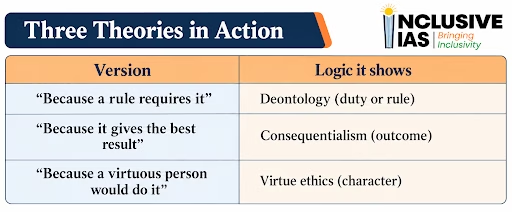
- The three major theories of normative ethics are Deontology, Consequentialism and Virtue Ethics.
- Deontology (Duty-Based Ethics)
- Deontology is an ethical theory that evaluates the morality of an action based on whether it conforms to moral duties, rules and principles, rather than its consequences.
- Example
- An individual tells the truth because honesty is a moral duty, even when lying would bring personal benefits or avoid blame, since the act is right in itself regardless of its outcome.
- Example
- Deontology is an ethical theory that evaluates the morality of an action based on whether it conforms to moral duties, rules and principles, rather than its consequences.
- Consequentialism (Outcome-Based Ethics)
- Consequentialism is an ethical theory that evaluates the morality of an action based on its consequences or outcomes.
- It holds that an action is morally right if it produces the best overall consequences, compared with the available alternatives.
- Utilitarianism
- Utilitarianism is a major form of consequentialism. It holds that actions should maximise overall happiness or well-being.
- Example
- Allocating limited disaster-relief resources to the area where they will save the most lives.
- Example
- Utilitarianism is a major form of consequentialism. It holds that actions should maximise overall happiness or well-being.
- Consequentialism is an ethical theory that evaluates the morality of an action based on its consequences or outcomes.
- Virtue Ethics
- Virtue ethics is an ethical theory that focuses on the moral character of individuals rather than judging actions solely by rules or consequences.
- It emphasises the cultivation of virtues such as honesty, courage, compassion, integrity, justice and self-discipline.
- It holds that ethical behaviour arises from good moral character and the habitual practice of virtues
- Right action is what a virtuous person would do.
- The question is not “what is my duty?” or “what gives the best result?” but “what would a virtuous person do?”
- An officer treats a poor, frightened citizen with patience and respect, because that is what a compassionate and virtuous person would do
- The question is not “what is my duty?” or “what gives the best result?” but “what would a virtuous person do?”
- Deontology (Duty-Based Ethics)
Meta Ethics
- Meta-ethics is the branch of ethics that examines the meaning, nature and foundations of moral concepts and judgments.
- It does not ask what is right or wrong, but what “right” and “wrong” actually mean and whether moral claims can be true.
- Key questions
- Meaning of moral terms: What do good, bad, right, wrong and ought mean?
- Objectivity vs subjectivity: Are moral values universal and objective, or subjective and dependent on individual or cultural beliefs?
- Truth of moral judgments: Can “corruption is wrong” be true or false, or does it only express feelings?
- Source of morality: Does morality come from reason, God, society, human nature or emotion?
- Moral knowledge: Can we know moral truths, and how are they justified?
- Moral motivation: Why should a person act morally?
- Key Schools of Meta-Ethics
- Moral Realism
- Moral realism holds that objective moral facts or truths exist independently of individual beliefs, emotions or social approval.
- The statement "Torturing innocent people is wrong" can be objectively true, even if a society considers such conduct acceptable.
- Moral realism holds that objective moral facts or truths exist independently of individual beliefs, emotions or social approval.
- Moral Relativism
- Moral relativism holds that the truth or validity of moral judgments depends on the standards of a particular culture or society, rather than on universal moral standards.
- Moral standards vary across societies, cultures and historical periods.
- An action considered acceptable in one cultural context may be considered wrong in another.
- Polygamy is considered morally acceptable in certain societies and religious traditions, while it is regarded as morally unacceptable in others that emphasise monogamous marriage.
- Moral Subjectivism
- Moral subjectivism holds that moral judgments depend on the attitudes, feelings or beliefs of individuals, rather than objective moral facts.
- Moral judgments reflect individual moral perspectives.
- Different individuals can make conflicting moral judgments because their attitudes differ.
- “Capital punishment is right” is only the speaker’s personal approval.
- Emotivism
- Emotivism holds that moral statements primarily express emotions or attitudes rather than describe moral facts.
- It states that moral statements like "stealing is wrong" do not report real-world facts. Instead, they voice personal feelings (like "boo to stealing") and try to change other people's minds.
- Saying "Corruption is wrong" expresses disapproval of corruption, similar to saying "Down with corruption!"
- Error Theory
- Moral error theory holds that people make moral judgments as if there are objective moral truths, but in reality, no such objective moral truths exist. So all positive moral claims are false
- When someone says, “Stealing is morally wrong,” they assume that stealing is objectively wrong. However, according to error theory, no objective moral fact exists that makes stealing morally wrong, so the claim is false.
- Moral error theory holds that people make moral judgments as if there are objective moral truths, but in reality, no such objective moral truths exist. So all positive moral claims are false
- Moral Realism
Applied Ethics
Applied ethics is the branch of ethics concerned with the application of moral principles and ethical theories to practical problems and real-life situations.
Major Areas of Applied Ethics
- Medical Ethics
- Medical ethics deals with moral principles and ethical issues arising in healthcare, medical treatment and patient care.
- Major Principles
- Autonomy: Respecting patients' rights to make informed decisions about their treatment.
- Beneficence: Acting in the best interests of patients and promoting their well-being.
- Non-Maleficence: Avoiding unnecessary harm to patients.
- Justice: Ensuring fair and equitable access to healthcare and medical resources.
- Key Issues
- Euthanasia: Ethical conflict between respecting patient autonomy, relieving suffering and preserving human life.
- Abortion: Raises questions regarding reproductive autonomy, the moral status of the foetus and the protection of life.
- Organ Transplantation: Ethical concerns regarding fair allocation of scarce organs, organ trafficking and exploitation of vulnerable individuals.
- Informed Consent: Providing medical treatment without adequately informing patients or obtaining their voluntary consent.
- Business Ethics
- Business ethics examines moral principles and ethical issues arising in business operations, corporate decision-making and relationships with stakeholders.
- Major Principles
- Honesty and Integrity: Maintaining truthfulness and ethical conduct in business transactions.
- Fairness: Ensuring fair treatment of employees, consumers, suppliers and competitors.
- Fair Trade and Competition: Ensuring that businesses engage in fair competition, without exploitation or deceptive practices.
- Transparency: Conducting business openly and honestly, ensuring that stakeholders have access to the information they need to make informed decisions.
- Accountability: Holding businesses responsible for their decisions and practices.
- Social Responsibility: Considering the impact of business activities on society and the environment.
- Key Issues
- Corporate Fraud: Manipulation of financial records and deliberate deception of investors, regulators or other stakeholders.
- Misleading Advertisements: Providing false or exaggerated information that deceives consumers and influences their purchasing decisions.
- Unfair Labour Practices: Exploitation of workers through unsafe working conditions, discriminatory treatment or denial of fair wages.
- Conflicts of Interest: Personal financial interests improperly influencing business decisions and professional responsibilities.
- Environmental Damage: Pursuit of business profits at the expense of environmental protection and public health.
- Environmental Ethics
- Environmental ethics explores the moral relationship between humans and the natural environment, and the responsibilities humans have to protect and preserve nature.
- Major Principles
- Sustainability: Promoting the responsible use of natural resources to ensure that future generations can meet their own needs.
- Stewardship: The belief that humans have a duty to care for the Earth and its ecosystems.
- Environmental Justice: Ensuring fair distribution of environmental benefits and burdens.
- Responsibility: Recognising human obligations to prevent environmental degradation and protect ecological systems.
- Respect for Nature: Recognising the moral importance of ecosystems, biodiversity and other living beings.
- Key Issues
- Deforestation and Biodiversity Loss: Destruction of natural habitats and ecosystems through irresponsible human activities.
- Climate Change: Ethical questions regarding responsibility for greenhouse gas emissions and their unequal impacts on vulnerable populations.
- Overexploitation of Natural Resources: Excessive extraction and consumption of resources at the expense of ecological sustainability.
- Animal Rights: Ethical concerns regarding animal cruelty, exploitation and the use of animals for experimentation.
- Administrative Ethics
- Administrative ethics deals with moral principles and ethical standards governing the conduct and decisions of public officials.
- Major Principles
- Integrity: Maintaining honesty and adherence to moral principles in public service.
- Impartiality: Making decisions without favouritism, prejudice or discrimination.
- Objectivity: Basing administrative decisions on facts, evidence and merit.
- Accountability: Being answerable for official decisions and actions.
- Public Service: Placing public interest above personal or sectional interests.
- Key Issues
- Corruption: Misuse of public office and authority for private gain, undermining public interest and institutional integrity.
- Favouritism and Nepotism: Granting undue advantages based on personal relationships rather than merit and fairness.
- Conflicts of Interest: Situations where the personal interests of public officials improperly influence their official decisions.
- Whistleblowing: Ethical conflict between exposing wrongdoing in the public interest and maintaining organisational loyalty or confidentiality.
- Abuse of Discretionary Powers: Arbitrary or biased exercise of administrative authority, resulting in unfair treatment and injustice.
- Technology Ethics
- Technology ethics examines moral principles and ethical issues associated with the development, deployment and use of technology.
- Major Principles
- Privacy: Respecting individuals' rights to control their personal information.
- Fairness: Preventing discrimination and unjust treatment through technological systems.
- Digital Inclusion: Ensuring that all individuals have equal access to technology and digital resources, particularly marginalized groups.
- Transparency: Ensuring clarity about how technologies operate and influence decisions.
- Accountability: Establishing responsibility for the development and consequences of technological systems.
- Safety: Protecting individuals and society from preventable technological harm.
- Key Issues
- Data Privacy: Collection, use or disclosure of personal information without appropriate consent or safeguards.
- Algorithmic Bias: Discriminatory outcomes produced by automated systems due to biased data or flawed design.
- Misuse of Artificial Intelligence: Use of AI to generate deepfakes, spread misinformation or manipulate public opinion.
- Digital Surveillance: Ethical concerns regarding excessive monitoring of individuals and violations of privacy and personal freedom.
- Autonomous Weapons: Ethical questions regarding delegating life-and-death decisions to machines without meaningful human control.
- Media Ethics
- Media ethics deals with moral principles and ethical responsibilities associated with journalism, mass communication and dissemination of information.
- Major Principles
- Truthfulness: Reporting accurate and verified information.
- Objectivity: Presenting information fairly without deliberate distortion or manipulation.
- Independence: Maintaining editorial freedom from undue political, commercial or personal influence.
- Respect for Privacy: Protecting individuals from unjustified intrusion into their private lives.
- Accountability: Taking responsibility for published information and correcting errors.
- Key Issues
- Fake News and Misinformation: Dissemination of false or misleading information that distorts public understanding and undermines informed decision-making.
- Sensationalism: Exaggerated or emotionally provocative reporting intended to attract attention at the expense of accuracy and responsible journalism.
- Invasion of Privacy: Unjustified disclosure of personal information or intrusion into private lives in the name of public interest.
- Media Bias: Selective presentation or distortion of information to favour particular political, commercial or ideological interests.
- Trial by Media: Portraying individuals as guilty before judicial determination, undermining the presumption of innocence and fair trial.
- International Ethics
- International ethics deals with the moral principles and ethical responsibilities governing relations among nations, international organisations and other global actors.
- Major Principles
- Respect for Sovereignty: Recognising the independence, territorial integrity and political autonomy of nations.
- Justice and Fairness: Promoting equitable treatment of nations and fair distribution of global resources, opportunities and responsibilities.
- Respect for Human Rights: Protecting the fundamental rights and dignity of individuals irrespective of nationality, religion or ethnicity.
- Peaceful Coexistence: Resolving international disputes through dialogue, diplomacy and peaceful means rather than aggression or violence.
- International Cooperation: Encouraging collective action to address global challenges such as climate change, poverty, pandemics and humanitarian crises.
- Global Responsibility: Recognising that nations have moral responsibilities extending beyond their borders, particularly towards vulnerable populations and future generations.
- Key Issues
- War and Armed Conflicts: Ethical concerns regarding the use of military force, civilian casualties, proportionality and protection of non-combatants.
- Humanitarian Intervention: Ethical dilemma between respecting state sovereignty and protecting populations from genocide, war crimes and other mass atrocities.
- Climate Justice: Unequal historical contributions to greenhouse gas emissions and disproportionate climate impacts on vulnerable countries, raising questions about responsibility and burden-sharing.
- Refugees and Migration: Ethical responsibilities of states towards refugees and displaced persons, including protection, humanitarian assistance and respect for human dignity.
- International Trade and Economic Relations: Unfair trade practices, exploitation of workers and unequal bargaining power that undermine fairness in the global economic system.
- Compliance with International Commitments: Failure to honour treaties, agreements and humanitarian obligations, undermining mutual trust and international cooperation.
- Sports Ethics
- Sports ethics deals with the moral principles and ethical standards governing the conduct of athletes, coaches and sporting organisations. It promotes fairness, integrity, respect and responsible behaviour in sports.
- Major Principles
- Fair Play: Competing honestly and following the rules without seeking unfair advantages.
- Integrity: Maintaining honesty and rejecting cheating, doping and manipulation of sporting outcomes.
- Respect: Treating opponents, teammates, officials and spectators with dignity and sportsmanship.
- Equality and Non-Discrimination: Ensuring fair opportunities and treatment regardless of gender, race, religion or social background.
- Accountability: Holding athletes, officials and sporting organisations responsible for their conduct and decisions.
- Sportsmanship: Demonstrating humility in victory, dignity in defeat and respect for the spirit of competition.
- Key Issues
- Doping: Use of prohibited performance-enhancing substances or methods to gain an unfair competitive advantage, undermining fairness and athlete health.
- Match-Fixing: Deliberate manipulation of sporting results for financial or other benefits, compromising the integrity of competitions.
- Corruption in Sports Administration: Bribery, favouritism and misuse of authority in team selection, allocation of funds and organisation of sporting events.
- Gender Discrimination: Unequal opportunities, remuneration, facilities and recognition for athletes based on gender.
- Harassment and Abuse: Physical, psychological or sexual harassment of athletes by coaches, officials or others in positions of authority.
- Age Fraud: Falsification of athletes' ages to gain eligibility or unfair advantages in age-restricted competitions.
- Unfair Selection Practices: Selection of athletes based on personal connections, political influence or favouritism rather than merit and performance.
- Violence and Unsporting Behaviour: Aggression, deliberate fouls, intimidation and disrespect towards opponents or officials, undermining the spirit of sportsmanship.
- Social Media Ethics
- Social media ethics deals with the moral principles and ethical responsibilities governing the creation, sharing and consumption of content on social media platforms. It emphasises responsible communication, respect for others, privacy and integrity in digital interactions.
- Major Principles
- Truthfulness: Sharing accurate and verified information while avoiding the deliberate spread of false or misleading content.
- Respect for Privacy: Protecting personal information and respecting individuals' consent before sharing their private details or content.
- Respect and Dignity: Treating others with respect and avoiding abusive, discriminatory or degrading behaviour in online interactions.
- Accountability: Taking responsibility for the content shared and its consequences for individuals and society.
- Transparency: Clearly disclosing sponsored content, paid promotions and commercial interests that influence online communication.
- Freedom of Expression: Respecting the right to express opinions while recognising ethical responsibilities towards the rights and dignity of others.
- Key Issues
- Misinformation and Disinformation: Spread of false or misleading information that distorts public understanding, creates confusion and undermines informed decision-making.
- Cyberbullying and Online Harassment: Use of social media to intimidate, threaten, humiliate or repeatedly target individuals, causing psychological and reputational harm.
- Hate Speech: Dissemination of content that promotes hostility, discrimination or violence against individuals or communities based on their identity.
- Privacy Violations: Sharing personal information, photographs or private communications without consent, violating individual privacy and dignity.
- Online Trolling: Deliberate use of abusive, provocative or insulting content to harass individuals and disrupt meaningful discussions.
- Digital Addiction: Excessive use of social media that interferes with mental well-being, personal relationships, productivity and daily responsibilities.
- Echo Chambers and Polarisation: Repeated exposure to similar opinions and selective information that reinforces existing beliefs and deepens social or political divisions.
- Deepfakes and Impersonation: Creation or circulation of manipulated images, videos or fake identities to deceive others, damage reputations or commit fraud.
- Undisclosed Paid Promotions: Influencers promoting products or services without revealing financial relationships, misleading audiences and undermining consumer trust.