Government Securities
A Government Security (G-Sec) is a tradable debt instrument issued by the Central Government or State Governments. It represents the government’s obligation to repay the borrowed amount according to the terms of the security.
Government securities carry very low default risk because they are backed by the sovereign.For this reason, they are commonly referred to as risk-free or gilt-edged securities
Government securities are short term (usually called Treasury Bills, with original maturities of less than one year) or long term (usually called Government Bonds or Dated Securities with original maturity of one year or more).
Issuers
- The Central Government issues both:
- Treasury Bills
- Government Bonds or Dated Securities
- The State Governments issue only long-term dated securities, known as State Development Loans (SDLs).The State governments do not issue any treasury bills.
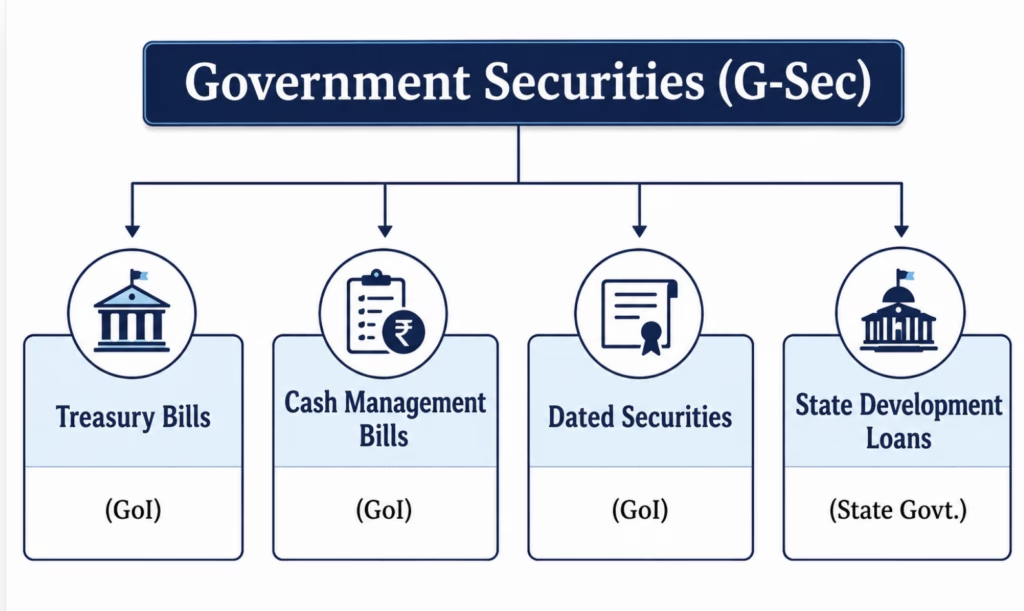
Types of Government Securities
- Treasury bills or T-bills:
- Cash Management Bills (CMB)
- Dated Securities
- State Development Loans (SDL)
Note:All the four types of Government Securities qualify as eligible securities for maintaining the Statutory Liquidity Ratio (SLR):
1.Treasury bills or T-bills
- Debt obligations of the Government that have maturities of less than one year called Treasury Bills or T-Bills.
- Treasury bills are money market instruments.
- These are presently issued in three tenors, namely, 91 day, 182 day and 364 day.
- These are zero coupon securities and pay no interest.Instead, they are issued at a discount to the face value and redeemed at the face value at maturity
- Example:
- Suppose a 91-day Treasury Bill has a face value of ₹100 but is issued at ₹98.20.
- At maturity, the government repays ₹100.
- Therefore:
- Return = ₹100 − ₹98.20 = ₹1.80
- Thus, the investor earns a return of ₹1.80 without receiving any separate interest payment.
- Treasury Bills are issued only by the Central Government (Government of India). State Governments do not issue Treasury Bills
- T-Bills are available in both the primary market, where they are newly issued, and the secondary market, where they can be traded after issuance.
2.Cash Management Bills (CMB)
- Cash Management Bills (CMBs) are short-term money market instruments introduced by the Government of India in consultation with the RBI in May,2010.
- They are issued to meet temporary mismatches in the cash flows of the Central Government.
- CMBs are similar to Treasury Bills in their basic features, but they have a maturity of less than 91 days.
- Key Features of CMBs
- Maturity: CMBs have a maturity period of less than 91 days.
- Zero-Coupon Instruments:These are zero coupon securities and pay no interest.
- Discounted Redemption:Similar to Treasury Bills, CMBs are issued at a discount and redeemed at face value upon maturity. For instance, if a cash management bill has a face value of Rs 100, it can be acquired at Rs 97, and upon maturity, typically after 60 days, it can be redeemed for Rs 100. No interest payment is made, but the discount is the return on investment.
- Flexible Tenure: The tenure, total quantity of CMBs to be issued (notified amount), and date of issuance depend on the temporary cash requirements of the Government.
- SLR Eligibility: CMBs are eligible as Statutory Liquidity Ratio (SLR) securities.
- CMBs are traded in the money market.
3.Dated Securities
- Dated Securities are basically long-term securities issued by the Central Government.
- These are usually long term in nature (maturities of more than one year). Generally, the tenor of dated securities ranges from 5 years to 40 years.
- Dated Securities carry a fixed or floating coupon (interest rate) which is paid on the face value, on a half-yearly basis.
- They qualify as SLR instruments and can also be placed as collaterals for market repo borrowing as well as borrowing under RBI’s Liquidity Adjustment Facility (LAF).
4.State Development Loans
- State Development Loans (SDLs) are dated securities issued by State Governments to raise funds from the market.
- They are issued through auctions conducted in a manner similar to Central Government dated securities.
- Interest is serviced at half-yearly intervals and the principal is repaid on the maturity date.
- Like dated securities issued by the Central Government, SDLs issued by the State Governments also qualify for SLR.
- They are also eligible as collaterals for borrowing through market repo as well as borrowing by eligible entities from the RBI under the Liquidity Adjustment Facility (LAF) and special repo conducted under market repo by CCIL
RBI and Management of Government Securities
- The Reserve Bank of India (RBI) manages and services both Government of India Securities and State Government Securities.
- Management of State Government Debt:
- Under Section 21A(1)(b) of the RBI Act, 1934, the RBI may, through an agreement with a State Government, undertake the management of the public debt of that State.
- Accordingly, the RBI manages the public debt of the State Governments and the Union Territory of Puducherry with which it has entered into such agreements.
How are the G-Secs issued?
- G-Secs are issued through auctions conducted by RBI.
- Auctions are conducted on the electronic platform called the E-Kuber, the Core Banking Solution (CBS) platform of RBI.
- Thus, e-Kuber is the electronic platform used for primary-market issuance and auction of Government Securities.
- Commercial banks, scheduled UCBs, Primary Dealers , insurance companies and provident funds, who maintain funds account (current account) and securities accounts (Subsidiary General Ledger (SGL) account) with RBI, are members of this electronic platform. All members of E-Kuber can place their bids in the auction through this electronic platform.
Types of Auctions
- An auction may either be yield based or price based.
- Yield Based Auction: A yield-based auction is generally conducted when a new G-Sec is issued.
- Price Based Auction: A price based auction is conducted when the Government of India re-issues securities which have already been issued earlier.
- Depending upon the method of allocation to successful bidders, auctions may be conducted on Uniform Price basis or Multiple Price basis. In a Uniform Price auction, all the successful bidders are required to pay for the allotted quantity of securities at the same rate, i.e., at the auction cut-off rate, irrespective of the rate quoted by them. On the other hand, in a Multiple Price auction, the successful bidders are required to pay for the allotted quantity of securities at the respective price / yield at which they have bid.
- An investor, depending upon his eligibility, may bid in an auction under either of the following categories:
- Competitive Bidding: In a competitive bidding, an investor bids at a specific price / yield and is allotted securities if the price / yield quoted is within the cut-off price / yield. Competitive bids are made by well-informed institutional investors such as banks, financial institutions, PDs, mutual funds, and insurance companies.
- Non-Competitive Bidding (NCB):With a view to encouraging wider participation and retail holding of Government securities, retail investors are allowed participation on “non-competitive” basis in select auctions of dated Government of India (GoI) securities and Treasury Bills.
Trading in Government Securities (G-Secs)
Government Securities have an active secondary market, where already-issued securities can be bought and sold among investors.
G-Secs can be traded through the following mechanisms:
- Negotiated Dealing System – Order Matching (NDS-OM)
- Over the Counter (OTC) and reported on NDS-OM
- NDS-OM Web
- Stock Exchanges
Role of the Clearing Corporation of India Limited (CCIL)
- The CCIL is the clearing agency for G-Securities.
- It acts as a Central Counter Party (CCP) for all transactions in G-Secs by interposing itself between two counterparties. In effect, during settlement, the CCP becomes the seller to the buyer and buyer to the seller of the actual transaction. All outright trades undertaken in the OTC market and on the NDS-OM platform are cleared through the CCIL.
FAQs
1. What is a Government Security or G-Sec?
A Government Security is a tradable debt instrument issued by the Central or State Governments representing their obligation to repay borrowed funds according to specified terms.
2. Why are Government Securities considered low-risk investments?
Government securities carry very low default risk because they are backed by the sovereign. They are therefore commonly described as gilt-edged securities.
3. What are the major types of Government Securities in India?
The major instruments covered under the government securities framework include Treasury Bills, Cash Management Bills, Central Government dated securities and State Development Loans.
4. What is the difference between Treasury Bills and dated securities?
Treasury Bills are short-term Central Government securities with maturities of less than one year. Dated securities have maturities of one year or more and generally make periodic coupon payments.
✍️ Curated by InclusiveIAS Editorial Team
At InclusiveIAS, our editorial team is led by experts who have successfully cleared multiple stages of the UPSC Civil Services Examination, including Mains and Interview. With deep insights into the demands of the exam, we focus on crafting content that is accurate, exam-relevant, and easy to grasp.
Whether it’s Polity, Current Affairs, GS papers, or Optional subjects, our notes are designed to:
Break down complex topics into simple, structured points
Align strictly with the UPSC syllabus and PYQ trends
Save your time by offering crisp yet comprehensive coverage
Help you score more with smart presentation, keywords, and examples
🟢 Every article, note, and test is not just written—but carefully edited to ensure it helps you study faster, revise better, and write answers like a topper.