


Liquidity Adjustment Facility (LAF)
Liquidity Adjustment Facility (LAF) refers to the Reserve Bank of India’s operations through which it injects liquidity into or absorbs liquidity from the banking system.
The full fledged LAF was introduced by the RBI on 5 June 2000. Before this, the RBI had introduced an Interim Liquidity Adjustment Facility (ILAF) in April 1999 as a transitional arrangement.
The LAF was introduced following the recommendations of the Narasimham Committee on Banking Sector Reforms (1998).
Purpose
- To help banks meet daily liquidity mismatches (shortages or excesses of funds).
- To allow RBI to absorb surplus liquidity from the banking system.
How LAF Works?
Liquidity Shortage → RBI Injects Liquidity
Excess Liquidity → RBI Absorbs Liquidity
Who Can Access the Liquidity Adjustment Facility (LAF)?
- The principal participants eligible to access RBI’s LAF are:
- Scheduled Commercial Banks (SCBs), excluding Regional Rural Banks (RRBs)
- Primary Dealers (PDs)
- What about NBFCs?
- All Non-Banking Financial Companies (NBFCs) cannot access the Reserve Bank of India’s Liquidity Adjustment Facility (LAF), but Standalone Primary Dealers (SPDs), which are registered as NBFCs, are specifically authorized by the RBI to access the LAF.
As per the RBI guidelines for Primary Dealers:
“A non-bank entity applying for permission to undertake PD business shall obtain Certificate of Registration as an NBFC under Section 45-IA of the RBI Act, 1934.”
Thus, NBFCs generally do not have access to the LAF merely by virtue of being NBFCs. However, Standalone Primary Dealers (SPDs), which are registered as NBFCs and authorised by the RBI to undertake Primary Dealer business, can access the LAF.
Instruments under LAF
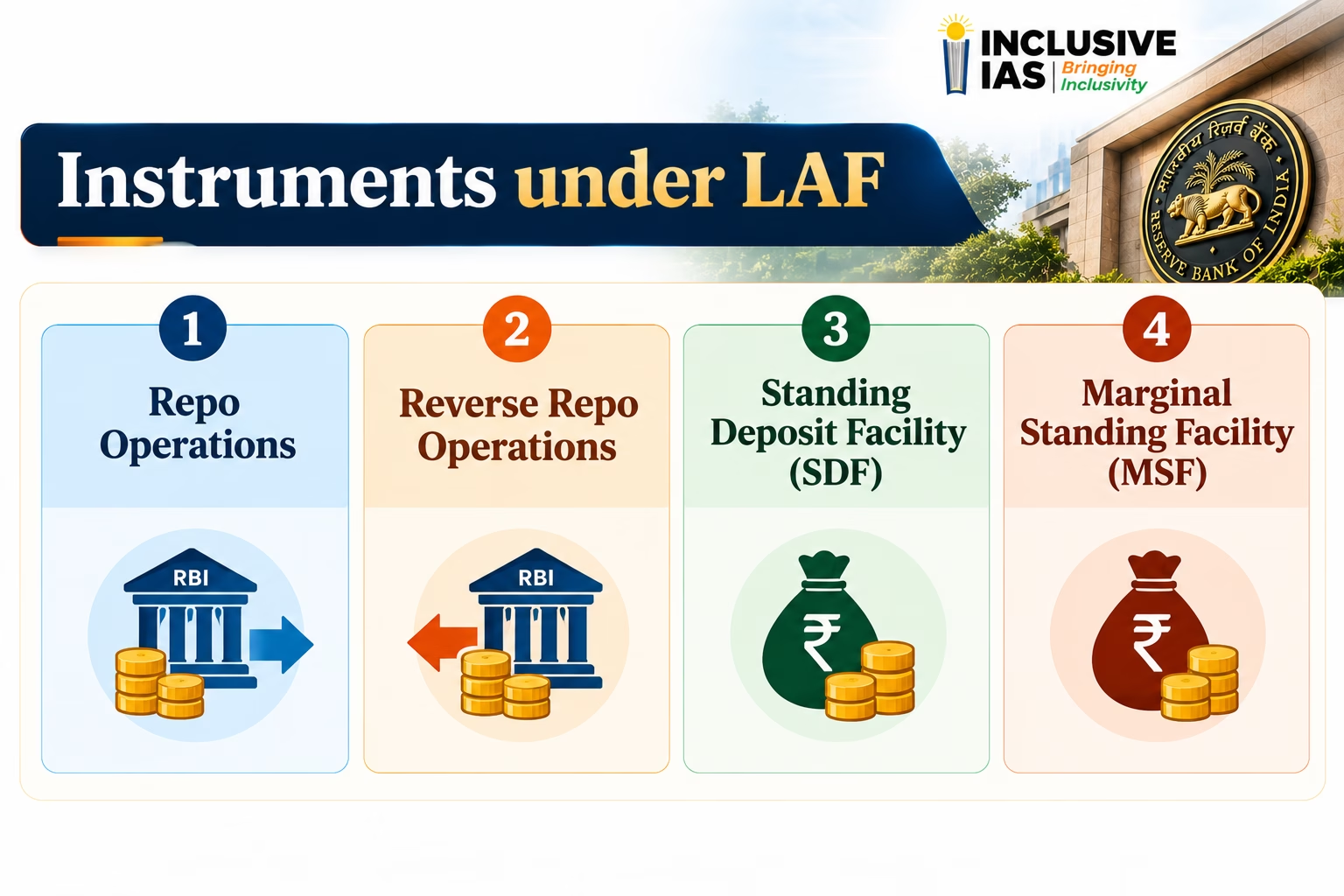
LAF consists of overnight as well as term repo/reverse repos (fixed as well as variable rates), Standing Deposit Facility (SDF) and Marginal Standing Facility (MSF).
Apart from LAF, instruments of liquidity management include outright Open Market Operations (OMOs), Forex Swaps and Market Stabilisation Scheme (MSS).
Repo
- When banks need liquidity to meet its daily requirement, they borrow from RBI through repo.
- Banks borrow funds from RBI by pledging government securities.
- The rate at which they borrow funds is called the repo rate.
- Repo operations therefore inject liquidity into the system.
Reverse Repo
- Reverse repo is when RBI borrows from the market (absorbs excess liquidity) on the basis of securities and repurchases them the next day or after a few days.
- The rate at which it borrows is called reverse repo rate as it is the reverse of the repo operation.
- Reverse repo operation therefore absorbs the liquidity in the system.
Standing Deposit Facility (SDF)
- The Standing Deposit Facility (SDF) is a facility under the Liquidity Adjustment Facility (LAF) through which the RBI absorbs liquidity from the banking system without providing any collateral.
- Introduction: The Finance Act, 2018 amended Section 17 of the RBI Act, 1934, empowering the RBI to introduce the SDF.
- The SDF was actually introduced on 8 April 2022.
- Eligibility: All participants eligible under the LAF are eligible to participate in the SDF.
- Tenor: Eligible entities can ordinarily place funds with RBI on an overnight basis. RBI can also use SDF to absorb liquidity for longer tenors when required. The SDF is available on all days of the week, throughout the year.
- SDF Rate: It is the rate at which the Reserve Bank accepts uncollateralised deposits, on an overnight basis, from all LAF participants. It is normally placed 25 basis points below the policy repo rate.
- Floor of LAF Corridor: With the introduction of SDF, the SDF rate replaced the fixed reverse repo rate as the floor of the LAF corridor.
Marginal Standing Facility (MSF)
- Marginal Standing Facility, introduced in 2011, allows scheduled commercial banks to borrow additional overnight funds from the Reserve Bank, beyond what they can access through the repo window.
- Under this arrangement, banks can dip into their Statutory Liquidity Ratio (SLR) holdings up to a specified limit (2%) and borrow at a penal rate of interest.
- This provides a safety valve against unanticipated liquidity shocks to the banking system.
- The MSF rate is placed at 25 basis points above the policy repo rate.
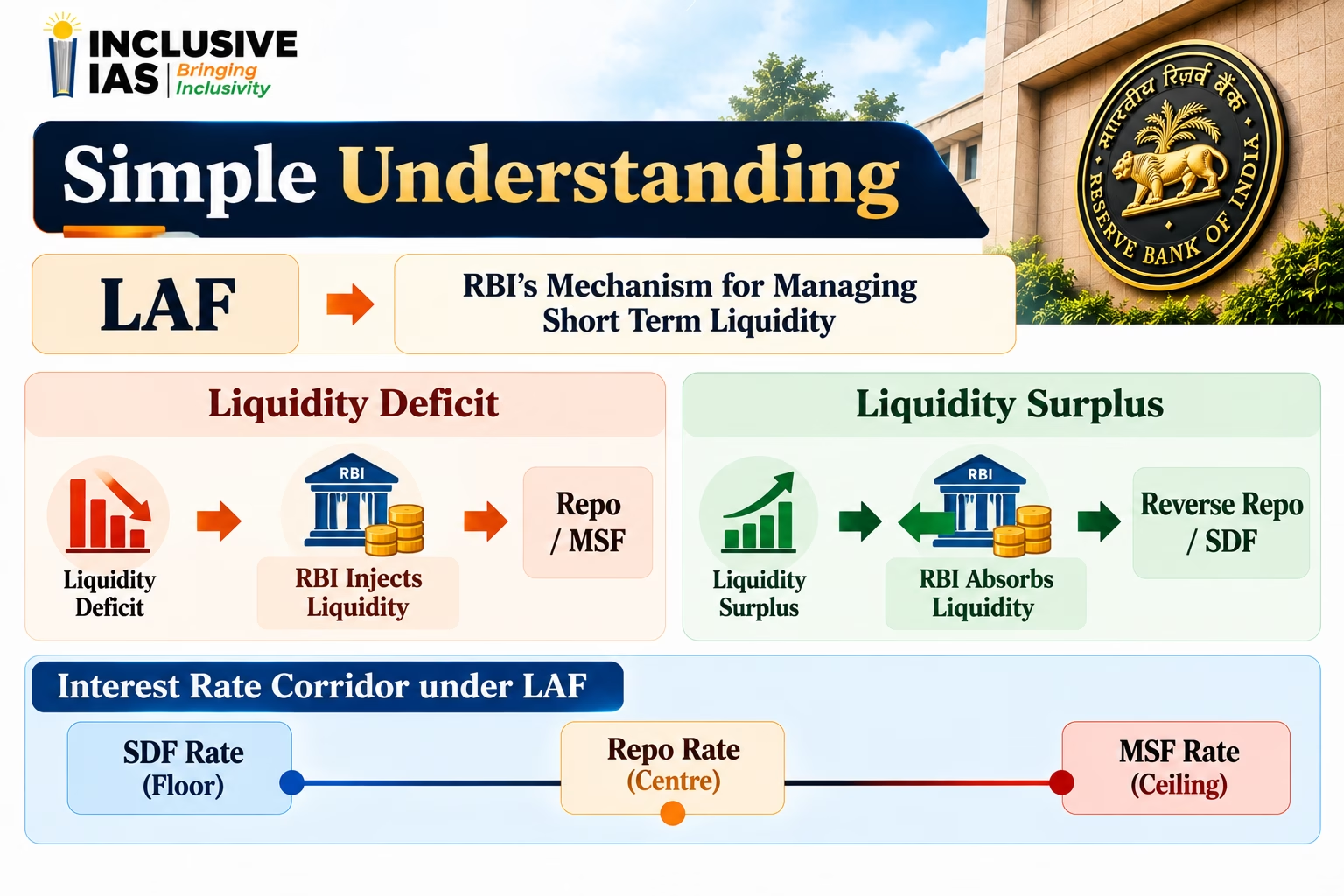
LAF Corridor: The LAF corridor has the marginal standing facility (MSF) rate as its upper bound (ceiling) and the standing deposit facility (SDF) rate as the lower bound (floor), with the policy repo rate in the middle of the corridor.