


Economy
Repo Rate
Repo Rate is the interest rate at which the Reserve Bank of India (RBI) provides liquidity under the Liquidity Adjustment Facility (LAF) to eligible LAF participants, such as Scheduled Commercial Banks (except Regional Rural Banks) and Primary Dealers, against the collateral of government and other approved securities.
Repo Rate is also called the “Policy Rate”.
How Repo Rate Works
- Banks provide eligible securities to RBI → RBI provides liquidity to Banks → Banks repay the funds with interest at the Repo Rate → RBI returns the securities
- The transaction involves an agreement to repurchase the securities at a predetermined price/date, hence the term repurchase agreement.
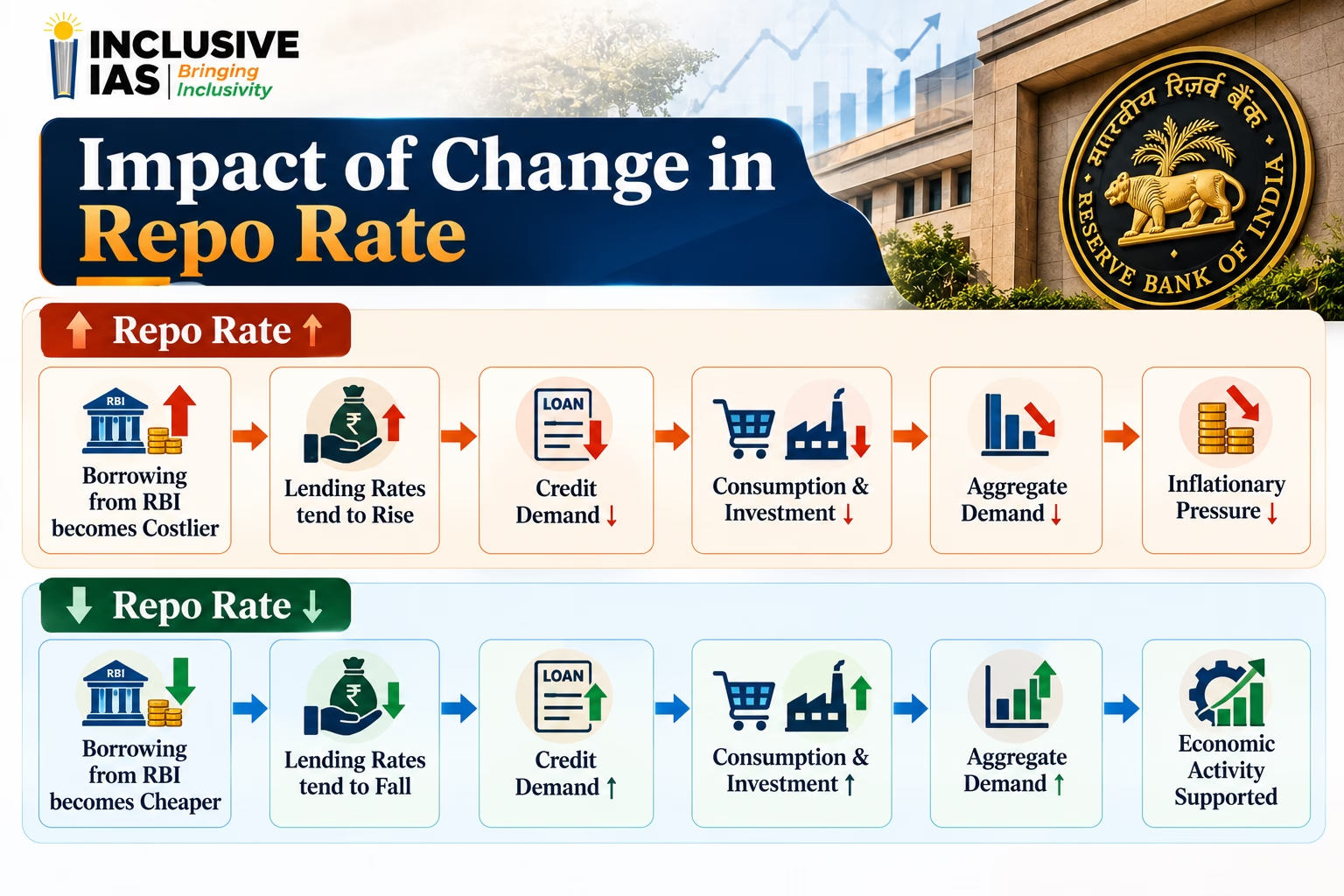
Repo Rate as a Monetary Policy Tool
- To Control Inflation: RBI can increase the repo rate, making borrowing costlier. This reduces borrowing and spending in the economy and helps control inflation.
- Repo Rate ↑ → Cost of Funds for Banks ↑ → Bank Lending Rates ↑ → Loans Become Costlier → Borrowing ↓ → Consumption & Investment ↓ → Overall Demand in Economy ↓ → Inflationary Pressure ↓
Example
Suppose RBI increases the repo rate.
- Banks may increase interest rates on home loans, car loans and business loans.
- Higher loan rates discourage some households from borrowing for consumption and businesses from borrowing for investment.
- As borrowing and spending decline, aggregate demand in the economy moderates.
- Lower demand reduces the pressure on businesses to keep raising prices.
Thus, Repo Rate ↑ → Demand Pressure ↓ → Inflationary Pressure ↓
It is not that a higher repo rate directly reduces prices; it works mainly by reducing demand and inflationary pressure through higher interest rates.
- To Support Economic Growth: RBI can reduce the repo rate, making borrowing cheaper. This encourages borrowing, spending and investment and supports economic growth.
- Monetary Policy Signalling: Changes in the repo rate indicate whether the RBI wants to make borrowing cheaper or costlier and influence other interest rates in the economy.