


Statutory Liquidity Ratio (SLR)
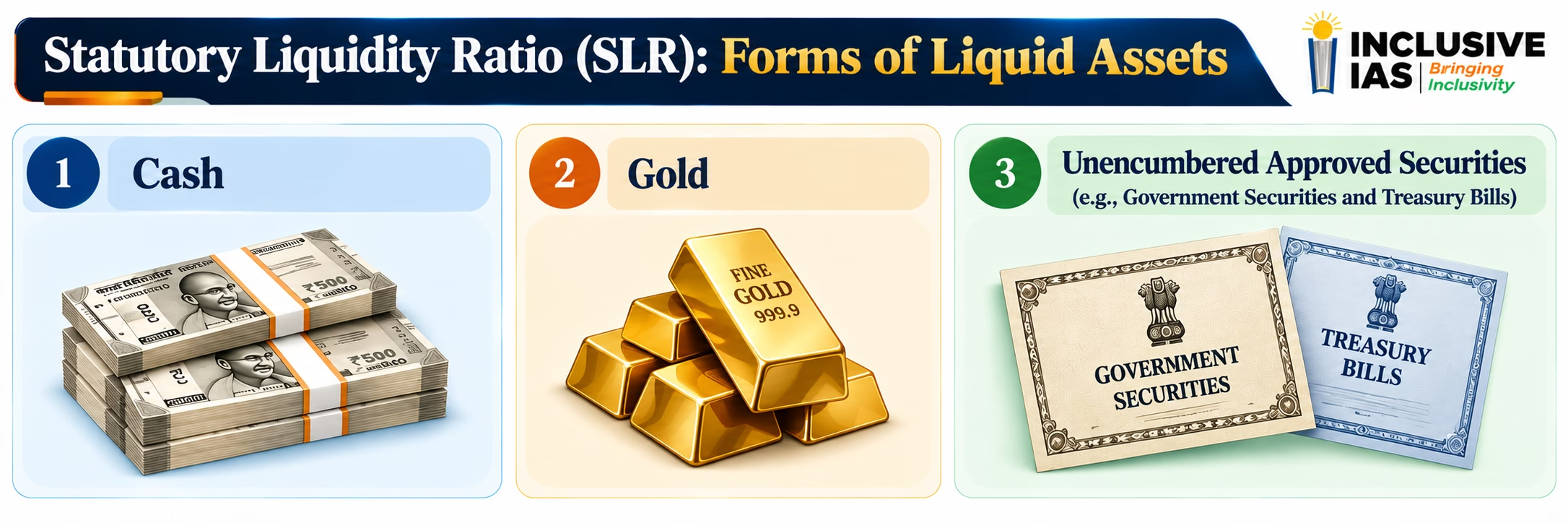
Statutory Liquidity Ratio (SLR) is the percentage of a bank’s Net Demand and Time Liabilities (NDTL) that it is required to maintain in the form of specified liquid assets such as cash, gold and approved securities. Unlike CRR, which is maintained with the RBI, SLR assets are maintained by the banks themselves.
Net Demand and Time Liabilities
The public’s demand deposits are demand liability of the bank and time deposits are time liability of the banks and the total demand and time deposits of the public is called ‘Net Demand and Time Liabilities (NDTL)’ of the banks.
Objectives of SLR
- Ensure Liquidity of Banks: SLR requires banks to keep a portion of their funds in liquid assets so that they can meet their payment and withdrawal obligations.
- Promote Safety of Bank Funds: By requiring banks to hold assets such as cash, gold and government securities, SLR ensures that a part of their funds remains invested in relatively safe and liquid assets.
- Regulate Credit Expansion: A higher SLR leaves fewer funds available for lending, helping RBI restrain excessive credit growth when required.
- Support Government Borrowing: Since government securities form a major part of SLR holdings, SLR creates regular demand for government securities and thereby supports government borrowing.
Key Features
- Maintained by Banks: Banks maintain SLR assets themselves rather than depositing them with the RBI.
- Forms of SLR: SLR can be maintained in the form of cash, gold and approved government securities.
- Excess CRR Balances: Cash maintained with the RBI over and above the required CRR are treated as liquid assets for the purpose of SLR.
- Statutory Basis: SLR is governed by Section 24 of the Banking Regulation Act, 1949.
- Maximum Limit: RBI can prescribe SLR at a rate not exceeding 40% of a bank’s NDTL. Thus, the statutory maximum limit for SLR is 40%. However, SLR has no statutory minimum limit.
Banking Regulation Act 1949 (Section 24) governs maintenance of SLR for all banks (scheduled and non-scheduled) commercial and cooperative.
Impact of Change in SLR
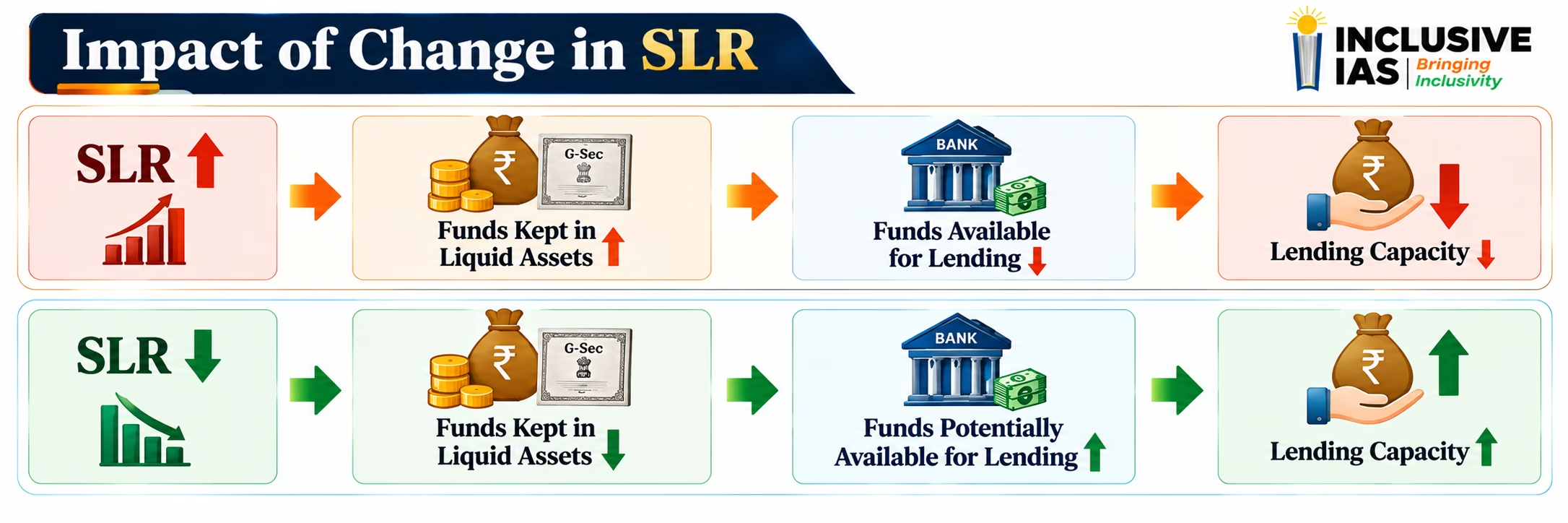
- Increase in SLR: An increase in SLR requires banks to keep a larger proportion of their funds in specified liquid assets, leaving a smaller proportion available for lending.
- SLR ↑ → Funds Kept in Liquid Assets ↑ → Funds Available for Lending ↓ → Lending Capacity ↓
- Decrease in SLR: A decrease in SLR reduces the proportion of funds that banks are required to keep in specified liquid assets, potentially leaving more funds available for lending.
- SLR ↓ → Funds Kept in Liquid Assets ↓ → Funds Potentially Available for Lending ↑ → Lending Capacity ↑
When may RBI increase SLR?
RBI may increase SLR when there is excessive credit growth or when high demand is adding to inflation. A higher SLR requires banks to keep a larger share of their funds in liquid assets, leaving less money available for lending.
When may RBI decrease SLR?
RBI may decrease SLR when economic growth is weak and bank lending needs to be encouraged. A lower SLR reduces the amount banks must keep in liquid assets, potentially leaving more funds available for lending.
Cash Reserve Ratio (CRR) vs Statutory Liquidity Ratio (SLR)
| Basis | Cash Reserve Ratio (CRR) | Statutory Liquidity Ratio (SLR) |
|---|---|---|
| Meaning | Percentage of NDTL that banks must maintain as cash balance with RBI | Percentage of NDTL that banks must maintain in specified liquid assets |
| Maintained With | RBI | Banks themselves |
| Form | Only cash | Cash, gold and unencumbered approved securities |
| Interest/Return | RBI does not pay interest on CRR balances | Banks can earn returns on eligible securities held for SLR |
| Statutory Basis | Section 42(1), RBI Act, 1934 for scheduled banks | Section 24, Banking Regulation Act, 1949 |
| Statutory Limit | No statutory floor or ceiling | No statutory minimum; maximum 40% of NDTL |