UPDATES

Consumer Price Index (CPI)

  • Home
  • Consumer Price Index (CPI)
Shape Image One

Consumer Price Index

The Consumer Price Index (CPI) is a key measure of inflation that tracks the average change in retail prices paid by consumers for a fixed basket of goods and services over time. It reflects the cost of living for various segments of the population and is crucial for monetary policy decisions, especially for the Reserve Bank of India (RBI), which uses CPI inflation as the anchor for its inflation targeting framework.

Overview​

A consumer price index (CPI) measures changes over time in the general level of prices of goods and services that households acquire for the purpose of consumption.

Features:

  • Coverage: It includes both goods and services.
  • Published by: National Statistical Office, MoSPI
  • Base year : 2024 (Revised in 2026)
  • The weights of the CPI basket are based on the average household expenditure taken from the Consumer expenditure survey.
  • It includes indirect taxes.
  • The CPI measures price changes by comparing, on a point to point basis, the cost of a fixed basket of commodities like the WPI.
  • Method of collection:
    • CPI 2024 series covers 1,465 rural markets and 1,395 urban markets across 434 towns. In addition, 12 online markets are covered across 12 towns having a population of more than 25 lakh.
    • Price data are collected monthly from rural and urban markets. Online prices are collected on weekly basis.

New Base Year

  • The Ministry of Statistics and Programme Implementation (MoSPI) has released a new India Consumer Price Index (CPI) series with 2024 as the base year.
  • Reference Period and Base Year Selection:The latest Household Consumption Expenditure Survey (HCES) 2023-24 is used for updating item basket and weights of CPI 2024 series.
    • For any price index to be robust and analytically sound, the price reference period should be as close as possible to the weight reference period. In CPI 2024, expenditure weights are derived from HCES 2023–24, while base-period prices were collected during January 2024 to December 2024. Accordingly, 2024 has been selected as the base year, ensuring close alignment between the weight reference period and the price reference period, thereby improving internal consistency and representativeness.
  • Revision of Item Basket and Coverage: At the all-India level, the number of weighted items has increased from 299 to 358 in CPI 2024.Within this:
    • Goods items are increased from 259 to 308
    • Services items are increased from 40 to 50
    • This expansion strengthens the representation of the services sector, which has assumed greater importance in household expenditure over time.
  • Key enhancements: First-time inclusion of rural house rent for improving coverage of rural housing consumption
    • Strengthened representation of modern consumption items such as online media services and fuels (CNG/PNG)
    • Improved coverage of data available on digital and administrative sources, including telephone charges, rail fare, air fare, fuel, postal charges and online media and streaming services (OTT subscriptions).
  • Adoption of International COICOP – 2018 Framework
    • The CPI 2024 series adopts the Classification of Individual Consumption According to Purpose (COICOP) 2018, replacing the earlier structure comprising six broad groups. This is the latest classification system developed by United Nations Statistics Division.
    • Under the revised framework, expenditure is classified into 12 divisions at the first level, 43 groups, 92 classes, 162 subclasses enabling and 358 items at last level of hierarchy which enables:
      • Classification of items according to its usage
      • Ensures global comparability of India’s CPI
      • Enables more granular dissemination of indices and inflation rates
  • Revised Weights and Weighing Diagram
    • The revised weights reflect updated household expenditure patterns as captured in HCES 2023–24. Share of Food & Beverages has declined in the new series.However, it continues to remain the largest component of the CPI basket.
  • Housing Index Compilation
    • In the revised CPI series, the Housing index is compiled using a weighted average of three constituent groups, namely “actual rental payments for housing”, “maintenance, repair and security of the dwelling”, and “water supply and other miscellaneous services” relating to the dwelling. Housing inflation is thereafter computed on a year-on-year basis based on the resulting composite Housing index.

Note:A diagrammatic presentation of the revised weighing structure, showing division-wise shares for CPI 2012 (Base 2012=100) and CPI 2024 (Base 2024=100), is provided to illustrate changes in relative importance across major consumption groups. The revised weighing diagram highlights:
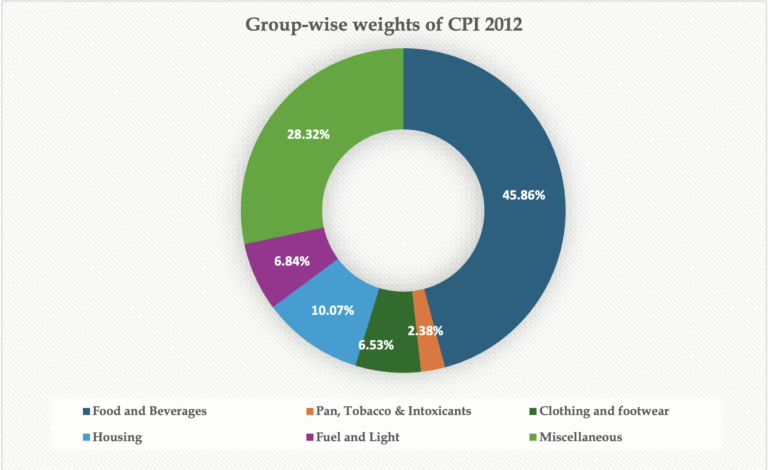
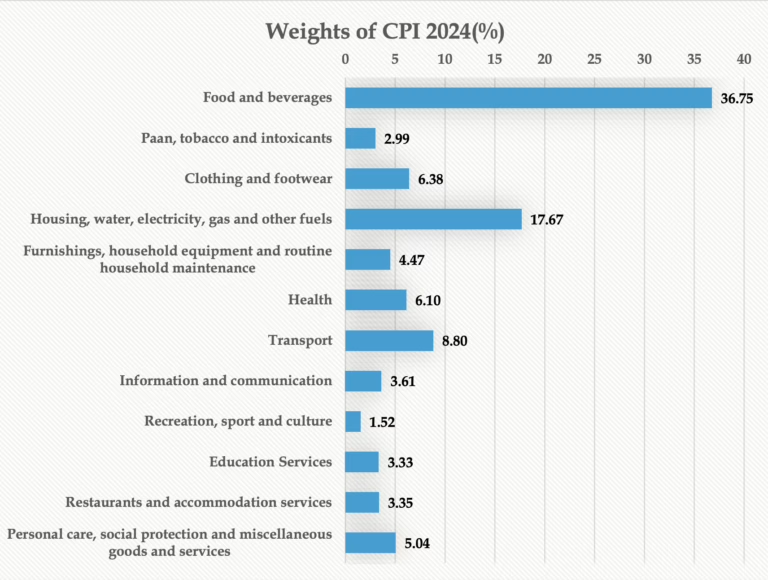
  • Declining food share in household expenditure
  • Importance of housing, services, and transport-related items
  • Better alignment with current consumption behaviour

Components along with their weightage

Consumer Food Price Index (CFPI)

  • The Consumer Food Price Index (CFPI) is a measure of change in retail prices of food items consumed by the population.
  • It is a specific measure of inflation that focuses exclusively on the price changes of food items in a consumer’s basket of goods and services.
  • The CFPI is a sub-component of the broader Consumer Price Index (CPI).
  • The Central Statistics Office (CSO) under the Ministry of Statistics and Programme Implementation (MOSPI) began publishing the Consumer Food Price Index (CFPI) separately for rural, urban, and combined categories across India starting from May 2014.
  • Base year : 2024
  • Methodology:
    • Like the Consumer Price Index (CPI), the CFPI is also calculated monthly and the methodology remains the same as the CPI.

Significance of the Consumer Price Index (CPI)

  • Main Measure of Retail Inflation
    • CPI tracks price changes at the consumer level, reflecting the cost of living.
    • It measures how much households pay for a fixed basket of goods and services over time.
  •  Monetary Policy Anchor
    • The Reserve Bank of India uses CPI Combined as the primary inflation benchmark for setting policy rates.
    • Under the Flexible Inflation Targeting Framework, RBI aims to keep CPI inflation at 4% ± 2%.
  • Cost of Living Adjustments
    • CPI indices are used to adjust:
    • Dearness Allowance (DA) for government employees.
    • Pensions and wages to protect purchasing power against inflation.
    • For example, CPI for Industrial Workers (CPI-IW) determines DA revisions.
  • Socioeconomic Policy
    • CPI helps assess how inflation affects different groups:
    • Industrial workers (CPI-IW)
    • Agricultural and rural labourers (CPI-AL, CPI-RL)
    • Urban and rural consumers (CPI Urban and Rural)
    • This informs welfare programs, subsidies, and poverty alleviation measures.
  • Business and Investment Planning
    • Businesses use CPI data to:
    • Forecast demand and pricing strategies.
    • Plan salary hikes and contracts.
    • Investors track CPI to gauge inflation risks and returns.
  • International Comparisons
    • CPI enables comparisons of inflation trends across countries, supporting trade and investment decisions.
  • Indicator of Economic Stability
    • Sustained high CPI inflation signals rising cost pressures and impacts economic growth.
    • A stable CPI helps maintain confidence in the economy.

Factly

  • What are the major changes in CPI 2024 series?
    • Major changes in CPI 2024 includes revising item baskets and weights as per HCES 2023-24, adoption of COICOP – 2018 Framework, refinement in Index compilation methodology, inclusion of alternative data sources, use of modern technology and more granular data dissemination
  • Which organization collects CPI price data for MoSPI?
    • Field Operations Division of National Sample Survey (NSS), MoSPI collects monthly price data for CPI.
  • How are prices collected under the CPI 2024 series?
    • In the CPI 2024 series, prices are collected using a tablet-based software application via Computer Assisted Personal Interview (CAPI), replacing the traditional paper-based method.
  • Why free social transfers expenditure is not considered in the CPI?
    • By definition, CPI should include only items on which households actually spend money. IMF’s manual on CPI also suggests that social transfer in kind should not be considered in CPI compilation. In view of this, free social transfers are excluded from CPI. 
  • What alternative data sources are being used in the CPI 2024 series?
    • In the CPI 2024 series, alternative data sources such as administrative data and e-commerce/online price data are used.
  • Have online markets been included in the CPI 2024 series?
    • Twelve online markets have been added across 12 towns with a population of more than 25 lakh to capture price variations of items sold on e-commerce and online platforms. In addition, price collection for airfare, telephone and OTT are also collected through online platforms.
  • How has the number of weighted items changed in the CPI 2024 series compared to CPI 2012?
    • At All-India level, the total weighted items have been increased from 299 to 358. Specifically, goods items have risen from 259 to 308, and services items from 40 to 50.
  • What are Index reference period, Weight reference period and Price reference period?
    • Index reference period: It is the period for which index equals 100. For the current CPI, the index reference period is 2024=100.
    • Weight reference period: It is the period for on the basis of which weights are calculated. For CPI 2024, Household Consumption Expenditure Survey 2023-24 data is used for deriving the weights.
    • Price reference period: It is the period during which the base prices are collected. The price reference for the current CPI series is calendar year 2024.

The Consumer Price Index is a vital tool for measuring retail inflation and understanding its impact on households. As the primary gauge for monetary policy and cost-of-living adjustments, CPI plays a central role in maintaining economic stability, protecting purchasing power, and guiding decisions across government, business, and society.

FAQs

Q1. What is the Consumer Price Index (CPI)?

CPI measures the average change in the prices of a basket of goods and services consumed by households over time.

Q2. Who publishes CPI in India?

The National Statistical Office (NSO), Ministry of Statistics and Programme Implementation (MoSPI) publishes CPI for Rural, Urban, and Combined categories.

Q3. What is the base year for CPI in India?

The current base year for CPI (Rural/Urban/Combined) is 2024, and for CPI-IW, the base year is 2016.

Q4. What are the major components of CPI?

CPI includes Food & Beverages, Housing, Fuel & Light, Clothing & Footwear, Pan/Tobacco/Intoxicants, and Miscellaneous categories.

✍️ Curated by InclusiveIAS Editorial Team

At InclusiveIAS, our editorial team is led by experts who have successfully cleared multiple stages of the UPSC Civil Services Examination, including Mains and Interview. With deep insights into the demands of the exam, we focus on crafting content that is accurate, exam-relevant, and easy to grasp.

Whether it’s Polity, Current Affairs, GS papers, or Optional subjects, our notes are designed to:

  • Break down complex topics into simple, structured points

  • Align strictly with the UPSC syllabus and PYQ trends

  • Save your time by offering crisp yet comprehensive coverage

  • Help you score more with smart presentation, keywords, and examples

🟢 Every article, note, and test is not just written—but carefully edited to ensure it helps you study faster, revise better, and write answers like a topper.