
NOTICE
✅ Answer Writing Program solutions will be uploaded regularly in the InclusiveIAS App. Download the app now: Download Now ✅ Answer Writing Program solutions will be uploaded regularly in the InclusiveIAS App. Download the app now: Download Now

Coral Triangle

Shape Image One

Coral Triangle

The Coral Triangle is a vast marine region covering about 6 million km². It spans parts of Indonesia, Malaysia, Papua New Guinea, the Philippines, the Solomon Islands, and Timor-Leste. It is recognized as the global epicenter of marine biodiversity.
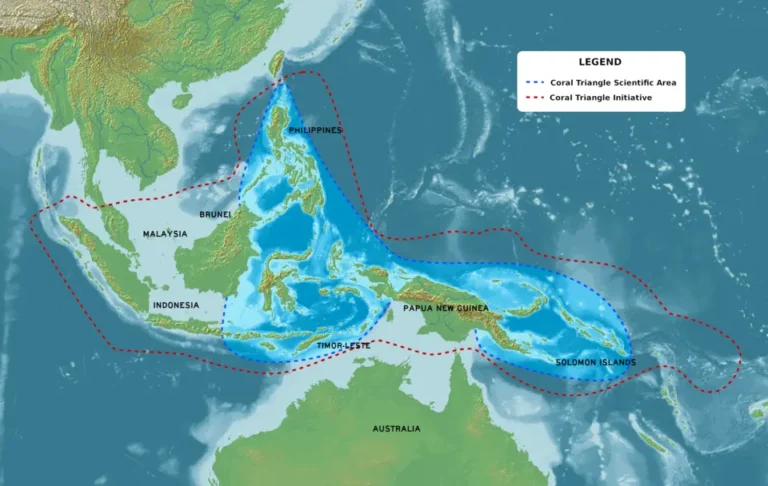
Location

  • The Coral Triangle is located betweenthe Pacific and Indian oceans.
  • It encompasses portions of two biogeographic regions: the Indonesian-Philippines Region, and the Far Southwestern Pacific Region

Key Features

  • Home to more coral reef species than anywhere else on Earth.
  • It contains 76% of the world’s coral species, the highest coral diversity in the world.
  • It is home to three-quarters of known molluscs.
  • It has more coral reef fish diversity than anywhere else in the world: 37% (2,228) of the world’s coral reef fish species (6,000), and 56% of the coral reef fishes in the Indo-Pacific region (4,050).
  • It is home to 6 of the world’s 7 marine turtle species.

Why is the Coral Triangle the Global Epicenter of Marine Biodiversity?

The Coral Triangle is often called the “Amazon of the Seas”, but the reason for its unparalleled biodiversity is still debated. Scientists have proposed multiple explanations:

  •  Center of Origin Hypothesis
    • Some scientists believe that the Coral Triangle is the birthplace of coral reef species. From here, species spread out and dispersed across the wider Indo-Pacific region, making it the evolutionary center of reef diversity.
  •  Center of Accumulation Hypothesis
    • Another view is that the Coral Triangle’s richness is due to its location at the junction of the Indian and Pacific Oceans. Species from both oceans converge here, creating an overlap and accumulation of fauna that results in high biodiversity.
  •  Geological History and Isolation
    • Geological processes also played a major role.
    • During the Ice Age, sea levels were about 200 meters lower, reducing marine habitats and isolating species into small marine lakes and shallow seas.
    • In these isolated pockets, species evolved genetically and morphologically, adapting to different conditions.
    • When the ice melted around 10,000 years ago, sea levels rose again, connecting these waters into an open seaway. By then, isolated populations had already evolved into distinct species, greatly increasing the diversity in the Coral Triangle

FAQs

Q1. Why is the Coral Triangle called the “Amazon of the Seas”?

Because of its unmatched marine biodiversity, similar to how the Amazon rainforest is rich in terrestrial biodiversity.

Q2. Which countries form the Coral Triangle?

Indonesia, Malaysia, Papua New Guinea, the Philippines, Solomon Islands, and Timor-Leste.

Q3. Why is the Coral Triangle important for humans?

It provides food security, livelihoods, and climate protection for millions of people in the region.

✍️ Curated by InclusiveIAS Editorial Team

At InclusiveIAS, our editorial team is led by experts who have successfully cleared multiple stages of the UPSC Civil Services Examination, including Mains and Interview. With deep insights into the demands of the exam, we focus on crafting content that is accurate, exam-relevant, and easy to grasp.

Whether it’s Polity, Current Affairs, GS papers, or Optional subjects, our notes are designed to:

  • Break down complex topics into simple, structured points

  • Align strictly with the UPSC syllabus and PYQ trends

  • Save your time by offering crisp yet comprehensive coverage

  • Help you score more with smart presentation, keywords, and examples

🟢 Every article, note, and test is not just written—but carefully edited to ensure it helps you study faster, revise better, and write answers like a topper.