
Biochar

Shape Image One

Biochar

  • Biochar is a type of charcoal rich in carbon and is produced from agricultural residue and organic municipal solid waste. It offers a sustainable alternative to manage waste and capture carbon
  • It is a high-carbon, fine-grained residue

Production

Primary Method

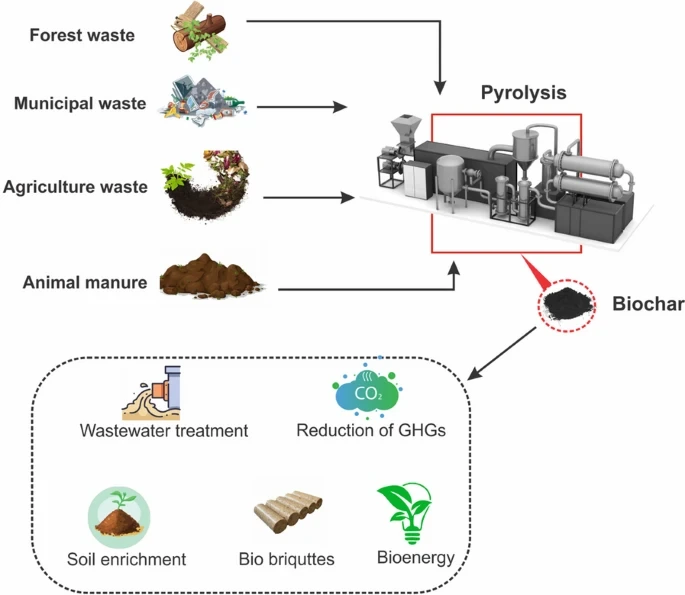
  1. Pyrolysis: It is produced via pyrolysis. It is the direct thermal decomposition of biomass in the absence of oxygen, which prevents combustion, and produces a mixture of solids (biochar), liquid (bio-oil), and gas (syngas) products.

Other Methods

  • Gasification: Biochar can also be produced by gasification, a process that differs from pyrolysis in that some oxygen is present and much higher temperatures are used

Gasification

Gasification is the process of incomplete or partial oxidation of biomass at high temperature ranging between 700°C and 1300°C to produce syngas

Gasification is used to convert carbon-based materials into carbon monoxide, hydrogen, and carbon dioxide (syngas or producer gas). The gas mixture can then be combusted to generate power

Do you Know?

Compared to pyrolysis, gasification systems produce much smaller quantities of biochar, since most carbon is converted into gas

Pyrolysis uses heat and no oxygen, gasification uses heat and some oxygen, and combustion uses all the oxygen and heat.

  • Torrefaction & Hydrothermal Carbonisation:Besides pyrolysis, torrefaction and hydrothermal carbonization processes can also thermally decompose biomass to the solid material. However, these products cannot be strictly defined as biochar. The carbon product from the torrefaction process contains some volatile organic components; thus its properties are between that of biomass feedstock and biochar

Torrefaction

  • Torrefaction is a thermal process that heats biomass to 250-320°C in low-oxygen, producing high-grade biofuel by removing moisture and volatiles.
    • When biomass is heated at such temperatures, the moisture evaporates and various low-calorific components (volatiles) contained in the biomass are driven out
  • Biomass torrefaction is used to produce high-grade solid biofuels from various streams of woody biomass or agro residues. 
  • The end product is a stable, homogeneous, high quality solid biofuel with far greater energy density and calorific value than the original feedstock.

Hydrothermal Carbonization (HTC) 

  • It is a process, in which biomass is heated in aqueous suspension to 180-250ºC under elevated pressure to produce a solid biochar (the so-called HTC-char). 
  • The produced char is a bituminous coal like material that can be used as an energy source but also for soil amelioration and as sorbent in water treatment processes.

  • Thermo-catalytic depolymerization is another method to produce biochar, which utilizes microwaves. It has been used to efficiently convert organic matter to biochar on an industrial scale, producing about 50% char

Do you know?

Though the word combustion seems antithetical to the production of biochar, combustion as a technology type is perhaps responsible for a majority of the biochar produced in North America.

Feedstock

Biochar can be made from a variety of feedstocks, including wood, agricultural residues(including bagasse), and municipal solid waste
Do you Know?

The composition of biochar — the amount of carbon, nitrogen, potassium, calcium, etc. — depends on two factors:

  1. The feedstock used 
  2. The duration and temperature of pyrolysis, or the process with which biochar is made. 

As an example, biochar produced from feedstocks which have greater contents of potassium, like animal litters, often have higher potassium contents than biochar made entirely from wood, which often have higher carbon contents.

Potential

India generates over 600 million metric tonnes of agricultural residue and over 60 million tonnes of municipal solid waste every year. A significant portion of both is burnt openly or dumped in landfills, leading to air pollution from particulate matter and greenhouse gases such as methane, nitrous oxide, and CO2.

  • By using 30% to 50% of surplus waste, India can produce 15-26 million tonnes of biochar and remove 0.1 gigatonnes of CO2-equivalent annually. 
  • Byproducts of biochar production, such as syngas (20-30 million tonnes) and bio-oil (24-40 million tonnes), can generate additional electricity and fuels. 
    • Theoretically, utilising syngas could generate around 8-13 TWh of power, equivalent to 0.5-0.7% of India’s annual electricity generation, replacing 0.4-0.7 million tonnes of coal per year. 
    • Bio-oil can likewise potentially offset 12-19 million tonnes (or 8%) of diesel or kerosene production annually, leading to lower crude oil imports and reducing more than 2% of India’s total fossil-fuel-based emissions.
  • Deploying biochar production equipment at the village level has the potential to create approximately 5.2 lakh rural jobs, linking climate action with inclusive economic development.

Applications and Benefits

  • Carbon Sink: Biochar can hold carbon in the soil for 100-1,000 years due to its strong and stable characteristics, making it an effective long-term carbon sink.
  • Agriculture: Applying biochar can improve water retention, particularly in semi-dry and nutrient-depleted soils. This, in turn, can abate nitrous oxide emissions by 30-50%. 
    • Notably, nitrous oxide is a greenhouse gas with 273-times the warming potential of CO2, making its mitigation a crucial benefit of biochar.
    • Soil fertility: Biochar can also be blended with fertiliser which will help to keep the soil fertile for a longer period. Due to the porous nature of the biochar, it is able to hold the nutrients for a longer time
  • Due to its highly aromatic structure, biochar is used as a soil amendment to enhance water retention, strengthen cation exchange capacity, and improve nutrient utilization efficiency. 
  • Research statistics show that adding biochar to soil can increase crop yields by 13–16%.
  • Among soil properties, pH is a crucial factor related to soil fertility. Studies indicate that most biochars are alkaline, with an average pH of 8.1–8.9. Increasing soil pH promotes microbial activity and helps prevent soil acidification, thus enhancing soil fertility.
  • Biochar application lowers fertilizer requirement (by 10-20%) 
  • Soil Restoration: Biochar can also enhance soil organic carbon, helping restore degraded soils.
  • Carbon Capture: Modified biochar can adsorb CO₂ from industrial exhaust gases, though its efficiency is currently lower than conventional methods.
  • Construction: Can be used as an additive in building materials like bricks and concrete, improving mechanical strength, heat resistance and increasing carbon sequestration.
    • Adding 2-5% of biochar to concrete can improve mechanical strength, increase heat resistance by 20%, and capture 115 kg of CO₂ per cubic metre, making building materials a stable carbon sink.
  • Industrial Application: Biochar is highly stable and caloric, making it applicable across various industries. One significant application is as a substitute for coke in the steel industry. 
    • Research has shown that replacing 50–100% of coke with biochar could reduce CO2 emissions during iron making by 3–7%
  • Wastewater Treatment: In wastewater treatment, biochar offers a low-cost and effective option to reduce pollution.
    • A kilogram of biochar, along with other substances, can treat 200-500 litres of wastewater, implying a biochar demand potential of 2.5-6.3 million tonne

India generates more than 70 billion litres of wastewater every day, of which 72% is left untreated.

A study utilized olive mill waste biochar to treat heavy metals (Cd2+, Co2+, Cu2+, and Zn2+) in water, and the results showed that each gram of biochar could adsorb more than 400 mg of heavy metals.

  • Stock fodder: Biochar has been used in animal feed for centuries
  • Biochar production can be certified for carbon removal credits which are increasingly being used by businesses to offset their carbon emissions in order to achieve a net zero or carbon negative target. 
    • Carbon credits are a growing market as businesses are aiming to be more sustainable by addressing their carbon footprints.

Challenges in Adoption

  1. Underrepresentation in carbon credit markets
    • Despite its theoretically substantial potential to capture carbon, biochar remains underrepresented in carbon credit systems due to the absence of standardised feedstock markets and consistent carbon accounting methods, which undermine investor confidence
  2. Market and Policy Gaps: Underdeveloped market & uncertainties, insufficient policy support, and lack of awareness hinder adoption.
    • Market development is constrained by limited awareness among stakeholders, weak ‘monitoring, reporting, verification’ frameworks, and a lack of coordination across areas such as agriculture, energy, and climate policy.
  3. Limited Resources
  • High initial costs: Setting up pyrolysis plants and processing units requires significant investment.
  • Feedstock Availability: Consistent supply of quality biomass feedstock is often uncertain due to competition with other uses (animal fodder, fuel, compost) and seasonal fluctuations
  • Infrastructure Constraints: Scarcity of efficient pyrolysis units and support facilities in rural and peri-urban regions hampers scale and operational efficiency.
  • Financial Barriers: High capital investment is needed for biochar production and related infrastructure, along with limited access to credit for farmers and small entrepreneurs.
  1. Technology: Biochar production and applications are still based on evolving, non-standardised technologies with scalability challenges.
  2. Effectiveness: Long-term effectiveness of biochar in carbon sequestration and soil improvement is still under scientific scrutiny and not universally proven.

Way Forward

  • To enable large-scale adoption, sustained support for R&D is essential to create region-specific feedstock standards and to optimise biomass utilisation rates based on agro-climatic zones and crop types. 
  • Biochar should be systematically integrated into existing and upcoming frameworks, including crop residue management schemes, bioenergy initiatives in both urban and rural contexts, and state-level climate strategies under the State Action Plans on Climate Change. 
  • Recognise biochar as a verifiable carbon removal pathway within the Indian carbon market and it will generate additional income for investors and farmers through carbon credits. 
  • Deploy biochar production equipment at the village level
  • Policy support for research, demonstration projects, and market mechanisms

Conclusion:

  • Biochar is a promising science-backed tool for emission reduction, waste management, and soil improvement.
  • Large-scale adoption needs multistakeholder support, policy, and market frameworks to realize its potential in meeting India’s climate and development goals.

Do you know?

Biochar is different from other similar products such as charcoal, hydrochar, ash and soot.

Charcoal

  • Charcoal is generally produced similar to biochar production through pyrolysis. The only difference is the operating temperature. Charcoal is produced in temperatures about 400oC. Whereas, biochar is produced in temperatures above 550oC. 
  • The difference is the left-over volatile contents in the product. At lower temperature, higher volatile content is left and as such the general application of charcoal is for fuel whereby the volatile contents are oxidised to generate ignition & heat.
  • Biochar has less volatile contents in it, and as such it is stable enough to be buried underground without igniting when exposed to the air.

Hydrochar

  • Hydrochar is produced from the hydro thermal carbonization process, i.e. heating in presence of water at lower temperature as compared to pyrolysis. Similar to charcoal, hydrochar has higher volatile content than biochar which makes hydrochar less stable and more likely to be used as fuel and not as carbon sequestration.

Ash

  • Ash is a residue left-over which is present in most materials upon combustion. It is mainly the incombustible inorganic content of the materials. Materials like glass, metal, rock, sand are referred to as ash. It has no benefit in the thermochemical process, in fact, its presence will reduce the efficiency of the process. It may contain toxic components, such as heavy metals, potentially contaminating soil and groundwater.

Soot

  • Soot, on the other hand, is unburned carbon particles formed due to incomplete combustion. It may also contain residual gas particles and inorganic compounds which may be toxic and corrosive when exposed to the air.

UPSC Spot Check

Prelims

With reference to Biochar, consider the following statements:

  1. It is produced mainly through the process of pyrolysis in limited or no oxygen conditions.
  2. Compared to pyrolysis, gasification systems produce smaller quantities of biochar.
  3. Biochar can be used in agriculture, construction, and wastewater treatment.
  4. It is produced by complete combustion of biomass in the presence of oxygen.

How many of the statements given above are correct?

  1. Only one
  2. Only two
  3. Only three
  4. All four

PYQ

What is the use of biochar in farming? (2020)

  1. Biochar can be used as a part of the growing medium in vertical farming. 
  2. When biochar is a part of the growing medium, it promotes the growth of nitrogen-fixing microorganisms. 
  3. When biochar is a part of the growing medium, it enables the growing medium to retain water for a longer time. 

Which of the statements given above is/are correct? 

  1. 1 and 2 only 
  2. 2 only  
  3. 1 and 3 only 
  4. 1, 2 and 3

✍️ Curated by InclusiveIAS Editorial Team

At InclusiveIAS, our editorial team is led by experts who have successfully cleared multiple stages of the UPSC Civil Services Examination, including Mains and Interview. With deep insights into the demands of the exam, we focus on crafting content that is accurate, exam-relevant, and easy to grasp.

Whether it’s Polity, Current Affairs, GS papers, or Optional subjects, our notes are designed to:

  • Break down complex topics into simple, structured points

  • Align strictly with the UPSC syllabus and PYQ trends

  • Save your time by offering crisp yet comprehensive coverage

  • Help you score more with smart presentation, keywords, and examples

🟢 Every article, note, and test is not just written—but carefully edited to ensure it helps you study faster, revise better, and write answers like a topper.