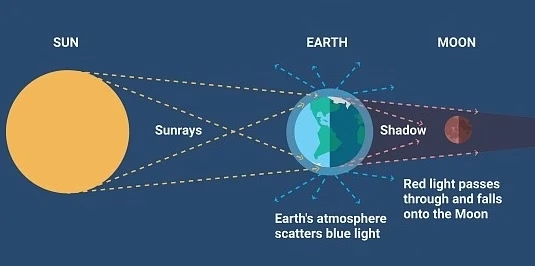
“Blood Moon” takes place when the Sun, Earth, and Moon align in such a way that Earth’s shadow falls on the Moon, giving it a distinct reddish tint.
Blood Moon
A Blood Moon occurs during a total lunar eclipse, when the Earth comes directly between the Sun and the Moon, blocking direct sunlight from reaching the Moon’s surface.
During this event, sunlight first reaches the Earth. While most of the light is blocked by the planet, some rays pass through Earth’s atmosphere. As the light travels through the atmosphere, air molecules scatter out most of the blue light. However, the red wavelengths are scattered less and are able to pass through. This red light reaches the Moon, illuminating its surface with a reddish glow — giving rise to the phenomenon known as a Blood Moon.
Key Facts
A Blood Moon = Total Lunar Eclipse + reddish hue.
It can be observed without eye protection, unlike solar eclipses.
Occurs only on a full moon night.
Does not occur every month, even though full moons are monthly—because the Moon’s orbit is tilted with respect to Earth’s orbit.
Caused by Rayleigh scattering of sunlight in Earth’s atmosphere.
Additional factors, such as atmospheric dust, volcanic activity, or moisture, can intensify the red hue, making each blood moon unique.
Types of Full Moons
A full moon occurs when the side of the Moon facing Earth is fully illuminated by sunlight. While this happens roughly once a month, not all full moons are the same. Due to varying orbital positions and cultural interpretations, several special types of full moons are recognized:
Blood Moon
Supermoon
Blue Moon
Harvest Moon
Supermoon
A supermoon refers to a full moon that occurs when the Moon is at its closest point (perigee) to Earth in its elliptical orbit. It appears larger and brighter in the night sky, although the change in size may not be easily perceptible to the naked eye.
Blue Moon
Despite its name, a blue moon is not blue in color. It refers to a rare occurrence and is defined in two ways:
Traditionally: The third full moon in a season that has four full moons.
Modern usage (since 1940s): The second full moon in a calendar month.This event usually occurs once every 2.5 years, giving rise to the phrase “once in a blue moon.”
Harvest Moon
The Harvest Moon is the full moon that occurs closest to the start of autumn(around September).
Why Do Full Moons Appear Different?
The Moon’s changing appearance is not due to physical changes in the Moon itself. Variations in color, size, or brightness are primarily due to:
Its distance from Earth
Its alignment with the Earth and Sun
Atmospheric conditions like dust and humidity
Rayleigh Scattering and its Role in Formation of Blood Moon
Rayleigh Scattering
Rayleigh scattering refers to the scattering of light (especially short wavelengths) by particles much smaller than the wavelength of light in Earth’s atmosphere.
Shorter wavelengths (like blue and violet) are scattered more strongly.
Longer wavelengths (like red and orange) are scattered less and thus travel further.
This is why:
The sky appears blue during the day (more blue light scattered in all directions).
The sunset appears red or orange, because blue light is scattered out and red light travels directly to our eyes.
Role of Rayleigh Scattering in a Blood Moon
During a total lunar eclipse:
The Earth moves between the Sun and the Moon, blocking direct sunlight from reaching the Moon.
However, some sunlight still reaches the Moon, after passing through the edges of Earth’s atmosphere.
As sunlight travels through this thick atmospheric layer:
Blue and violet light is scattered out due to Rayleigh scattering.
Red and orange wavelengths pass through and bend around Earth due to atmospheric refraction.
This filtered red light falls on the Moon’s surface and gives it a reddish hue, leading to the phenomenon called a Blood Moon.
At InclusiveIAS, our editorial team is led by experts who have successfully cleared multiple stages of the UPSC Civil Services Examination, including Mains and Interview. With deep insights into the demands of the exam, we focus on crafting content that is accurate, exam-relevant, and easy to grasp.
Whether it’s Polity, Current Affairs, GS papers, or Optional subjects, our notes are designed to:
Break down complex topics into simple, structured points
Align strictly with the UPSC syllabus and PYQ trends
Save your time by offering crisp yet comprehensive coverage
Help you score more with smart presentation, keywords, and examples
🟢 Every article, note, and test is not just written—but carefully edited to ensure it helps you study faster, revise better, and write answers like a topper.