GST Reforms 2025 Explained: Key Highlights, Sector-Wise Impact

  • Home
  • GST Reforms 2025 Explained: Key Highlights, Sector-Wise Impact
Shape Image One

GST Reforms 2025

The Brief by InclusiveIAS

Context

56th GST Council Meeting : Approved Next-Generation GST reforms.

Introduction

GST launched: 1st July 2017 – India’s most significant indirect tax reform since Independence.

Key Objective: Unified system bringing multiple central & state taxes together → created a common national market.

Benefits over 8 years:

  • Cascading of taxes reduced.
  • Simplified compliance.
  • Improved transparency.
  • Rate rationalisation & digitalisation.
  • Became the backbone of India’s indirect tax framework.

56th GST Council Meeting (FM Nirmala Sitharaman): Approved Next-Generation GST reforms.

Background

Road to GST: Challenges & Milestones

  • Pre-GST Era (VAT System) Problems: Before the launch of the Goods and Services Tax (GST), India’s indirect tax system was highly fragmented. Every state followed its own tax rates, levies, and procedures, making trade across India complicated and compliance-heavy. Businesses often faced overlapping taxes, inconsistent rules, and limited credit for inputs.
    • No uniform tax rates across states; additional levies like entry tax raised costs.
    • Different rules for returns, audits, and penalties created confusion.
    • Weak input tax credit provisions allowed misuse and tax evasion.
    • Double taxation (VAT plus service tax) increased the burden on both businesses and consumers.

Evolution

  • GST was first proposed in 2000 by the Empowered Committee of State Finance Ministers.
  • The 101st Constitutional Amendment Act (2016) paved the way.
  • Rolled out on 1st July 2017, hailed as “path-breaking legislation for New India.”

GST is a Milestone

  • Subsumed 17 taxes + 13 cesses into one unified tax.
  • Eliminated cascading of taxes (tax on tax).
  • Created a single national market with common rates & procedures.
  • Simplified compliance & improved transparency.
  • Symbolized economic integration of India.

Performance So Far

  • Expansion of Tax Base:
    • GST taxpayer base grew from 66.5 lakh (2017) → 1.51 crore (2025).
    • Reflects greater formalization of the economy.
  • Record Revenue Growth:
    • FY 2024-25: ₹22.08 lakh crore gross GST collections.
    • Doubled in just four years; CAGR 18%.
  • Economic Confidence:
    • Rising collections reflect stronger compliance, improved systems, and a robust economy.
    • Average monthly collections rose to ₹2.04 lakh crore (2025) vs ₹82,000 crore (2017-18).

Key Takeaways of Reforms

  • GST simplified to a two-slab structure (5% & 18%)
  • GST reforms cut taxes on household essentials (soaps, toothpaste, Indian breads) to 5% or  Nil boosting affordability
  • Life-saving drugs, medicines reduced from 12% to Nil or 5% making healthcare affordable
  • Two-wheelers, small cars, TVs, ACs, cement cut from 28% to 18% bringing relief to middle-class.
  • Farm machinery, irrigation equipment cut from 12% to 5%, reducing farming costs
  • Tobacco, pan masala, aerated drinks, and luxury goods taxed at 40%.

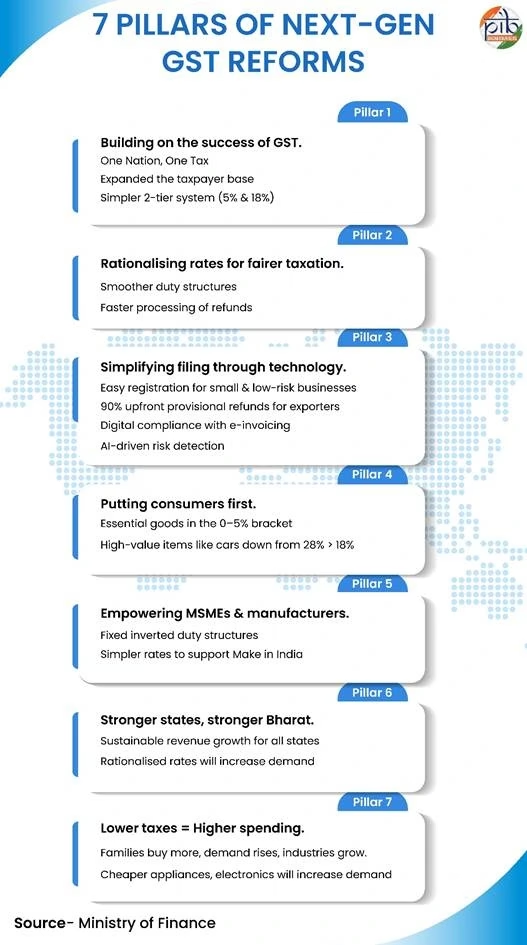
Pillars of Next Gen GST Reforms

  • Next-Gen GST reforms build on GST’s success with a simplified 2-tier structure, fairer taxation, and digital filing for ease and faster refunds. 
  • They prioritize consumers by lowering rates on essentials and high-value items, empower MSMEs and manufacturers with smoother cash flows, strengthen state revenues, and boost demand driving consumption and manufacturing growth across India.

Benefits of Next Gen GST Reforms

  • Lower Prices, Higher Demand: Cheaper goods and services increase household savings and stimulate consumption.
  • Support for MSMEs: Reduced rates on inputs like cement, auto parts, and handicrafts lower costs and make small businesses more competitive.
  • Ease of Living: A two-rate structure means fewer disputes, quicker decisions, and simpler compliance.
  • Wider Tax Net: Simpler rates encourage compliance, expanding the tax base and improving revenues.
  • Support for Manufacturing: Correcting inverted duty structures boosts domestic value addition and exports.
  • Revenue Growth: As seen in past reforms, lower rates with better compliance increase collections.
  • Economic Momentum: Lower costs → higher demand → larger tax base → stronger revenues → sustainable growth.
  • Social Protection: Exemption of GST on insurance and essential medicines strengthens household security and access to healthcare.

Additional Information

  • The shift to a two-slab system of 5% and 18%, removing the earlier 12% and 28% rates, will make taxation more transparent and easier to follow. 
  • At the same time, a 40% on luxury and sin goods such as pan masala, tobacco, aerated drinks, high-end cars, yachts, and private aircraft ensures fairness and revenue balance. 
  • Alongside, registration and return filing have been simplified, refunds made faster, and compliance costs reduced, easing the burden on businesses, especially MSMEs and startups.

Sector-wise follow-up of the reforms and their expected impact

Food and Household Sector

  • Reforms bring direct savings to households by reducing taxes on everyday essentials and packaged foods. GST rate cut on AC, Dishwashers and TVs (LCD, LED) is a dual win. It increases affordability for consumers while strengthening India’s electronics manufacturing ecosystem.
    • Products like Ultra-High Temperature (UHT) milk, Pre-packaged and labelled chena or paneer, all the Indian Breads will see NIL rates
    • Household goods like soaps, shampoos, toothbrushes, toothpaste, tableware, bicycles now at 5%.
    • Food items such as packaged namkeens, Bhujia, Sauces, Pasta, Chocolates, Coffee, Preserved Meat etc. reduced from 12% OR 18% to 5%
    • Consumer durables: TVs (LCD/LED) (> 32’), ACs, dishwashers: 28% → 18%.

Home Building & Materials

  • The cut in GST on cement and construction materials will give a big boost to the housing sector. This will lower the cost of homes and infrastructure projects, making ownership of houses more affordable. The move is also expected to spur demand in real estate and create new jobs in construction.
    • Cement: 28% → 18%.
    • Marble/travertine blocks, Granite blocks, Sand-lime bricks: 12% → 5%
    • Bamboo flooring / joinery, Packing cases & pallets (wood): 12% → 5%

Automobile Sector

  • Clearer classification of vehicles and auto parts will cut down disputes, improve compliance, and support growth in India’s automotive manufacturing and exports.
    • Small cars, two-wheelers ≤350cc: 28% → 18%.
    • Buses, trucks, three-wheelers, all auto parts: 28% → 18%.

Agriculture sector

  • Cheaper machinery and lower rates on bio-pesticides will help small farmers reduce costs and encourage sustainable farming practices. Correcting the inverted duty structure on Fertilizer inputs will boost domestic fertilizer production and reduce dependence on imports, strengthening self-reliance in agriculture.
    • Tractors: 12% → 5%; tires and parts: 18% → 5%.
    • Harvesters, threshers, sprinklers, drip irrigation, poultry & bee-keeping machines: 12% → 5%.
    • Bio-pesticides and natural menthol: 12% → 5%.

Service sector

  • Lower GST on hotel stays, gyms, salons, and yoga services will reduce costs for citizens, improve access to wellness, and give a fillip to the hospitality and service industries.
    • Hotel stays up to ₹7,500/day from 12% to 5%.
    • Gyms, salons, barbers, yoga GST cut from 18% to 5%.

Toys, Sports & Handicrafts 

  • Fixing duty structures for man-made fibres will improve the competitiveness of the textile industry, especially in exports. The inverted duty structure in the sector has been corrected with reduction of GST rate on manmade fibre from 18% to 5% and manmade yarn from 12% to 5%.
  • Further, lower GST rates on handicrafts will support artisan livelihoods, preserve India’s cultural heritage, and promote rural economic growth.
    • Handicraft idols & statues: 12% → 5%.
    • Paintings, sculptures: 12% → 5%.
    • Wooden/metal/textile dolls & toys: 12% → 5%.

Education Sector

  • Education has become more affordable with exercise books, erasers, pencils, crayons and sharpeners moving to 0% GST. This directly supports families and students, ensuring lower costs of learning materials.
    • Geometry boxes, school cartons, trays: 12% → 5%.

Medical Sector

  • Reduced rates on medicines and medical devices will improve access to healthcare and support domestic manufacturing in the pharma and medical equipment sectors.
    • 33 life-saving drugs, diagnostic kits: 12% → 0%.
    • Other medicines including Ayurveda, Unani, Homoeopathy: 12% → 5%.
    • Spectacles and corrective goggles: 28% → 5%.
    • Medical oxygen, thermometers, surgical instruments: 12–18% → 5%.
    • Medical, dental, and veterinary devices cut from 18% to 5%.

Health and life Insurance

  • GST exemptions on life and health insurance premiums will expand financial protection and support the vision of Mission Insurance for All by 2047.
    • GST exemption on premiums for individual life insurance, health insurance, floater plans, and senior citizen policies.

UPSC Spot-Check

Mains

The latest GST reforms mark a significant step towards simplification and fairness in India’s indirect tax regime. Discuss their potential impact on consumers, businesses, and government revenues.

(15 marks, 250 words)

Prelims

Consider the following statements:

Statement I: Under the latest GST reforms, luxury and sin goods such as pan masala, tobacco, aerated drinks, high-end cars, yachts, and private aircraft attract a 40% tax rate.

Statement II: Sin goods are taxed at higher rates because they are considered harmful to health or the environment, and higher taxation helps discourage consumption while generating revenue.

In the context of the above statements, which of the following is correct?

  1. Both Statement I and Statement II are correct and Statement II is the correct explanation of Statement I
  2. Both Statement I and Statement II are correct but Statement II is not the correct explanation of Statement I
  3. Statement I is correct but Statement II is incorrect
  4. Statement I is incorrect but Statement II is correct

✍️ Curated by InclusiveIAS Editorial Team

At InclusiveIAS, our editorial team is led by experts who have successfully cleared multiple stages of the UPSC Civil Services Examination, including Mains and Interview. With deep insights into the demands of the exam, we focus on crafting content that is accurate, exam-relevant, and easy to grasp.

Whether it’s Polity, Current Affairs, GS papers, or Optional subjects, our notes are designed to:

  • Break down complex topics into simple, structured points

  • Align strictly with the UPSC syllabus and PYQ trends

  • Save your time by offering crisp yet comprehensive coverage

  • Help you score more with smart presentation, keywords, and examples

🟢 Every article, note, and test is not just written—but carefully edited to ensure it helps you study faster, revise better, and write answers like a topper.