UPDATES

Black Holes – Types, Formation, Structure

  • Home
  • Black Holes – Types, Formation, Structure
Shape Image One

Black Holes

Black holes are among the most mysterious and least understood objects in the universe. Despite the name, they are not actual holes but extremely dense concentrations of matter compressed into a tiny region. Their gravity is so intense that, beyond a certain boundary called the event horizon, nothing — not even light — can escape. Unlike a solid surface, the event horizon is simply a boundary enclosing all the matter that forms the black hole.

  • A black hole is a region in space where gravity is so intense that nothing, not even light, can escape from it.
  • Albert Einstein predicted the existence of gravitational waves in 1916 in his general theory of relativity

Factly

  • The term “black hole” was coined many years later in 1967 by American astronomer John Wheeler. 
  • The first black hole ever discovered was Cygnus X-1, located within the Milky Way in the constellation of Cygnus, the Swan.

Types of Black holes

Black holes can be divided  into three categories according to their mass: 

Stellar Mass Black Holes:

  • If a star had around 20 times the Sun’s mass or more, the star’s core collapses into a stellar-mass black hole.
  • These are born from the death of stars much more massive than the Sun. When some of these stars run out of the nuclear fuel that makes them shine, their cores collapse into black holes under their own gravity. 
  • Other stellar mass black holes form from the collision of neutron stars.
  • These are probably the most common black holes in the cosmos.

Supermassive Black Holes 

  • These are the monsters of the universe, living at the centers of nearly every galaxy. 
  • They range in mass from 100,000 to billions of times the mass of the Sun, far too massive to be born from a single star. 
  • Supermassive black holes can grow by feeding on smaller objects, like their stellar-mass relatives and neutron stars. They can also merge with other supermassive black holes when galaxies collide.

Intermediate Mass Black Holes 

  • They weigh 100 to 10,000 times the mass of the Sun, putting them between stellar and supermassive black holes.

Factly

  • At the heart of the Milky Way lies a supermassive black hole — Sagittarius A*.
  • The first image of a black hole was captured in 2019 by the Event Horizon Telescope (EHT) collaboration.

Formation of black holes

Black holes form via two distinct ways: 

  1. They are stellar corpses, so they form when massive stars die. Stars whose birth masses are above roughly 8 to 10 times the mass of our sun, when they exhaust all their fuel — their hydrogen — they explode and die leaving behind a very compact dense object, a black hole. The resulting black hole that is left behind is referred to as a stellar mass black hole and its mass is of the order of a few times the mass of the sun.
  2. Formation of black holes through direct collapse of gas.Its a process that is expected to result in more massive black holes with a mass ranging from 1000 times the mass of the sun up to even 100,000 times the mass of the sun. This channel circumvents the formation of the traditional star, and is believed to operate in the early universe and produce more massive black hole seeds.

Factly

  • Not all stars leave behind black holes, stars with lower birth masses leave behind a neutron star or a white dwarf.

Structure

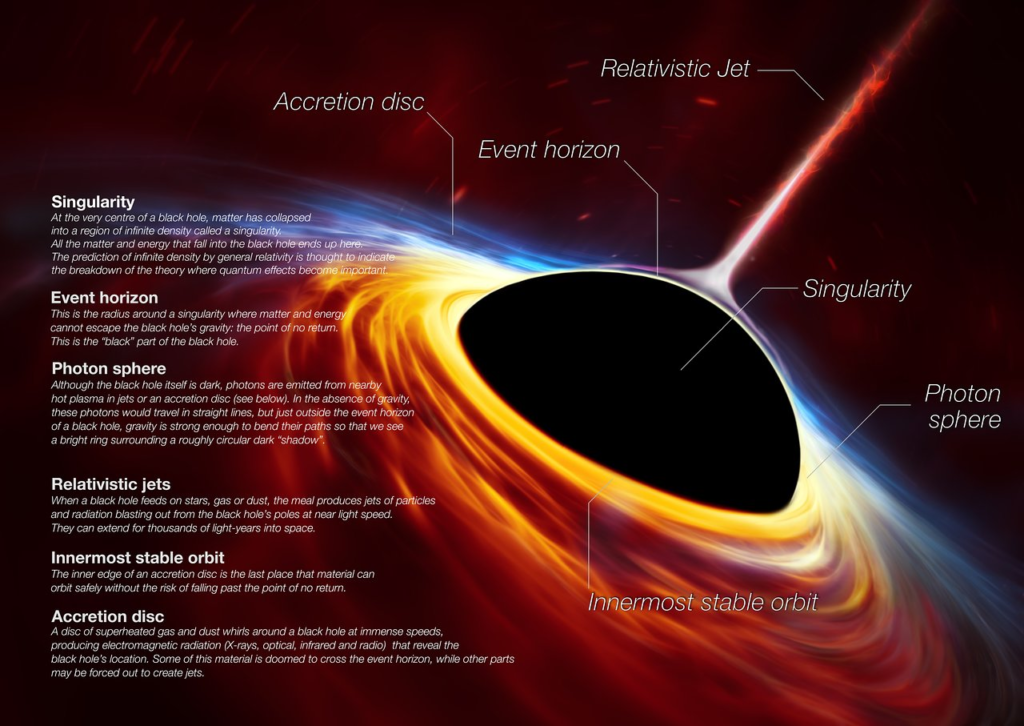
Singularity: A black hole’s entire mass is concentrated in an almost infinitely small and dense point called a singularity.

Event Horizon: The event horizon of a black hole is the boundary around the mouth of the black hole, past which light cannot escape. Once a particle crosses the event horizon, it cannot leave. Gravity is constant across the event horizon.

How Black Holes are detected?

Black holes don’t emit or reflect light, making them effectively invisible to telescopes. Scientists primarily detect and study them based on how they affect their surroundings:

  1. A supermassive black hole’s intense gravity can cause stars to orbit around it in a particular way.
  2. Black holes can be surrounded by rings of gas and dust, called accretion disks, that emit light across many wavelengths, including X-rays.
  3. When very massive objects accelerate through space, they create ripples in the fabric of space-time called gravitational waves. Scientists can detect some of these by the ripples’ effect on detectors.
  4. Massive objects like black holes can bend and distort light from more distant objects. This effect, called gravitational lensing, can be used to find isolated black holes that are otherwise invisible.

Factly

  • All black holes spin.
  • The nearest known black hole, called Gaia BH1, is about 1,500 light-years away.
  • The most distant black hole detected, at the center of a galaxy called QSO J0313-1806, is around 13 billion light-years away.
  • The most massive black hole observed, TON 618, tips the scales at 66 billion times the Sun’s mass.
  • The lightest-known black hole is only 3.8 times the Sun’s mass. It’s paired up with a star.
  • Monster black holes at the centers of galaxies can launch particles to near light speed.

FAQs 

1. What is a black hole?

A black hole is a region in space where gravity is so strong that nothing, not even light, can escape it.

2. Who coined the term “black hole”?

The term “black hole” was coined by American astronomer John Wheeler in 1967.

3. What are the types of black holes?

Black holes are categorized as:

  • Stellar Mass Black Holes

  • Intermediate Mass Black Holes

  • Supermassive Black Holes

4. What is Sagittarius A?*

Sagittarius A* is a supermassive black hole located at the center of the Milky Way galaxy.

5. What is an event horizon?

It is the boundary around a black hole beyond which nothing can escape its gravitational pull.

✍️ Curated by InclusiveIAS Editorial Team

At InclusiveIAS, our editorial team is led by experts who have successfully cleared multiple stages of the UPSC Civil Services Examination, including Mains and Interview. With deep insights into the demands of the exam, we focus on crafting content that is accurate, exam-relevant, and easy to grasp.

Whether it’s Polity, Current Affairs, GS papers, or Optional subjects, our notes are designed to:

  • Break down complex topics into simple, structured points

  • Align strictly with the UPSC syllabus and PYQ trends

  • Save your time by offering crisp yet comprehensive coverage

  • Help you score more with smart presentation, keywords, and examples

🟢 Every article, note, and test is not just written—but carefully edited to ensure it helps you study faster, revise better, and write answers like a topper.