UPDATES

Off-Budget Borrowings: Meaning, Methods, Fiscal Impact & Way Forward

  • Home
  • Off-Budget Borrowings: Meaning, Methods, Fiscal Impact & Way Forward
Shape Image One

Off-Budget Borrowings

Off-budget borrowings refer to borrowings not directly made by the government (generally by public sector enterprises) but for which principal and interest are serviced from the government budget. It can be through various methods such as NSSF borrowings, domestic market borrowings, foreign market borrowings. 

How are off-budget borrowings raised?

  • The government can ask an implementing agency to raise the required funds from the market through loans or by issuing bonds. 
    • For example, food subsidy is one of the major expenditures of the Centre.
      • In the Budget presentation for 2020-21, the government paid only half the amount budgeted for the food subsidy bill to the Food Corporation of India. The shortfall was met through a loan from the National Small Savings Fund. This allowed the Centre to halve its food subsidy bill from Rs 1,51,000 crore to Rs 77,892 crore in 2020-21.
    • Other public sector undertakings have also borrowed for the government. For instance, public sector oil marketing companies were asked to pay for subsidised gas cylinders for Pradhan Mantri Ujjwala Yojana beneficiaries in the past.
    • Public sector banks are also used to fund off-budget expenses. 
      • For example, loans from PSU banks were used to make up for the shortfall in the release of fertiliser subsidies.

Facts

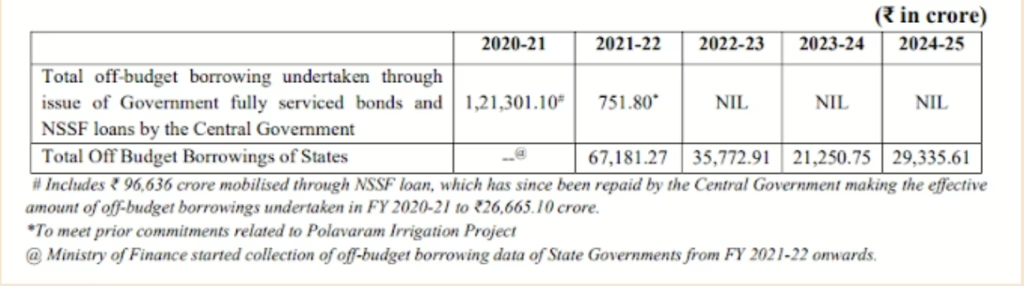
  • Off-budget borrowings surged during the pandemic and touched ₹67,181 crore in FY 2020-21, before moderating to ₹29,335 crore in FY 2024-25.
  • In FY 2024-25, the top four states with the highest off-budget borrowings were:
    • Maharashtra: ₹13,990 crore
    • Karnataka: ₹5,438 crore
    • Telangana: ₹2,697 crore
    • Kerala: ₹983 crore
  • Off-budget borrowings by states rose to ₹29,335 crore in FY25 from ₹21,251 crore the year before, finance ministry data shows.

Methods Used

  •  NSSF Borrowings 
    • The NSSF, a part of the Union’s Public Account, receives deposits under National Savings Schemes. The balance in the fund is regularly invested in special government securities. Withdrawals from the NSSF do not require prior approval from Parliament (since it is part of the Public Account). This makes it easier for the union government to use this fund as a source of extra budgetary financing. 
    • The government often makes use of this gap, and many entities, such as central PSUs and union ministries receive loans from this fund for projects implemented by them. 
    • The NSSF liabilities are included in the Statement of Liabilities of the Central Government, which forms part of the Union Receipt Budget. 
    • Even though these liabilities are included in the government’s total liabilities, they are not reflected in the fiscal deficit. 
      • This is because, for calculating the Union’s fiscal indicators, such as the fiscal deficit, and revenue and capital expenditure, only the Consolidated Fund of India’s (CFI) balance is considered. The expenditure incurred from the NSSF balance is not included in the total government expenditure. Furthermore, the NSSF deficit is not merged with that of the CFI, resulting in an under-inclusive deficit statistic
  •  Government Fully Serviced Bonds 
    • A bond is defined as a debt instrument by which an entity borrows money from an investor for a predetermined period and interest rate. Public sector units and SPVs, like Air India Assets Holding Limited (AIAHL), make use of union government bonds to raise funds from the market. Special securities issued by the government to banks, PSUs, and other entities are listed in the Asset and Liability Statement of the Receipt Budget. Sometimes the securities are in the form of government fully serviced bonds, for which the entire liability falls on the union government and is not shared by the PSU. Despite this, some of these bonds do not feature under government liabilities in the budget
  • Domestic Market borrowings 
    • State PSUs and SPVs raise resources from markets to meet the financial requirements for providing services for which the government is typically responsible (for instance, a drinking water supply project which is a government welfare scheme, but being implemented by a PSU or SPV). 
    • In several cases, the state government is liable for servicing the principal and interest obligations of the debt picked up by state PSUs, despite not being listed as an explicit guarantor. Since PSUs are distinct legal entities, formally separate from the state government, the latter argue that PSU borrowings are on the strength of the PSU’s balance sheet alone. Ultimately, despite the government being liable, this liability escapes the state government’s accounts, and can only be found in the PSU accounts. 
  • Foreign Market Borrowings 
    • Apart from raising funds from domestic markets, PSUs have also directly approached external funding agencies. As per Articles 292 and 293(1) of the Constitution, only the union government has the power to borrow from overseas, and states are expressly restricted to borrowing only within the territory of India. 
      • Despite this constitutional prohibition, there are examples of state PSUs resorting to overseas off-budget borrowings which will have to be repaid by their state government, through the issue of masala bonds . These rupee-dominated bonds are instruments of debt raised in foreign markets in Indian currency, instead of the local currency or dollars. 
        • For example, the Kerala Infrastructure Investment Board (KIIFB) raised Rs 2,150 crore in 2018–19 through masala bonds, which the CAG observed to be in violation of Article 293(1). The repayment of the KIIFB borrowings was done from the state petroleum cess and motor vehicle tax, which makes them a direct liability of the State. 
        • In 2018-19, the Andhra Pradesh State government cleared Rs 2,000 crore of bonds to be raised by the Capital Region Development Authority (CDRA), which also included masala bonds. 
  • Special Banking Arrangements 
    • Special banking arrangements (SBAs) refer to the arrangements made by the government with banks to facilitate cash and credit flow outside the budgetary appropriation. 
    • The beneficiary body can be a PSU, SPV, or any Implementing Agency involved in quasi-fiscal operations with the government. 
    • In the past, SBAs have been used to postpone budgetary expenditure on fertiliser subsidies, to be paid to fertiliser companies. Often, the payment is not made in the same year, leading to carryover liabilities. To make up for non-payments, the Department of Fertilizers arranges loans from PSU banks to the fertiliser companies. The department also partially bears the interest on these loans. Fertiliser companies, at times, leverage the pending subsidy payments with banks to avail credit.

Reasons

  • Meeting Fiscal and Expenditure Pressures
    • To meet short-term expenditure requirements arising from revenue shortfalls.
    • To finance specific flagship or priority projects (e.g., food subsidy, PM Krishi Sinchai Yojana).
    • To expand the available pool of funds while formally adhering to FRBM-mandated fiscal deficit targets.
      • For instance, it was widely reported that in July 2019, just three days after the presentation of the Budget, the CAG pegged the actual fiscal deficit for 2017-18 at 5.85% of GDP instead of the government version of 3.46%.
    • To maintain a lower reported debt-to-GDP ratio, thereby supporting stable bond yields and sovereign credit ratings.
  • Avoiding Fiscal and Political Constraints
    • To avoid detailed parliamentary scrutiny over politically sensitive or contentious projects.
    • To finance fiscally imprudent election promises, such as loan waivers and large subsidies, without reflecting them directly in the budget.
    • Use of creative accounting practices to keep liabilities outside the formal fiscal deficit (e.g., States showing lower deficits through off-budget routes).
  • Enhancing Executive Flexibility
    • To gain greater autonomy in expenditure decisions beyond the rigidities of annual budgetary approval.
    • To ensure quicker fund mobilisation without lengthy legislative processes.
  • Supporting Public Sector and Special Entities
    • To provide financial assistance to state-owned enterprises and PSUs without increasing headline government debt.
    • To route borrowings through Special Purpose Vehicles (SPVs) for infrastructure and capital projects (e.g., state capital city or infrastructure development projects).
  • Responding to Unforeseen Circumstances
    • To address emergency situations such as economic shocks or pandemics (e.g., COVID-19-related health and welfare spending).
    • To manage sudden fiscal stress without breaching statutory deficit limits.
  • Economic Management and Structural Adjustments
    • To support economic growth measures, including infrastructure push and crowding-in private investment.
    • To address contingent liabilities, such as those arising from power sector reforms.
    • To restructure existing debt obligations, including repayment of dues to the Central Government through off-budget mechanisms.

Key Issues and Concerns

  • Undermines Fiscal Transparency and Accountability
    • Hides True Fiscal Deficit: By keeping borrowings off-budget, the reported fiscal deficit appears lower than the actual liability, misleading Parliament, investors, and rating agencies.
    • Violates FRBM Spirit: Circumvents targets set under the Fiscal Responsibility and Budget Management (FRBM) Act, defeating its purpose of fiscal discipline.
  • Creates Fiscal Risks
    • Contingent Liabilities: These borrowings often carry an implicit or explicit government guarantee, creating future contingent liabilities that can strain finances during economic stress.
    • Debt Sustainability Concerns: Excluding such borrowings underestimates public debt, risking long-term fiscal sustainability.
  • Distorts Resource Allocation
    • Bypasses Parliamentary Scrutiny: Expenditure financed through off-budget routes avoids detailed discussion and approval by Parliament, weakening legislative oversight.
    • Skewed Prioritization: Allows the government to fund politically popular schemes without reflecting their true cost in the budget.
  • Increases Cost of Borrowing
    • Higher Interest Costs: Off-budget entities often borrow at higher interest rates than sovereign rates, increasing the overall cost of public projects.
    • Crowding Out Effect: Large off-budget borrowings can absorb market funds, raising borrowing costs for the private sector.
  • Compromises Macroeconomic Management
    • Misleading Indicators: Key metrics like debt-to-GDP and fiscal deficit ratios become unreliable, hampering effective policy formulation.
    • Rating Agency Scrutiny: Agencies like Moody’s and Fitch account for off-budget liabilities, which can affect India’s sovereign credit rating.
  • Inequity and Inter-generational Burden
    • Shifts Burden to Future Governments: The repayment liability often falls on future administrations, creating an inter-generational equity issue.
    • Lacks Inter-temporal Fairness: Current beneficiaries enjoy services financed by debt that future taxpayers must repay.

Government Steps

Central Government

  • The Central Government is transparently disclosing off-budget borrowing undertaken, through Budget documents
  • The Central Government has discontinued off-budget borrowing from financial year 2022-23
  • As per the provisions of the Fiscal Responsibility and Budget Management Act, 2003, outstanding amount of off-budget borrowing is counted in Central Government debt

State Government

  • Since FY22, Centre has tightened rules for states by counting debt raised through state-owned entities, where repayment is backed by state budgets, taxes, or other revenues, toward their overall borrowing limits under Article 293(3) of the Constitution.

Way Forward

  • Legislative and Institutional Reforms
    • Amend FRBM Act: Explicitly include all public liabilities (including guarantees and off-budget borrowings) under fiscal deficit calculation.
    • Adopt “Public Sector Borrowing Requirement” (PSBR): Shift from fiscal deficit to PSBR as the primary measure, capturing borrowings of all public sector entities.
    • Set Legal Ceilings on Guarantees: Statutory cap on government guarantees (e.g., 2-3% of GDP) with parliamentary approval for exceptions.
  • Enhanced Transparency and Disclosure
    • Consolidated Public Sector Report: Publish an annual statement of all liabilities (on and off-budget) as a budget annexure.
    • Real-Time Guarantee Registry: Digitally track and disclose all government guarantees and off-budget commitments .
    • Audit by C&AG: Mandate audit of all off-budget entities and their expenditure by the Comptroller and Auditor General.
  • Strengthened Oversight Mechanisms
    • Parliamentary Approval: Require prior approval of Parliament’s Public Accounts Committee (PAC) for any off-budget financing beyond a threshold.
    • Independent Fiscal Council: Empower a statutory Fiscal Council (as recommended by the NK Singh Committee) to assess and report on all liabilities.
    • State-Level Monitoring: Extend oversight to state-level off-budget borrowings 
  • Fiscal Risk Management
    • Risk-Weighted Provisioning: Mandate risk-based provisioning for contingent liabilities
    • Sinking Fund: Create a “Contingent Liability Fund” with annual budgetary contributions to meet potential defaults.
    • Regular Stress Testing: Conduct periodic stress tests on the fiscal impact of off-budget exposures.
  • Alternative Financing Models
    • Promote Viability Gap Funding (VGF): Use transparent VGF for infrastructure instead of opaque off-budget vehicles.
    • Expand Municipal Bonds: Develop municipal bond markets for urban infrastructure to reduce reliance on off-budget SPVs.
    • Blended Finance: Leverage private capital through PPPs with clear risk-sharing frameworks.
  • Accountability and Culture Shift
    • Outcome Budgeting Link: Tie off-budget spending to measurable outcomes in the Output-Outcome Framework.
    • Ministerial Responsibility: Hold ministries accountable for the financial performance of their off-budget entities.
    • Public Awareness: Publish simplified “Citizen’s Fiscal Responsibility Reports” to build public awareness.

The goal should be to move from opaque fiscal engineering to transparent and rules-based fiscal management. This aligns with global best practices (e.g., New Zealand’s Public Finance Act) and will strengthen India’s fiscal credibility, support higher sovereign ratings, and ensure sustainable development financing.

Sample UPSC Mains Question 

Q. Off-budget borrowings, while helping governments meet fiscal and expenditure pressures, raise serious concerns regarding transparency and debt sustainability. Examine the rationale behind off-budget financing in India, its key methods, and the challenges it poses to fiscal governance. Suggest reforms to ensure greater accountability.

✍️ Curated by InclusiveIAS Editorial Team

At InclusiveIAS, our editorial team is led by experts who have successfully cleared multiple stages of the UPSC Civil Services Examination, including Mains and Interview. With deep insights into the demands of the exam, we focus on crafting content that is accurate, exam-relevant, and easy to grasp.

Whether it’s Polity, Current Affairs, GS papers, or Optional subjects, our notes are designed to:

  • Break down complex topics into simple, structured points

  • Align strictly with the UPSC syllabus and PYQ trends

  • Save your time by offering crisp yet comprehensive coverage

  • Help you score more with smart presentation, keywords, and examples

🟢 Every article, note, and test is not just written—but carefully edited to ensure it helps you study faster, revise better, and write answers like a topper.