Money Market
The money market is the segment of the financial market where short-term financial instruments, having a maturity of up to one year, are issued and traded.
Features of Money Market
- Short-Term Market: It deals in financial instruments having a maturity of up to one year.
- High Liquidity: Money market instruments can generally be converted into cash easily because of their short maturity.
- Debt Instruments: It primarily deals in short-term debt instruments rather than equity instruments.
- Secured and Unsecured Transactions: Money market transactions could be both secured (with collateral) and unsecured (clean, without collateral).
- Participants in the Money Market: Major participants include the RBI, banks, primary dealers, mutual funds, financial institutions and eligible corporates.
- Low Risk: Money market instruments generally carry relatively lower risk because of their short maturity, though the degree of risk varies across instruments and issuers.
- Liquidity Management: It enables institutions to manage temporary shortages or surpluses of funds.
- Wholesale Market: Transactions generally involve large amounts and institutional participants, although retail investors may access certain money-market instruments directly or through investment products.
- RBI’s Key Role: The Reserve Bank of India plays the principal regulatory and developmental role in major segments of India’s money market.
Classification of Money Market
Depending on the maturity period (tenor) of the transaction, the money market can be classified into:
- Overnight Market: Transactions have a maturity of one working day.
- Notice Money Market: Transactions have a maturity ranging from 2 days to 14 days.
- Term Money Market: Transactions have a maturity ranging from 15 days to one year.
Participants in the Money Market
The money market has a wide range of participants, including:
- Banks
- Primary Dealers
- Financial Institutions
- Mutual Funds
- Insurance Companies
- Provident Funds
- Pension Funds
- Corporates etc.
- Reserve Bank of India (RBI)
Money Market Instruments
Major Money Market Instruments include
- Call and Notice Money
- Treasury Bills
- Cash Management Bills
- Commercial Paper
- Certificates of Deposit
- Repurchase Agreements (Repos)
- Collateralized Borrowing and Lending Obligations
Functions of Money Market
- Providing Short-Term Funds: The money market enables borrowers to raise funds for short-term requirements, such as temporary cash-flow mismatches etc.
- Facilitating Liquidity Management: The money market allows financial institutions to manage temporary surpluses and shortages of funds. Institutions with surplus funds can lend them for short periods, while those facing temporary shortages can borrow funds.
How Does the Money Market Work?
The money market facilitates short-term borrowing and lending, generally for periods up to one year. It connects entities that need temporary funds with those that have surplus funds.
- Borrowers: Governments, banks, financial institutions and companies may raise short-term funds to meet liquidity needs, working-capital requirements or temporary cash-flow mismatches.They do this by issuing or using money market instruments such as Treasury Bills, Commercial Paper, Certificates of Deposit and Repo transactions.
- Investors:Banks, mutual funds, financial institutions, corporates and other eligible investors deploy their short-term surplus funds in money market instruments.In return, they earn income through interest or the difference between the purchase price and redemption value, depending on the instrument.
- Money Market Instruments:Different instruments are used according to the borrower’s need, maturity and credit profile.Common instruments include Treasury Bills, Commercial Paper etc
- Secondary Market Trading:Many money market instruments can be bought and sold before maturity.This improves liquidity by allowing investors to convert their holdings into cash without waiting for the instrument to mature.
- Money Market Funds:Money market mutual funds pool money from investors and invest in a diversified portfolio of short-term debt and money market instruments. They provide investors with indirect and professionally managed access to the money market.
- Regulatory Oversight:The Reserve Bank of India plays the principal regulatory role.
Surplus funds with investors → Money market instruments → Short-term funds for borrowers → Interest/return to investors
Call/Notice Money
- Under call money market, funds are transacted on overnight basis and under notice money market, funds are transacted for the period between 2 days and 14 days.
- These are unsecured instruments.Borrowing and lending happen without any collateral or security.
- The entities permitted to participate both as lender and borrower in the call/notice money market are Scheduled Commercial Banks (excluding RRBs), Co-operative Banks (other than Land Development Banks) and Primary Dealers (PDs).
- The interest rates depend on the surplus funds available with lenders and the demand for the same which remains volatile.
Term Money
- It refers to the borrowing and lending of funds on an unsecured basis between banks and eligible financial institutions for a period exceeding 14 days and up to a maximum of one year.
- The interest rates depend on the surplus funds available with lenders and the demand for the same which remains volatile.
Treasury Bills
- Debt obligations of the Government that have maturities of less than one year called Treasury Bills or T-Bills. Treasury Bills are short-term obligations of the Treasury/ Government.
- These are presently issued in three tenors, namely, 91 day, 182 day and 364 day.
- These are zero coupon securities and pay no interest.Instead, they are issued at a discount to the face value and redeemed at the face value at maturity
- Example:
- Suppose a 91-day Treasury Bill has a face value of ₹100 but is issued at ₹98.20.
- At maturity, the government repays ₹100.
- Therefore:
- Return = ₹100 − ₹98.20 = ₹1.80
- Thus, the investor earns a return of ₹1.80 without receiving any separate interest payment.
- Treasury Bills are issued only by the Central Government (Government of India). State Governments do not issue Treasury Bills.
Cash Management Bills
- Cash Management Bills (CMBs) are short-term money market instruments introduced by the Government of India in consultation with the RBI in May,2010.
- They are issued to meet temporary mismatches in the cash flows of the Central Government.
- CMBs are similar to Treasury Bills in their basic features, but they have a maturity of less than 91 days.
- Key Features of CMBs
- Maturity: CMBs have a maturity period of less than 91 days.
- Zero-Coupon Instruments:These are zero coupon securities and pay no interest.
- Discounted Redemption:Similar to Treasury Bills, CMBs are issued at a discount and redeemed at face value upon maturity. For instance, if a cash management bill has a face value of Rs 100, it can be acquired at Rs 97, and upon maturity, typically after 60 days, it can be redeemed for Rs 100. No interest payment is made, but the discount is the return on investment.
- Flexible Tenure: The tenure, total quantity of CMBs to be issued (notified amount), and date of issuance depend on the temporary cash requirements of the Government.
- SLR Eligibility: CMBs are eligible as Statutory Liquidity Ratio (SLR) securities.
- Auction by RBI:Cash Management Bills are auctioned by the Reserve Bank of India.
Commercial Paper
Commercial Paper (CP) is an unsecured money market instrument issued in the form of a promissory note. It is held in dematerialised form through depositories approved by and registered with SEBI.
It was introduced in India in 1990 with a view to enabling highly rated corporate borrowers to diversify their sources of short-term borrowings and provide an additional instrument to the investors.
- Key Features of Commercial Paper
- Unsecured Instrument: CP is not backed by collateral. Its issuance therefore depends significantly on the creditworthiness of the issuer.
- Form: It is issued as a promissory note and held in dematerialised form.
- Denomination: CP is issued in a minimum denomination of ₹5 lakh and multiples thereof.
- Issued at Discount: CP is issued at a discount to its face value and redeemed at face value on maturity. The difference represents the investor’s return.
- No Underwriting or Co-Acceptance: A CP issue cannot be underwritten or co-accepted.
- No Call or Put Options: Call and put options are not permitted on Commercial Paper.
- Short-Term Maturity: Can be issued for a maturity for a minimum of 7 days and a maximum upto one year from the date of issue.
- Regulatory Framework: In India, CP issuance is governed by the Reserve Bank of India (RBI).
- Eligible Issuers of Commercial Paper (CP)
- Companies
- Non-Banking Financial Companies (NBFCs), including Housing Finance Companies
- Infrastructure Investment Trusts (InvITs) and Real Estate Investment Trusts (REITs)
- All India Financial Institutions (AIFIs)
- Other body corporates having a minimum net worth of ₹100 crore, provided they are legally permitted to borrow or issue debt instruments in India
- Co-operative Societies having a minimum net worth of ₹100 crore
- Limited Liability Partnerships (LLPs) having a minimum net worth of ₹100 crore
- Primary dealers
- Any other entity specifically permitted by the RBI
- Key Condition
- Where the issuer has borrowed from banks, AIFIs or NBFCs, such borrowing must be classified as a Standard Asset by the lender at the time the CP or NCD is issued.
- Rating Requirement
- Commercial paper must be rated by an independent, SEBI-registered credit rating agency.
Certificates of Deposit
Certificate of Deposit (CD) is a negotiable money market instrument and issued in dematerialised form or as a Usance Promissory Note against funds deposited at a bank or other eligible financial institution for a specified time period
- Key Features
- Issuers: CDs can be issued by:
- Scheduled Commercial Banks, excluding Regional Rural Banks (RRBs) and Local Area Banks (LABs)
- Eligible All-India Financial Institutions
- Minimum Amount:The minimum amount of a CD is ₹5 lakh, and further issuances are made in multiples of ₹5 lakh.
- Maturity: The maturity depends on the type of issuer:
- Banks: Not less than 7 days and not more than 1 year
- Eligible Financial Institutions: Not less than 1 year and not more than 3 years
- Investors: CDs may be issued to:
- Individuals
- Companies and corporations
- Banks and Primary Dealers
- Trusts
- Funds
- Associations
- Non-Resident Indians (NRIs) may also subscribe to CDs, but only on a non-repatriable basis.
- Certificates of Deposit can be issued at a discount to their face value.Banks and financial institutions can also issue certificates of deposit with floating interest rates.
- CDs are fully taxable under the Income Tax Act.
- CDs shall be issued only in dematerialised form and held with a depository registered with Securities and Exchange Board of India.
Repurchase Agreements (Repos)
Repo
A repo (repurchase agreement) is a transaction in which one party sells securities to another party and simultaneously agrees to repurchase them on a specified future date at a predetermined price.
Borrower sells securities → Receives funds → Repurchases securities later at an agreed price
Reverse Repo
A reverse repo involves providing funds by purchasing securities with an agreement to sell them back to the borrower on a specified future date at an agreed price.
- How Does a Repo Transaction Work?
- A repo transaction consists of two legs:
- First Leg: The borrower sells securities to the lender and receives funds.
- Second Leg: On the agreed future date, the borrower repurchases the securities by paying the original amount along with the agreed return.
- The period between these two transactions is known as the repo period.
- The interest charged on the funds borrowed is determined by the agreed repo rate.
- Example
- Suppose Bank A needs ₹100 crore for one day.
- Bank A sells eligible securities to Bank B for ₹100 crore with an agreement to repurchase them the next day at a slightly higher price.
- For Bank A, the transaction is a repo because it is borrowing funds.
- For Bank B, the same transaction is a reverse repo because it is lending funds.
- Therefore, repo and reverse repo are two perspectives of the same transaction.
- Regulation: The repo market in India is regulated by the Reserve Bank of India.
Collateralised Borrowing and Lending Obligation (CBLO)
- A Collateralised Borrowing and Lending Obligation (CBLO) was a money-market instrument developed by the Clearing Corporation of India Limited (CCIL) to facilitate short-term borrowing and lending of funds.
- Unlike unsecured call money transactions, borrowing under CBLO was backed by eligible collateral, thereby reducing credit risk.
- In simple terms, CBLO was a short-term borrowing arrangement in which the borrower received funds and agreed to repay them on a specified future date. The borrowing was backed by collateral, usually eligible securities, which reduced the risk for the lender.
- Note: Collateralised Borrowing and Lending Obligation (CBLO) segment of the money market was discontinued and replaced with Triparty Repo with effect from November 05, 2018
FAQs
1. What is a financial market?
A financial market is a marketplace where financial assets and securities such as shares, bonds, currencies and derivatives are issued or traded. It facilitates the transfer of funds between savers and borrowers.
2. What are the two major types of financial markets?
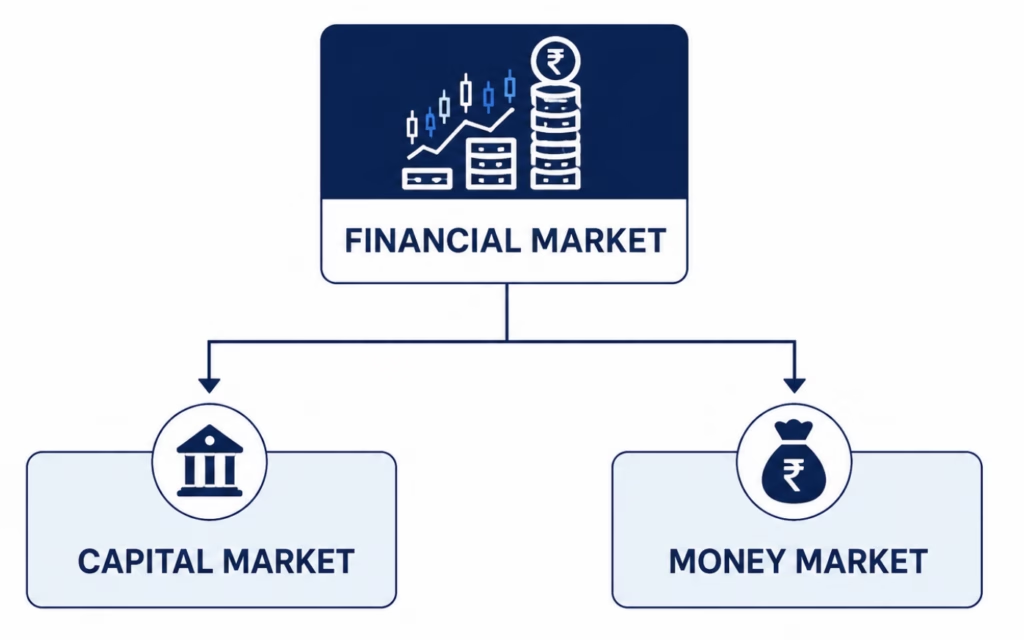
Financial markets are broadly divided into the capital market and the money market. The capital market primarily deals with longer-term financing, while the money market deals with short-term funds.
3. What is the primary market?
The primary market is where new securities are issued to investors for the first time. Funds raised through such issuance flow to the issuer. An IPO is a common example.
4. What is the secondary market?
The secondary market is where securities already issued are bought and sold among investors. The issuing company generally receives no fresh funds from these transactions.
5. What is a money market?
The money market is the segment of the financial market where short-term financial instruments, generally having maturities of up to one year, are issued and traded.
6. What are the major money market instruments in India?
Major instruments include Treasury Bills, Commercial Paper, Certificates of Deposit, Call and Notice Money, Cash Management Bills and repo-related instruments.
✍️ Curated by InclusiveIAS Editorial Team
At InclusiveIAS, our editorial team is led by experts who have successfully cleared multiple stages of the UPSC Civil Services Examination, including Mains and Interview. With deep insights into the demands of the exam, we focus on crafting content that is accurate, exam-relevant, and easy to grasp.
Whether it’s Polity, Current Affairs, GS papers, or Optional subjects, our notes are designed to:
Break down complex topics into simple, structured points
Align strictly with the UPSC syllabus and PYQ trends
Save your time by offering crisp yet comprehensive coverage
Help you score more with smart presentation, keywords, and examples
🟢 Every article, note, and test is not just written—but carefully edited to ensure it helps you study faster, revise better, and write answers like a topper.