Aquaponics

Shape Image One

Aquaponics

  • Aquaponics is an integrated fish and plant production technology, essentially comprising two sub-systems, viz., ‘Aquaculture’ and ‘Hydroponics’.
    • Aquaculture – raising fish in tanks
    • Hydroponics – cultivating plants in nutrient-rich water without soil
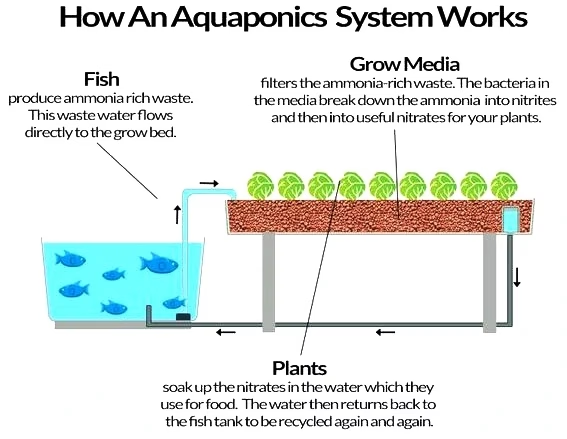
    • The underlying principle is to efficiently utilize water to produce two crops instead of one, by partitioning and sharing nutrients between fish and plants. This forms a recirculatory aquaculture system, where the waste generated by fish (ammonia) is converted by beneficial bacteria into nitrates — a nutrient that plants can absorb. In return, plants help purify the water before it’s recirculated back to the fish tank.
  • This farming system is commonly used in resource limited and urban areas to raise both fish and vegetables in an integrated system. Aquaponics involves the culture of horticulture plants along with fishes. 
  • Crops Suitable for Aquaponics
    • Many plants are suitable for aquaponics systems, though which ones work for a specific system depends on the maturity and stocking density of the fish.
    • Green leafy vegetables with low to medium nutrient requirements are well adapted to aquaponics systems, including capsicum, tomatoes, lettuce, cabbage, lettuce, basil, spinach, chives, herbs, and watercress.

      System Design

      Aquaponics functions as a closed-loop system:

      • Fish are fed quality floating pellet feed.
      • Waste-rich water is pumped into biofilter troughs or grow beds.
      • Plants in these beds absorb nutrients and help purify the water.
      • Clean water is then recirculated to the fish tank.
      • The flow rate of water is controlled using timers and pumps.

      Note: This Recirculation Culture System ensures minimal water wastage, enhances nutrient recycling, and creates a symbiotic relationship between aquatic and plant life.

      Advantages

      • Year-Round Cultivation
        • Temperature and environmental factors can be regulated in controlled aquaponic setups, allowing continuous food production throughout the year — irrespective of weather conditions.
      •  Efficient Water Use
        • Aquaponics uses 90% less water than traditional soil-based farming, as the system recycles and reuses water between fish and plants, making it ideal for drought-prone or water-scarce regions.
      •  No Soil, No Weeding
        • Plants are grown without soil, eliminating most weeding problems and soil-borne diseases. This simplifies maintenance and reduces labour.
      • Faster Plant Growth
        • Plants grow faster in aquaponic systems due to constant access to nutrient-rich water, oxygen, and balanced pH conditions.
      • Dual Income Opportunities
        • Commercial farmers benefit from two revenue streams: selling organic vegetables/fruits and marketable fish such as tilapia, catfish, or carp.
      •  Reduces Carbon Footprint
        • Aquaponics requires less land, emits fewer pollutants, and minimizes transport needs when implemented locally, helping to lower the carbon footprint of food production.
      • Suitable for Degraded or Urban Land
        • Aquaponics is ideal for land-scarce, rocky, or nutrient-poor regions, and can be set up on rooftops, backyards, or greenhouses — enabling agriculture even in urban environments.
      •  Supports Self-Reliance and Sustainable Living
        • Aquaponics complements off-grid, self-sufficient lifestyles, particularly when integrated with solar power, rainwater harvesting, and home-based livestock systems

      Challenges

      • High initial cost for setting up tanks, pumps, biofilters, etc.
      • Requires technical know-how for managing water quality, pH, temperature, and fish health.
      • Limited crop suitability
        • Not all crops are suitable for this method.

      Aquaponics represents a revolutionary shift toward sustainable, integrated, and resource-efficient agriculture. By combining aquaculture and hydroponics, it offers a closed-loop system that minimizes waste, conserves water, and yields organic, high-nutrient produce and fish. Its suitability for urban spaces, degraded land, and climate-vulnerable regions makes it a promising solution for India’s twin challenges of food and nutritional security. As we move toward a more climate-resilient and self-reliant agricultural future, aquaponics can play a vital role in promoting circular economy principles and ensuring sustainable livelihoods.

      FAQs 

      1. What is aquaponics?

      Aquaponics is an integrated farming method that combines aquaculture (raising fish) and hydroponics (growing plants without soil) in a symbiotic system.

      2. How does aquaponics work?

      Fish waste provides nutrients for plants, and plants purify water that is then recirculated back to the fish tank. Bacteria help convert fish waste into usable nutrients for the plants.

      ✍️ Curated by InclusiveIAS Editorial Team

      At InclusiveIAS, our editorial team is led by experts who have successfully cleared multiple stages of the UPSC Civil Services Examination, including Mains and Interview. With deep insights into the demands of the exam, we focus on crafting content that is accurate, exam-relevant, and easy to grasp.

      Whether it’s Polity, Current Affairs, GS papers, or Optional subjects, our notes are designed to:

      • Break down complex topics into simple, structured points

      • Align strictly with the UPSC syllabus and PYQ trends

      • Save your time by offering crisp yet comprehensive coverage

      • Help you score more with smart presentation, keywords, and examples

      🟢 Every article, note, and test is not just written—but carefully edited to ensure it helps you study faster, revise better, and write answers like a topper.