Council of Europe (CoE) – Origin, Objectives, Structure

  • Home
  • Council of Europe (CoE) – Origin, Objectives, Structure
Shape Image One

Council of Europe (CoE)

The Council of Europe is an international organisation with the goal of upholding human rights, democracy and the rule of law in Europe.

Headquarters: Strasbourg, France

Objective

To promote democracy, human rights and the rule of law across Europe and beyond.

Members

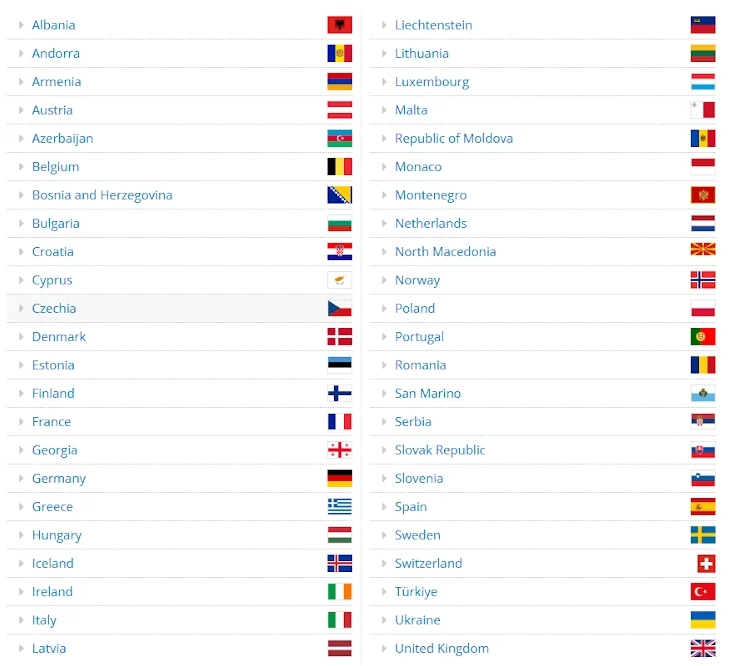
It includes 46 member states, 27 of which are members of the European Union.
Work

  • It sets standards, monitor compliances and work with states to:
    • Fight violence against women, child sexual abuse, corruption, cybercrime, discrimination, racism, human trafficking, money laundering, organ trafficking, terrorism and torture
    • Protect freedom of speech, media freedom, free elections, privacy, personal data, social rights, national minorities and minority languages
    • Promote democratic citizenship, human rights education, youth participation, integrity in sport, culture and Europe’s cultural and natural heritage
    • Support civil society
    • Tackle future challenges, such as artificial intelligence, bioethics and the environment

Main Entities

Secretary General

  • Leads the Organisation, providing strategic management

Committee of Ministers

  • Main decision-making body, representing member states
  • The Committee of Ministers is composed of the Ministers for Foreign Affairs of the 46 member States of the Council of Europe or their Permanent Representatives in Strasbourg.
  • The Committee of Ministers is the Council of Europe’s decision-making body. 
  • It is both a governmental body where national approaches to European problems are discussed on an equal footing and a forum to find collective responses to these challenges.
  • With the Parliamentary Assembly, it is the guardian of the Council’s fundamental values, and monitors member states’ compliance with their undertakings.

Parliamentary Assembly

  • Democratic forum for monitoring and debate among national parliamentarians
  • The Parliamentary Assembly of the Council of Europe consists of 306 members of parliament from the 46 member states
  • The Assembly elects the Secretary General, the Human Rights Commissioner and the judges to the European Court of Human Rights
  • It provides a democratic forum for debate and monitors elections
  • Its committees play an important role in examining current issues.

Congress of Local and Regional Authorities

  • Strengthens local and regional democracy

European Court of Human Rights

  • Rules on individual or State applications

Commissioner for Human Rights

  • Promotes respect for human rights in member states
  • The Commissioner for Human Rights, whose office was established in 1999 with an independent mandate, plays a crucial role in advancing human rights protection by raising awareness about important trends and issues in our societies and through regular country visits and interaction with both national authorities and civil society.

Monitoring and advisory bodies

  • Advise member states and check they are respecting their commitments

The European Court of Human Rights

  • The European Court of Human Rights is an international court set up in 1959.
  • This is the permanent judicial body which guarantees for all Europeans the rights safeguarded by the European Convention on Human Rights.
  • It rules on individual or State applications alleging violations of the civil and political rights set out in the European Convention on Human Rights.
  • Its judgments are binding on the countries concerned
  • The Court is based in Strasbourg

The European Convention on Human Rights

  • The European Convention on Human Rights is an international treaty under which the member States of the Council of Europe promise to secure fundamental civil and political rights, not only to their own citizens but also to everyone within their jurisdiction. 
  • The Convention, which was signed on 4 November 1950 in Rome, entered into force in 1953.
  • The Convention secures in particular: 
    • the right to life
    • the right to a fair hearing
    • the right to respect for private and family life
    • freedom of expression
    • freedom of thought, conscience and religion 
    • the protection of property. 
  • The Convention prohibits in particular:
    • torture and inhuman or degrading treatment or punishment
    • slavery and forced labour
    • death penalty
    • arbitrary and unlawful detention
    • discrimination in the enjoyment of the rights and freedoms set out in the Convention.
  • The 46 member states of the Council of Europe are parties to the Convention.

FAQs 

Q1. What is the Council of Europe (CoE)?

The Council of Europe is a regional international organisation aimed at promoting human rights, democracy, and the rule of law in Europe. It is headquartered in Strasbourg, France.

Q2. How many countries are members of the Council of Europe?

The CoE has 46 member states, 27 of which are also members of the European Union.

✍️ Curated by InclusiveIAS Editorial Team

At InclusiveIAS, our editorial team is led by experts who have successfully cleared multiple stages of the UPSC Civil Services Examination, including Mains and Interview. With deep insights into the demands of the exam, we focus on crafting content that is accurate, exam-relevant, and easy to grasp.

Whether it’s Polity, Current Affairs, GS papers, or Optional subjects, our notes are designed to:

  • Break down complex topics into simple, structured points

  • Align strictly with the UPSC syllabus and PYQ trends

  • Save your time by offering crisp yet comprehensive coverage

  • Help you score more with smart presentation, keywords, and examples

🟢 Every article, note, and test is not just written—but carefully edited to ensure it helps you study faster, revise better, and write answers like a topper.