


Economy
Expansionary Monetary Policy
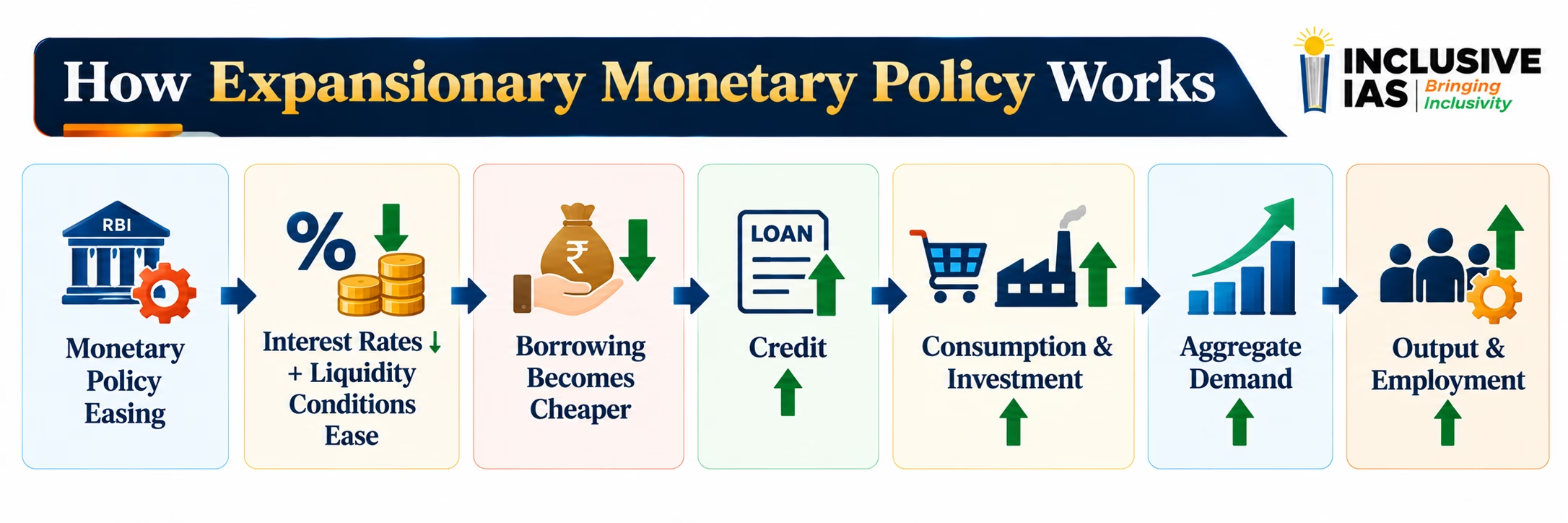
Expansionary monetary policy (Cheap Money Policy/Easy Money Policy) is a type of monetary policy used by a central bank to stimulate economic activity by increasing the money supply, lowering interest rates and boosting aggregate demand.
Objectives
- Stimulate Economic Growth: Central banks lower interest rates to make borrowing cheaper for businesses and consumers, driving up investment and consumer spending.
- Encourage Investment: Lower borrowing costs make it cheaper for businesses to take loans, start new projects and expand production.
- Increase Consumption: Cheaper and more easily available credit encourages people to spend more on goods and services.
- Reduce Unemployment: Higher consumption and investment increase demand for goods and services, encouraging businesses to produce more and hire more workers.
- Counter Deflationary Pressures: Stronger aggregate demand helps prevent persistent decline in the general price level.
Instruments of Expansionary Monetary Policy
1. Reduction in Policy Interest Rate
- The central bank lowers its policy interest rate, making borrowing cheaper and encouraging consumption and investment.
- India → RBI reduces the Policy Repo Rate
- Repo Rate ↓ → Lending Rates tend to ↓ → Borrowing ↑ → Consumption & Investment ↑ → Aggregate Demand ↑
2. Reduction in Bank Reserve Requirements
- The central bank can reduce the reserve requirements imposed on banks, leaving banks with more funds available for lending and credit creation.
- Reserve Requirements ↓ → Funds Available with Banks ↑ → Lending Capacity ↑ → Credit Creation ↑
- India: A reduction in the Cash Reserve Ratio (CRR) releases funds that banks would otherwise maintain with the RBI.
- CRR ↓ → Cash Reserves with RBI ↓ → Funds Available with Banks ↑ → Lending Capacity ↑ → Credit Creation ↑
3. Open Market Purchases
- The central bank can purchase government securities in the open market, thereby injecting liquidity into the financial system.
- Central Bank Purchases Government Securities → Funds Enter Banking/Financial System → Liquidity ↑
- India: The RBI conducts Open Market Operations (OMOs) involving outright purchases and sales of government securities to manage durable liquidity.
- RBI Purchases G-Secs → Money/Liquidity Injected into Banking System → Availability of Funds ↑
Direction of Monetary Policy Instruments
During monetary easing, the following changes generally have an expansionary effect:
- Repo Rate ↓ → Borrowing from RBI becomes cheaper → Credit conditions ease
- Bank Rate ↓ → Borrowing from RBI becomes cheaper
- MSF Rate ↓ → Overnight borrowing from RBI under MSF becomes cheaper
- SDF Rate ↓ → Return on funds parked with RBI ↓ → Parking surplus funds with RBI becomes relatively less attractive
- CRR ↓ → Banks maintain less cash with RBI → Funds available for lending ↑
- SLR ↓ → Smaller proportion of deposits required to be maintained in specified liquid assets → More funds potentially available for lending
- Reverse Repo Rate ↓ → Parking surplus funds with RBI becomes relatively less attractive → Encourages deployment of funds elsewhere
- OMO Purchase of Government Securities → RBI purchases G-Secs → Liquidity injected into the banking system
Impact on the Economy
- Economic Growth: Higher consumption and investment increase aggregate demand and support economic activity.
- Investment: Lower borrowing costs encourage firms to undertake new investment.
- Consumption: Cheaper credit encourages household expenditure.
- Employment: Higher demand encourages businesses to increase production and employment.
- Credit Growth: Easier monetary conditions tend to increase demand for and availability of credit.
- Inflation: As aggregate demand increases, inflationary pressures can rise, particularly when the economy is operating close to its productive capacity.
- Exchange Rate: Lower interest rates can contribute to currency depreciation, which can support exports but also increase the domestic cost of imported goods and inputs.
Expansionary vs Contractionary Monetary Policy
| Expansionary Monetary Policy | Contractionary Monetary Policy |
|---|---|
| Policy interest rates ↓ | Policy interest rates ↑ |
| Bank reserve requirements ↓ | Bank reserve requirements ↑ |
| Liquidity ↑ | Liquidity ↓ |
| Borrowing cost tends to ↓ | Borrowing cost tends to ↑ |
| Credit tends to ↑ | Credit tends to ↓ |
| Consumption & Investment ↑ | Consumption & Investment ↓ |
| Aggregate Demand ↑ | Aggregate Demand ↓ |
| Supports growth and employment | Moderates inflationary pressure |