


Economy
Standing Deposit Facility (SDF)
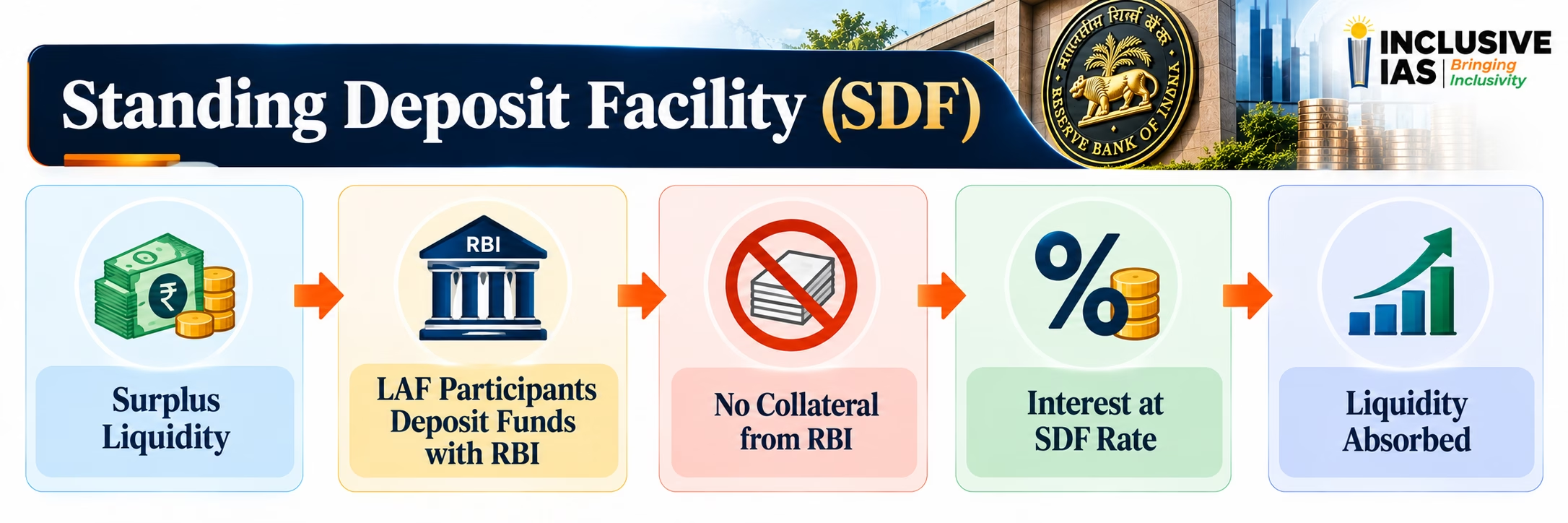
The Standing Deposit Facility (SDF) is a facility under the Liquidity Adjustment Facility (LAF) through which the RBI absorbs liquidity from the banking system without providing any collateral. By removing the binding collateral constraint on the RBI, the SDF strengthens the operating framework of monetary policy.
Under SDF, eligible LAF participants, such as banks, can place surplus funds with the RBI on an overnight basis at the SDF rate, without receiving any collateral from the RBI.
Liquidity Adjustment Facility (LAF)
- The LAF refers to the Reserve Bank’s operations through which it injects/absorbs liquidity into/from the banking system.
- It consists of overnight as well as term repo/reverse repos (fixed as well as variable rates), SDF and MSF.
Role of SDF
- Liquidity Management: SDF enables the RBI to absorb surplus liquidity from the banking system without the constraint of providing collateral.
- Financial Stability: The SDF also serves as a financial stability tool, in addition to its role in liquidity management.
Background
- The Standing Deposit Facility (SDF) was first recommended by the Urjit Patel Committee (the Expert Committee to Revise and Strengthen the Monetary Policy Framework) in January 2014 as part of the overhaul of the operating framework of monetary policy.
- The committee recommended that a (low) remunerated SDF may be introduced as the floor for absorption of surplus liquidity from the system but without the need for providing collateral in exchange, with the discretion to set the interest rate without reference to the policy target rate.
- The SDF was also proposed to be used for sterilisation operations as it will not require the provision of collateral for absorption – which may be a binding constraint on the reverse repo facility in the face of sustained surge in capital flows (RBI, 2014).
- The Finance Act, 2018 amended Section 17 of the RBI Act, 1934, empowering the RBI to introduce the SDF.
- The SDF was introduced on 8 April 2022.
Eligibility
- All participants eligible under the LAF are eligible to participate in the SDF.
- The principal participants eligible to access the RBI’s LAF are:
- Scheduled Commercial Banks (SCBs), excluding Regional Rural Banks (RRBs)
- Primary Dealers (PDs)
Tenor
- Eligible entities can ordinarily place funds with RBI on an overnight basis.
- RBI, however, retains the flexibility to absorb liquidity of longer tenors as and when the need arises, with appropriate pricing.
Availability
- The SDF is available on all days of the week, throughout the year.
SDF Rate
- The SDF Rate is the rate at which the RBI accepts uncollateralised overnight deposits from LAF participants.
- The SDF rate is placed 25 basis points below the policy repo rate
Floor of LAF Corridor
- With the introduction of SDF, the SDF rate replaced the Fixed Rate Reverse Repo (FRRR) rate as the floor of the LAF corridor.
Electronic Operation
- The Reserve Bank of India operates the Standing Deposit Facility (SDF) electronically through its RBI e-Kuber core banking platform
LAF Corridor: The LAF corridor has the marginal standing facility (MSF) rate as its upper bound (ceiling) and the standing deposit facility (SDF) rate as the lower bound (floor), with the policy repo rate in the middle of the corridor.