Gender Budgeting
Gender budgeting is a public financial management tool that integrates gender perspectives into government budgeting processes. Its objective is to ensure that public resources are planned, allocated, and spent in ways that promote gender equality and empower women.It acknowledges the diverse and intersectional needs of women while promoting transparency in the use of budgeting to bridge gender gaps.
Gender budgeting is viewed as an instrument to advance social justice, strengthen government accountability, and align national budgets with the Sustainable Development Goals (SDGs).
Gender Budgeting
Gender budgeting is a strategic approach to planning and public expenditure that ensures government budgets address gender inequalities and promote women’s empowerment. It does not mean a separate budget for women, but rather a process of mainstreaming gender concerns into all stages of the budgetary cycle — planning, implementation, and evaluation.
It is a public policy tool that analyses and restructures budget allocations to promote gender equality and equity. It aims to:
- Assess how public resources affect men and women differently.
- Integrate gender perspectives into all stages of policymaking and budgeting.
- Improve accountability in government spending for women’s welfare.
The purpose of Gender Budgeting is to track spending and services to make sure women’s needs are included and to improve their access to public resources.
Benefits of Gender Budgeting
Promotes Gender Equality
- Gender budgeting ensures that government spending and policies address the different needs, priorities, and roles of men and women, rather than treating them as a homogeneous group. It helps integrate gender concerns into every stage of the budgeting process.
Enhances Social Justice
- It strengthens the commitment to inclusive growth and equitable resource distribution, ensuring that public funds reach women and girls who are often excluded from mainstream development programmes.
Improves Policy Effectiveness
- By incorporating gender perspectives, gender budgeting leads to better-designed and targeted programmes, resulting in higher efficiency and greater social impact of government schemes.
Strengthens Governance and Accountability
- Gender budgeting enhances transparency in public finance management by tracking how resources are allocated and spent for different gender groups. It also promotes institutional accountability through gender audits and performance reviews.
Boosts Economic Growth
- Closing gender gaps in labour participation, education, and entrepreneurship can increase productivity and national income. Gender budgeting ensures women’s economic empowerment becomes central to macroeconomic planning.
Aligns with Global Commitments
- Gender budgeting aligns national development strategies with international frameworks such as the Sustainable Development Goals (SDG 5: Gender Equality) and Convention on the Elimination of All Forms of Discrimination Against Women (CEDAW).
Leads to Long-Term Structural Change
- Beyond short-term welfare schemes, gender budgeting promotes transformative policies that address structural inequalities in employment, education, healthcare, and social protection.
Gender Budgeting in India
In India, the National Policy for the Empowerment of Women (2001) serves as the overarching framework for advancing gender equality and women’s empowerment.
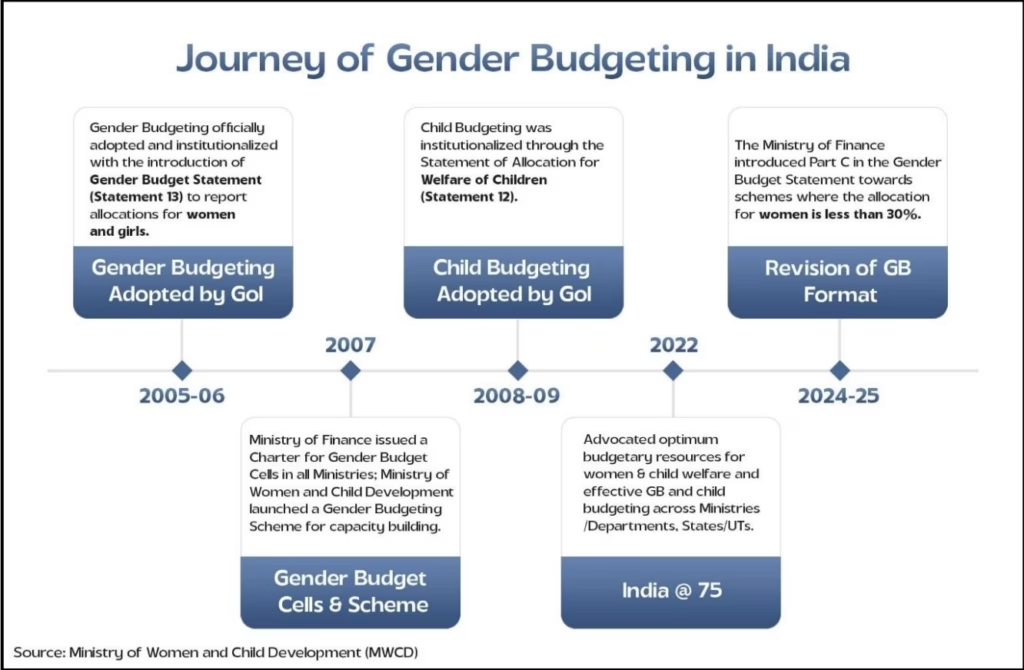
Responding to long-standing demands from feminist economists and women’s groups, the Government of India introduced its first Gender Budget in 2005–06, marking a milestone in mainstreaming gender in fiscal policy.
Each year, the Ministry of Finance issues a Gender Budget Circular, guiding ministries to prepare a Gender Budget Statement (GBS) in a standard format.
Structure of the Gender Budget Statement (GBS)
The GBS, annexed to the Union Budget, is divided into following parts:
- Part A: Schemes with 100% budget allocation for women, e.g., maternity benefits, hostels, or widow pensions.
- Part B: Schemes with at least 30% allocation for women, e.g., rural employment (MGNREGA), health, education, and sanitation programmes.
- Part C: In the Union Budget of 2024-25, Part C was included as schemes with allocations for women and girls below 30% of the provision.Inclusion of Part C in the GBS is expected to holistically reflect the allocations for women by the Government and its commitment towards gender equality and women empowerment.
Monitoring and Accountability
- The Comptroller and Auditor General (CAG) evaluates the impact and outcomes of gender-specific schemes.
- Various ministries also conduct gender auditS.
Institutional Framework
- Central Level: The Ministry of Women and Child Development (MWCD) serves as the nodal authority for implementing gender budgeting across sectors.
- State Level: Departments of Women and Child Development/Social Welfare and Finance or Planning oversee gender budgeting at the state level.
Gender Budget Cells (GBCs): Function as coordination units across ministries and departments to institutionalize gender-responsive budgeting.
Data Point
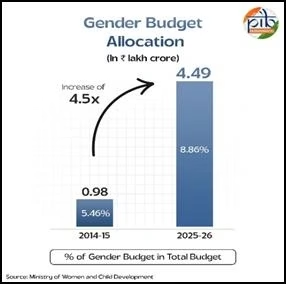
- From 2014-15 to 2025-26, there has been a significant jump in the allocation for Gender Budgeting in India.
- The outlay has increased from ₹0.98 lakh crore in 2014-15 to ₹4.49 lakh crore in 2025-26, with the percentage share for Gender Budgeting in the Union Budget surging to a robust 8.86% in FY 2025-26, up from 5.46% in 2014-15
- The Gender Budget framework includes a three-part structure; Part A (100% women specific schemes), Part B (schemes with 30-99% allocation for women) and Part C (schemes with below 30% allocation towards women).
- Ten ministries allocate 30%+ budgets to gender initiatives, led by-
- Ministry of Women and Child Development – 81.79%
- Dept. of Rural Development – 65.76%
- Dept. Food & Public Distribution – 50.92%
Historical Trajectory of Gender Budgeting in India
The evolution of gender budgeting in India reflects the country’s progressive efforts to integrate gender perspectives into planning and public expenditure. Broadly, this trajectory can be divided into four key phases — knowledge building and networking, institutionalisation, capacity building, and increasing accountability.
- The National Policy for Empowerment of Women (2001) laid the foundation for gender-responsive planning and budgeting.
- During 2001–02, the Government of India began initial efforts to incorporate gender budgeting concepts into the federal budget framework.
- In 2005–06, the Planning Commission introduced the Women’s Component Plan (WCP) to earmark a defined percentage of the budget for women-centric schemes and programmes.
- The Ministry of Finance institutionalised the process by introducing the Gender Budget Statement (GBS) in the Union Budget of 2005–06, formalising India’s entry into gender budgeting practice.
- Gender Budgeting Cells (GBCs) were established across ministries to coordinate gender-related allocations and policies.
- In 2010–11, the National Mission for Empowerment of Women (NMEW) was launched to strengthen inter-ministerial coordination and convergence of women-related programmes.
- By 2013–14, the Ministry of Finance began issuing a separate statement on gender budgeting within the Union Budget to improve transparency and monitoring.
- In 2017-18, the focus on gender budgeting was increased by integrating gender-specific indicators into programmes.
- In 2020–21, the Ministry of Women and Child Development (MWCD), in collaboration with the Ministry of Finance, launched the Online Gender Budgeting Portal to track fund allocation, utilisation, and outcomes.
- In the 2025–26 Union Budget, the Gender Budget accounted for 8.8% of total expenditure, a significant rise from 6.8% in 2024–25, marking the highest allocation in two decades.
Key Government Initiatives
- Beti Bachao Beti Padhao: Aims to improve the child sex ratio and promote girls’ education.
- Ujjwala Yojana: Provides free LPG connections to reduce drudgery and improve health outcomes for women.
- Kasturba Gandhi Balika Vidyalayas (KGBVs): Focus on bridging gender gaps in secondary education for girls from disadvantaged groups.
Gender Budgeting Knowledge Hub
- In 2025, the Ministry of Women and Child Development organised a National Consultation on Gender Budgeting, during which the ‘Gender Budgeting Knowledge Hub‘ portal was launched.
- The Hub is a digital repository of all information related to gender budgeting processes, intended for use by central and state government ministries/departments, as well as other stake
State-Level Advances in Gender Budgeting
While gender budgeting began at the central level in 2005–06, several Indian states have played a pioneering role in integrating gender perspectives into their planning and expenditure frameworks. These initiatives demonstrate how decentralised governance and political will can translate gender policy into tangible development outcomes.
Pioneering States
- Odisha became the first state in India to adopt gender budgeting in 2004, even before the Union government.
- Uttar Pradesh and Tripura followed in 2005, while Karnataka and Gujarat implemented it in 2006.
- According to the Ministry of Women and Child Development (MWCD), 27 States and Union Territories have now institutionalised gender budgeting in some form.
Kerala: Decentralised and Gender-Responsive Planning
- Kerala formally adopted gender budgeting in 2008, pioneering the devolution of 35–40% of state funds to Local Self-Government Institutions (LSGIs). This was the first form of gender responsive allocation of funds held in Kerala.
- Each panchayat was mandated to prepare a dedicated chapter on the status of women
- The state also promoted gender-friendly infrastructure — such as toilets, restrooms, and drinking-water facilities — across public offices, transport hubs, and construction projects, ensuring women’s safety and accessibility in public spaces.
Odisha: Life-Cycle Approach to Women’s Development
- Odisha allocates at least 30% of its plan funds to women-related programmes.
- The State Policy for Women and Girls (2014) adopted a life-cycle approach, addressing women’s needs at every stage — from infancy and adolescence to adulthood and old age.
- Focus areas include health, education, livelihood, asset ownership, decision-making, political representation, and safety.
- Odisha’s model offers a holistic framework that can guide other states in institutionalising gender-responsive governance.
Challenges and Uneven Progress
Despite notable advances, states such as Uttar Pradesh, Bihar, and Rajasthan continue to lag behind.
Key reasons include:
- Lack of political commitment and policy prioritisation
- Furthermore, successful experiences show that the effectiveness of gender budgeting depends on active involvement from both state and local governance institutions.
Key Takeaway
The success of gender budgeting at the state level depends on strong political will, institutional capacity, and local participation. States like Kerala and Odisha exemplify how gender-responsive budgeting can move beyond symbolic allocations to drive real social and economic empowerment of women.
Gender Budget: Positive Trends
As per a paper by the Observer Research Foundation, titled- ‘Gender-Responsive Budgeting in India, Bangladesh and Rwanda: A Comparison’ (July 2020), India’s introduction of gender budget shows a positive trend:
- India has institutionalized gender-responsive budgeting (GRB) at both national and state levels, with Gender Budget Cells established across ministries and departments.
- The mandatory inclusion of Gender Budget Statements (GBS) in the Union Budget ensures regular tracking of allocations for women and girls.
- Capacity-building initiatives, such as manuals, handbooks, and training by the Ministry of Women and Child Development, have strengthened technical expertise in gender budgeting.
- Several states have adopted GRB, promoting decentralized and region-specific gender interventions.
- There is an increasing emphasis on collecting sex-disaggregated data and monitoring outcomes, moving beyond input-based accounting to impact assessment.
- Gender budget allocations have steadily increased over the years, reflecting a growing financial commitment to gender equality.
- GRB has influenced the design of new women-centric schemes, enhancing women’s economic and social empowerment across sectors.
These trends collectively demonstrate India’s progress in mainstreaming gender considerations into public expenditure and policy planning.
Challenges in Gender Budgeting
- The implementation of gender budgeting faces multiple challenges, including inadequate guidance, weak coordination, limited expertise among officials, and poor quality of Gender Impact Assessments (GIAs).
- Lack of gender disaggregated data make it difficult to formulate effective policies. Additionally, it limits the ability to accurately measure the effectiveness of the Gender Budgeting policies and initiatives.
- Skewed Implementation: Several sectors and schemes with significant potential to impact women still do not incorporate gender budgeting practices.
- Lack of Accountability: There is no mandate to have a minimum allocation with respect to Gender Budget.
- Reporting Anomalies:
- The Gender Budget often overlooks several major schemes that significantly benefit women. For instance, the Jal Jeevan Mission (JJM), which aims to provide household tap connections to all rural households by 2024, can greatly enhance women’s quality of life—since it is primarily women and girls who bear the burden of fetching water in rural areas. Yet, none of JJM’s allocations are reflected in the Gender Budget.
- Furthermore, schemes allocating less than 30% of their funds for women are excluded from Part B of the Gender Budget, limiting the comprehensiveness of reporting.
- There is also ambiguity in how schemes determine the share of funds benefiting women. For example, the Pradhan Mantri Awaas Yojana–Gramin (PMAY-G) was included in Part A of the 2023–24 Gender Budget, accounting for 24% of total allocations, because it promotes joint or female ownership of houses, indirectly benefiting women. In contrast, the Mahatma Gandhi National Rural Employment Guarantee Scheme (MGNREGS), where women constitute about 55% of total workers, was placed under Part B, with only 27% of its allocations reflected in the Gender Budget.
Way Forward
Enactment of a Gender Budgeting Act:
- NITI Aayog has suggested introducing a Gender Budgeting Act to institutionalize gender-sensitive budgeting across all Ministries and States/UTs. The Act can make it mandatory for data-collecting agencies to publish gender-disaggregated statistics, thereby making the process more evidence-based and scientific.
Strengthening Role of MWCD and States:
- The Ministry of Women and Child Development (MWCD) should encourage States to enhance allocations for women and child welfare schemes, ensuring better fund availability and utilization. NITI Aayog has also emphasized finalizing the National Policy for Women by revising the 2016 Draft Policy to align with current gender priorities.
Uniform Guidelines and Methodology:
- There is an urgent need for standardized guidelines for implementing Gender Budgeting. IMF survey findings indicate that in the absence of clear guidelines or a standardized methodology for impact assessment, line Ministries face challenges in adopting a consistent approach to Gender Budgeting analysis.
Data and Monitoring Improvements:
- Tools for data collection, monitoring, and impact evaluation must be upgraded. Reliable, disaggregated data enables better measurement of gender outcomes and facilitates targeted interventions for promoting gender equality.
Gender Impact Assessments (GIAs):
- As per IMF recommendations, fiscal policies should prioritize sectors where gender gaps remain. Conducting Gender Impact Assessments helps evaluate the gender implications of existing and proposed policies, allowing for evidence-based policy redesign to ensure equitable outcomes.
Need to Go Beyond Mere Budgetary Allocation
Mainstreaming Gender in Governance
Gender budgeting serves as a strategic tool to mainstream gender concerns across all levels of policy and governance. Initially introduced in India to ensure more effective targeting of public expenditure for women’s empowerment, it has evolved into a mechanism for promoting equity, inclusion, and accountability in development planning.
Beyond Budgetary Allocation
While the formulation of gender-responsive budgets marked a critical first step, the focus must now move beyond mere financial allocations. True gender budgeting requires:
- Integration of gender perspectives in policy formulation, implementation, and monitoring.
- Capacity building within ministries and local governance institutions to design and evaluate gender-focused interventions.
- Institutional mechanisms for regular gender audits and impact assessments.
- Better targeting by extending its reach to vulnerable groups like tribals, Dalits, Muslims, and transgender. States like Kerala and Odisha have taken steps in the right direction by allocating funds for transgender.
From Tokenism to Transformation
However, such measures must move beyond token gestures and lead to tangible changes in the lived realities of women and marginalized genders.
Effective gender budgeting must ensure:
- Concrete outcomes in health, education, livelihoods, and safety.
- Participatory planning involving women’s collectives and local bodies.
- Evidence-based monitoring to track progress and bridge gaps between policy intent and on-ground impact.
Gender budgeting is not merely about allocating funds for women; it is a transformative governance approach that seeks to make every rupee spent contribute to gender equity. As India’s states increasingly design women-focused schemes, effective gender budgeting ensures these initiatives translate into measurable empowerment, economic participation, and social justice — essential pillars for inclusive development.
FAQs
Q1. What is Gender Budgeting?
Gender budgeting is a public financial management tool that integrates gender perspectives into government budgets. It ensures that public expenditure promotes gender equality, women’s empowerment, and equitable access to resources across sectors.
Q2. When was Gender Budgeting introduced in India?
India introduced its first Gender Budget in 2005–06, following directives from the Ministry of Finance and the National Policy for Empowerment of Women (2001). It marked the institutionalisation of gender-responsive fiscal planning.
Q3. Who is the nodal ministry for Gender Budgeting in India?
The Ministry of Women and Child Development (MWCD) is the nodal ministry responsible for implementing, coordinating, and monitoring gender budgeting initiatives across all ministries and departments.
Q4. What is the structure of the Gender Budget Statement (GBS)?
The Gender Budget Statement is divided into three parts:
Part A: 100% women-specific schemes (e.g., maternity benefits, hostels).
Part B: Schemes with 30–99% allocation for women (e.g., MGNREGA, health, education).
Part C (introduced in 2024–25): Schemes with less than 30% allocation for women.
At InclusiveIAS, our editorial team is led by experts who have successfully cleared multiple stages of the UPSC Civil Services Examination, including Mains and Interview. With deep insights into the demands of the exam, we focus on crafting content that is accurate, exam-relevant, and easy to grasp.
Whether it’s Polity, Current Affairs, GS papers, or Optional subjects, our notes are designed to:
Break down complex topics into simple, structured points
Align strictly with the UPSC syllabus and PYQ trends
Save your time by offering crisp yet comprehensive coverage
Help you score more with smart presentation, keywords, and examples
🟢 Every article, note, and test is not just written—but carefully edited to ensure it helps you study faster, revise better, and write answers like a topper.