INTERPOL – Role, Structure, Red Notices & India’s Involvement

  • Home
  • INTERPOL – Role, Structure, Red Notices & India’s Involvement
Shape Image One

INTERPOL – International Criminal Police Organization

  • The International Criminal Police Organization (INTERPOL), commonly referred to as Interpol, is an international organisation that promotes international police collaboration and crime prevention. 
  • It is the largest police organization in the world.
  • It is an inter-governmental organization
  • Official Languages: Arabic, English, French, and Spanish.
  • Status: It is ‘not’ a unit or part of a united nation system. It is an independent international organization.
  • It is often the first point of contact for many countries pursuing an international investigation. 
  • It does not actively investigate crimes
  • Headquarters: Lyon, France

History

It was originally established in 1923 as the International Criminal Police Commission, and in 1956, it adopted the name International Criminal Police Organization – INTERPOL.

Mandate & Objectives

  • Facilitate international police cooperation across borders.
  • Combat transnational crimes like terrorism, human trafficking, cybercrime, drug trafficking, money laundering, and corruption.
  • Provide a secure global police communication system.

Membership

  • 196 members including India
  • India joined INTERPOL in 1949 and has consistently contributed towards the operational and organizational success of INTERPOL.

INTERPOL – Work

Core Functions

  • Databases: Manages 19 global police databases (names, fingerprints, DNA, stolen passports, vehicles, etc.) accessible in real-time to member countries.
  • Investigative Support: Provides forensics, analysis, and assistance in locating fugitives worldwide.
  • Training: Builds capacity of law enforcement officials to use INTERPOL systems effectively.

Focus Areas (4 Global Crime Programmes)

  • Terrorism
  • Cybercrime
  • Organized Crime
  • Financial Crime & Anti-Corruption

Governance

General Assembly

  • Supreme governing body of INTERPOL.
  • Composed of representatives from all member countries (196).
  • Meets once a year for about four days.
  • Decision-making principle: One country, one vote.
  • Functions:
    • Sets policies and directions.
    • Ensures INTERPOL’s activities meet the needs of member states.

Executive Committee

  • 13 members, representing all regions.
    • Elected by the General Assembly, the Executive Committee has 13 members comprising the President of the Organization, three vice-presidents and nine delegates. They are all from different countries and the geographical distribution is balanced.
  • Governing body supervising execution of General Assembly decisions.
  • Oversees administration and work of the General Secretariat.
  • Meets three times a year.
  • Its role is to:
    • Supervise the execution of the decisions of the General Assembly;
    • Prepare the agenda for sessions of the General Assembly;
    • Submit to the General Assembly any programme of work or project which it considers useful;
    • Supervise the administration and work of the Secretary General.

President of INTERPOL

  • Elected by the General Assembly for a period of 4 years
  • Provides high-level guidance and representation.
  • Role
    • Preside at meetings of the General Assembly and the Executive Committee and direct the discussions;
    • Ensure that the activities of the Organization are in conformity with the decisions of the General Assembly and the Executive Committee;
    • Maintain, as far as possible, direct and constant contact with the Secretary General of the Organization.
  • The role of President is part-time and unpaid, with the holder retaining their full-time post within their national authority.

General Secretariat

  • Headquarters in Lyon
  • Headed by the Secretary-General 
    • The Secretary General is responsible for the day-to-day decision-making and functioning of all General Secretariat duty stations around the world.
    • This includes supervising all the policing activities, expertise, databases and services INTERPOL provides to its 196 member countries to support them in the fight against international crime, and also the ‘corporate’ functions that assist this work.
  • INTERPOL is a membership-based organization, and the General Secretariat is the body that coordinates its policing and administrative activities.
  • The General Secretariat runs INTERPOL’s day-to-day activities to support member countries in their international policing.

National Central Bureaus (NCBs)

  • Each member country has an NCB.
  • In each country, INTERPOL National Central Bureau (NCB) provides the central point of contact for the General Secretariat and other NCBs. 
  • An NCB is run by national police officials 
  • India’s NCB is under the CBI.

Do You Know?

I-24/7 – INTERPOL’s Secure Global Police Communications System

  • Launched by INTERPOL in 2002.
  • A secure global police communication network linking all member countries.
  • Allows real-time sharing of information on crimes and criminals.
  • It enables 195 member countries to exchange criminal data and coordinate their actions in real time.

Funding

Sources of Funding

  1. Statutory Contributions
    • Each of our member countries pays a statutory contribution to INTERPOL each year; it is an obligatory payment. 
    • The amount paid by each country is agreed by the General Assembly each year, according to an adapted scale of United Nations contributions, essentially based on economic weight.
    • Statutory contributions generally fund the running costs of the General Secretariat and some of the core policing, training and support activities according to our strategic priorities.
  2. Voluntary Contributions
    • From member countries, international organizations, foundations, and the private sector.
    • Voluntary cash funding primarily supports specific regional and crime initiatives.

Interpol Notice

  • INTERPOL Notices are international requests for cooperation or alerts allowing police in member countries to share critical crime-related information.
  • Notices are issued by the General Secretariat at the request of a member country’s INTERPOL National Central Bureau and are made available for all our member countries to consult in our Notices database.
  • Notices can also be issued at the request of International Criminal Tribunals and the International Criminal Court to seek persons wanted for committing crimes within their jurisdiction, notably genocide, war crimes, and crimes against humanity. 
  • They can also be issued at the request of the United Nations in relation to the implementation of sanctions imposed by the Security Council.
  • Most Notices are for police use only and are not available to the public. 
    • However, an extract of the Notice can be published on this site if the requesting country wishes to alert the public or seek their help. 
    • All United Nations Special Notices are public.

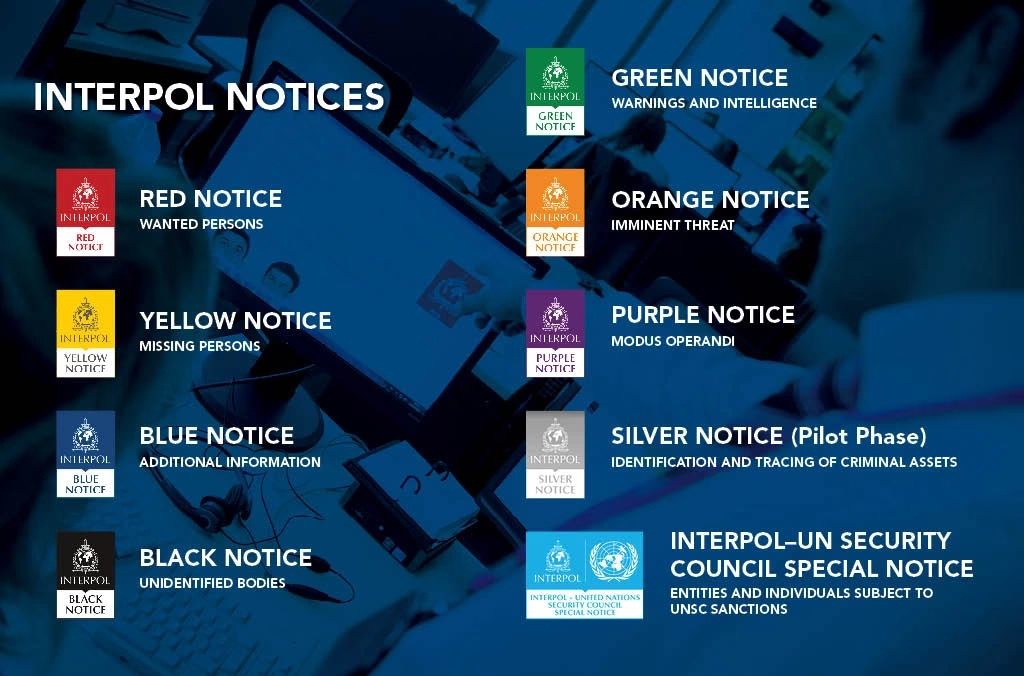
Interpol Notice Types

  • Red Notice: To seek the location and arrest of persons wanted for prosecution or to serve a sentence.
  • Yellow Notice: To help locate missing persons, often minors, or to help identify persons who are unable to identify themselves.
  • Blue Notice: To collect additional information about a person’s identity, location or activities in relation to a criminal investigation.           
  • Black Notice: To seek information on unidentified bodies.
  • Green Notice: To provide warning about a person’s criminal activities, where the person is considered to be a possible threat to public safety.
  • Orange Notice: To warn of an event, a person, an object or a process representing a serious and imminent threat to public safety.
  • Purple Notice: To seek or provide information on modus operandi, objects, devices and concealment methods used by criminals.
  • Silver Notice (pilot phase): To identify and trace criminal assets
  • INTERPOL–United Nations Security Council Special Notice: Issued for entities and individuals who are the targets of UN Security Council Sanctions Committees.

FAQs 

1. Is INTERPOL part of the United Nations?

No, INTERPOL is an independent intergovernmental organization and is not a part of the UN system.

2. What is a Red Notice issued by INTERPOL?

A Red Notice is a request to locate and provisionally arrest a person pending extradition, issued at the request of a member country.

3. Where is the headquarters of INTERPOL?

Lyon, France.

✍️ Curated by InclusiveIAS Editorial Team

At InclusiveIAS, our editorial team is led by experts who have successfully cleared multiple stages of the UPSC Civil Services Examination, including Mains and Interview. With deep insights into the demands of the exam, we focus on crafting content that is accurate, exam-relevant, and easy to grasp.

Whether it’s Polity, Current Affairs, GS papers, or Optional subjects, our notes are designed to:

  • Break down complex topics into simple, structured points

  • Align strictly with the UPSC syllabus and PYQ trends

  • Save your time by offering crisp yet comprehensive coverage

  • Help you score more with smart presentation, keywords, and examples

🟢 Every article, note, and test is not just written—but carefully edited to ensure it helps you study faster, revise better, and write answers like a topper.